Forex Hedging: Meaning, Methods, Strategies

Exchange-rate volatility can affect open FX positions, overseas assets, and foreign-currency cash flows. When traders or investors want to reduce that exposure without fully exiting a position, they may use forex hedging.
A forex hedge is generally used to manage risk rather than to maximise potential returns.
In other words, FX hedging means using one position or instrument to offset the impact of another. For experienced market participants, the more relevant question is not whether hedging in forex is possible, but when it improves the risk-adjusted profile of a position and when it may simply adds cost, complexity, or execution drag.
In this guide, we look at what is hedging in foreign exchange market, who are the typical hedgers in foreign exchange market, why market participants hedge, and different aspects associated with it.
The information in this article is provided for educational purposes only and does not constitute financial advice. Consult a financial advisor before making investment decisions.
.png)
Table of Contents
What Is Hedging in Forex?
Forex hedging is the process of opening one or more positions designed to manage the risk associated with an existing currency exposure.
In practice, forex hedging is used when a trader, investor, or business already has currency exposure and wants to reduce the impact of an adverse move.
That exposure may come from:
- An open FX trade
- Overseas assets
- Macroeconomic risk
- Short-term uncertainty around a broader directional view
Rather than eliminating risk entirely, a hedge is usually about adjusting how much exposure remains in place. That is also where hedge trading differs from directional trading: a directional position seeks to profit from a market move, while a hedge is used to reduce the effect of one.
In that sense, hedging trading decisions are usually driven more by exposure management than by return maximisation.
Now that you know what is forex hedging, let’s look at the main methods of hedging in forex markets.
Common Methods of Hedging in FX Markets
There is no single approach that fits every exposure. In practice, the right forex hedge strategy will usually depend on the source of the risk, the hedge duration, market liquidity, and the level of flexibility the trader wants to retain.
When hedging FX exposure, traders need to decide how much risk to offset, for how long, and at what cost.
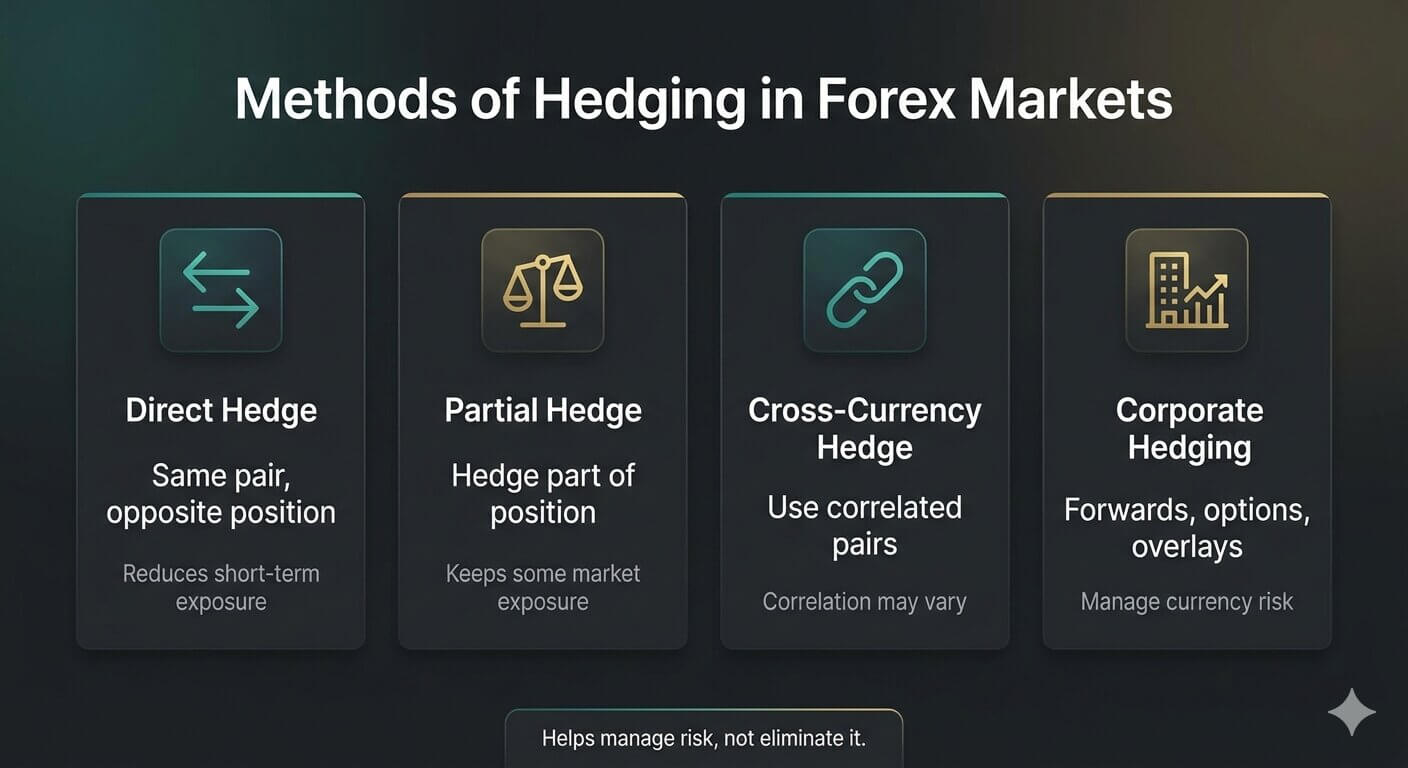
1. Direct hedge involves opening an opposite position in the same currency pair so that the second trade offsets some or all of the original exposure. It is usually used for short-term protection around uncertain market conditions, but it may be less useful as a long-term solution because costs can accumulate, and gains may be limited.
2. A partial hedge involves offsetting only part of the original position rather than the full exposure. It is usually used when a trader wants to manage downside risk while still keeping some participation in the original market view, but it may be less useful if the hedge is too small to make a meaningful difference or too large to justify keeping the trade open.
3. A cross-currency hedge involves using a different but related currency pair to offset part of the original risk. It is typically used when the goal is to reduce exposure to a specific currency without directly hedging the original trade, but it may be less useful when correlations weaken or break down, since the offset is not exact.
4. Corporate hedging involves using financial instruments such as forwards, options, or swaps to reduce the impact of exchange-rate movements on revenues, costs, or balance-sheet exposures. It is typically used by companies with foreign-currency cash flows, forex hedge funds and firms with overseas operations. In some cases, corporate hedging may also include a money market hedge.
Advanced Forex Hedging Strategies
Some traders use more advanced hedge structures to manage risk, portfolio exposure, or correlation-sensitive positions. Among the more commonly discussed advanced FX hedging strategies are correlated-pair hedging and layered hedging.
These approaches can be useful in the right context, but they also require stronger risk management and a clear understanding of how the hedge may behave if prevailing market conditions change.
Forex Hedging Strategy #1: Correlated-Pair Hedging
Correlated-pair hedging involves taking a position in a different but related currency pair to manage risk, rather than opening an opposite trade in the same pair. These pairs are typically positively or negatively correlated, meaning they tend to move in similar or opposite directions.
This type of hedge is considered imperfect hedge as correlations are not stable, and in stressed or news-driven market conditions, they may become weaker or stop holding altogether.
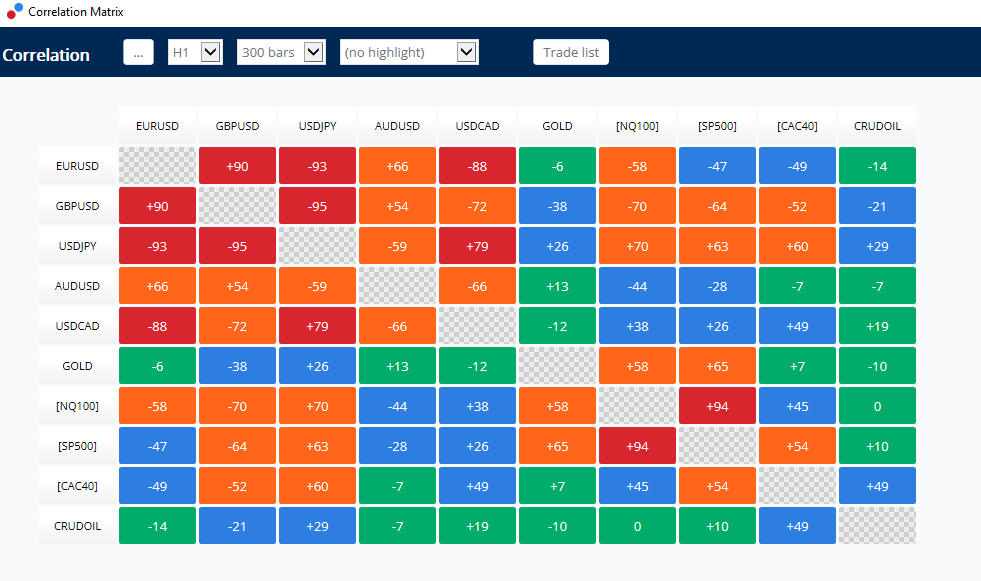
Here’s a practical forex hedging example. Assume a trader is long GBPUSD because the medium-term outlook for Sterling remains constructive. At the same time, the trader is concerned about short-term US Dollar volatility ahead of a major data release. Instead of going short on GBPUSD directly, the trader observes that USDCAD has historically shown a strong negative correlation with GBPUSD and opens a long USDCAD position as a partial hedge.
If the US Dollar strengthens broadly after the release:
- GBPUSD may come under pressure
- USDCAD may rise
- Gains on USDCAD may offset part of the loss on GBPUSD
If the US Dollar weakens:
- GBPUSD may rise
- USDCAD may fall
- The hedge may reduce some of the upside from the original trade
This illustrates the main trade-off. A correlated hedge may help manage short-term currency risk, but the offset is usually incomplete.
If you want to understand correlations better, the Correlation Matrix, also known as the Currency Strength Meter, can help assess the strength and direction of relationships between currency pairs at any given time. It is available as an in-built feature in the Admirals MetaTrader Supreme Edition.
Forex Hedging Strategy #2: Layered or Dynamic Hedging
Layered hedging, also called dynamic hedging, involves adjusting hedge exposure in stages as market conditions change rather than placing one full-size hedge at the outset.
In practice, a trader may begin with a small hedge ahead of a major news event, increase it if volatility accelerates, and reduce it again if conditions stabilise. This approach may offer more flexibility than a direct hedge, but it also demands more discipline.
For example, assume a trader is long EURUSD and still holds a constructive medium-term view, but expects short-term volatility around an ECB announcement. Rather than placing a full opposite position immediately, the trader opens a small short EURUSD hedge, increases it if price action weakens, and reduces it gradually if the trend resumes.
This can help manage risk without neutralising the original trade too early. However, poor timing or inconsistent position sizing may lead to over-hedging, under-hedging, or build unnecessary transaction costs.
For that reason, layered hedging is generally better suited to traders who already understand position sizing, exposure management, and execution costs.
How to Hedge Forex Exposure More Effectively
Effective hedging in forex usually comes down to four decisions:
- Define the exact exposure being hedged
- Size the hedge appropriately
- Decide the hedge time frame in advance
- Set clear conditions for reducing or removing it
If the exposure is unclear, the hedge is less likely to be effective. If the exit plan is unclear, the hedge may remain in place longer than needed, allowing costs to build even after the original risk has passed.
Potential Risks of Forex Hedging
Bottom Line on Forex Hedging
While hedging, the key question is not whether hedging can work or not, but whether the chosen hedge fits the specific risk, time horizon, and cost of the position being protected.
If used thoughtfully, hedging strategies forex may help manage drawdowns, smooth volatility, and protect capital during extremely volatile markets. Used poorly, they may add friction, complexity, and unnecessary cost drag. In many cases, the most useful hedging forex strategy is the one built around a clear objective, disciplined sizing, and a defined exit.
For traders who are just starting out, using a free demo account could be a sensible first step before applying forex hedging techniques in live markets.
A demo account allows you to practice forex trading under simulated market conditions without financial pressure. This can provide an opportunity to understand how direct hedging, partial hedging, and advanced FX hedge strategies behave in different scenarios before committing real capital.
Other articles you may find interesting:
- How To Become A Forex Trader
- Forex Fundamental Analysis: An Introduction
- Introduction To Forex Technical Analysis
Frequently Asked Questions on Forex Hedging
What is FX hedging?
FX hedging is another term for foreign exchange hedging. It refers to using one position or instrument to reduce the impact of adverse currency moves on an existing trade, investment, or cash flow.
What is hedging in trading?
Hedging in trading is a broader risk-management technique where one position is used to offset the risk of another.
Is forex hedging illegal?
Forex hedging is not universally illegal, but it is regulated differently across jurisdictions. In the U.S., some retail hedging practices are restricted, while in many other markets, hedging is allowed through regulated brokers. Traders should always check local rules and broker policies.
Can hedging reduce profits?
Yes. A hedge can reduce losses, but it can also limit gains if the original position moves in your favour. That is because the hedge offsets part of the exposure, so some of the upside may be reduced along with the downside.
About Admirals
Admirals is a multi-award-winning, regulated Forex and CFD broker, offering trading on over 8,000 financial instruments via the world's most popular trading platforms: MetaTrader 4 and MetaTrader 5.
INFORMATION ABOUT ANALYTICAL MATERIALS:
The given data provides additional information regarding all analysis, estimates, prognosis, forecasts, market reviews, weekly outlooks or other similar assessments or information (hereinafter “Analysis”) published on the websites of Admirals investment firms operating under the Admirals trademark (hereinafter “Admirals”) Before making any investment decisions please pay close attention to the following:
- This is a marketing communication. The content is published for informative purposes only and is in no way to be construed as investment advice or recommendation. It has not been prepared in accordance with legal requirements designed to promote the independence of investment research, and that it is not subject to any prohibition on dealing ahead of the dissemination of investment research.
- Any investment decision is made by each client alone whereas Admirals shall not be responsible for any loss or damage arising from any such decision, whether or not based on the content.
- With view to protecting the interests of our clients and the objectivity of the Analysis, Admirals has established relevant internal procedures for prevention and management of conflicts of interest.
- The Analysis is prepared by an analyst (hereinafter “Author”) with the assistance of AI tools. The Author Amrita Kundu is a contractor for Admirals. This content is a marketing communication and does not constitute independent financial research.
- Whilst every reasonable effort is taken to ensure that all sources of the content are reliable and that all information is presented, as much as possible, in an understandable, timely, precise and complete manner, Admirals does not guarantee the accuracy or completeness of any information contained within the Analysis.
- Any kind of past or modelled performance of financial instruments indicated within the content should not be construed as an express or implied promise, guarantee or implication by Admirals for any future performance. The value of the financial instrument may both increase and decrease and the preservation of the asset value is not guaranteed.
- Leveraged products (including contracts for difference) are speculative in nature and may result in losses or profit. Before you start trading, please ensure that you fully understand the risks involved.