How to Trade the Inside Bar Candlestick Pattern in Forex

The inside bar candlestick pattern is one of the most popular price action setups in Forex trading. While the name of the pattern clearly describes its structure, the way it's interpreted is often misunderstood by beginners.
When you look at it at first, an inside bar looks like nothing more than a smaller candle trapped inside the range of a larger one. However, beyond that structure, it may reflect a phase of the market where momentum stalls for a bit, volatility contracts, and the price moves into a brief phase of consolidation.
Inside bars may help traders anticipate trend continuation, spot potential reversals, and recognise volatility squeezes across multiple timeframes. However, misinterpreting the pattern or trading it without context may lead to whipsaws and poor decision-making.
Today, in this guide, we’ll understand meaning of an inside bar candle, how to identify a valid inside bar setup and also look at breakout and reversal strategies using the inside bar candlestick pattern. But first, let’s start with the basics.
The information in this article is provided for educational purposes only and does not constitute financial advice. Consult a financial advisor before making investment decisions.
.png)
Table of Contents
- What Is an Inside Bar Candle
- How Inside Bar Analysis May Help Forex Traders
- How to Trade the Inside Bar Pattern in Forex: Breakout and Reversal Strategies
- Inside Bar Breakout Strategy (Continuation Pattern)
- Inside Bar Reversal Strategy
- How to Identify a Valid Inside Bar Setup
- Five Types of Inside Bar Setups
- Four Common Inside Bar Trading Mistakes in Forex
- The Bottom Line: Inside Bar Pattern in Forex
- Frequently Asked Questions About the Inside Bar Pattern in Forex
What Is an Inside Bar Candle
An inside bar is a standalone candlestick or a series of candlesticks whose entire range is contained within the high and low of the previous big bar, also called the mother bar. What the inside bar ought to have is a higher low and a lower high than the mother bar.
_(1).png)
This candlestick pattern shows temporary indecision or consolidation, as neither buyers nor sellers are strong enough to push the prices beyond the prior range of the mother bar.
How Inside Bar Analysis May Help Forex Traders
You see, the market is a reflection of human psychology and traders’ emotions. It moves through phases of momentum and pause, meaning the market tends to trend when participants are decisive and rests when they reassess. The inside bar candlestick pattern typically appears during the rest phase when the market consolidates briefly, and price action tightens.
For forex traders, recognising and learning to interpret this pause in momentum can provide insight into whether the market is preparing to continue its trend or change direction. However, please note that inside bars do not predict or guarantee the next price move with certainty. Instead, they may help traders assess potential setups and plan trades more effectively while managing risk.
Where Do Inside Bars Appear on the Chart?
Inside bars may appear anywhere on the chart. But their significance depends on the preceding price action, such as whether the market was trending higher, trending lower, or trading around crucial support and resistance levels. Understanding this context is important before attempting to trade inside bars, because not every inside bar is a strong or tradable setup.
How to Trade the Inside Bar Pattern in Forex: Breakout and Reversal Strategies
There are technically two ways of trading an inside bar setup:
- Continuation Pattern: Continuation setups often result in continuation of the preceding momentum that was in place before the inside bar was formed.
- Reversal Pattern: For a reversal setup, the inside bar often forms near crucial support or resistance levels and may signal a potential change in market direction.
To assess whether an inside bar setup is worth trading, traders generally focus on three criteria:
- The prior price action
- Where the pattern is formed
- Confirmation through further price action
All the above three points taken together help traders distinguish between inside bars that represent meaningful consolidation from those that are merely short-term noise.
Let’s delve deeper to understand how these criteria apply to both continuation and reversal setups.
Inside Bar Breakout Strategy (Continuation Pattern)
When traders use the inside bar as a continuation pattern, the focus is usually on how price reacts around the mother bar’s range. So, rather than trying to predict the next move, many traders prefer to wait for price to break above or below the mother bar’s high or low, as this may indicate that momentum is gradually continuing.
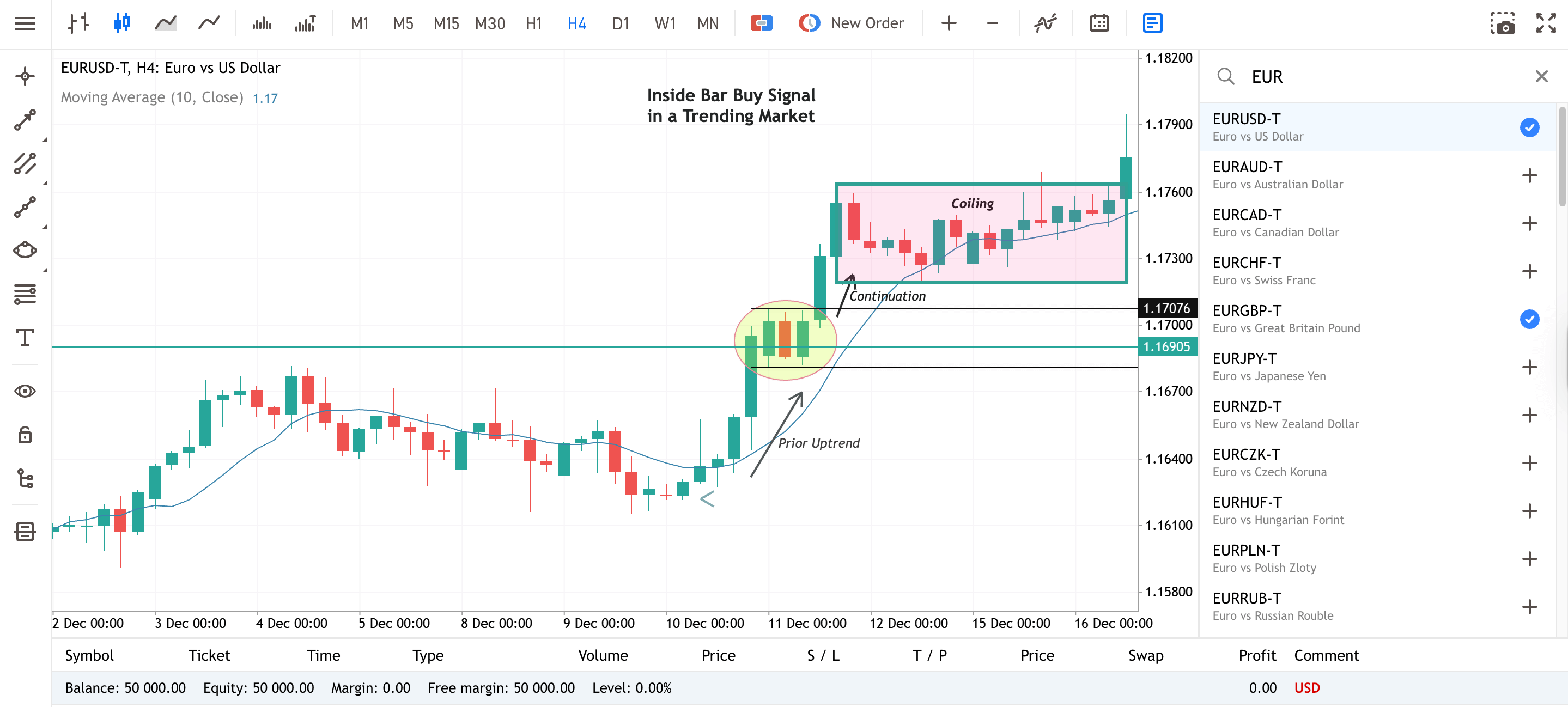
- The above image is an example of an inside bar continuation pattern in which the market is trending and price is trading above the moving average. The uptrend is followed by a larger candle, the mother bar (highlighted in yellow), within the high and low of the mother bar two consecutive inside bars form. This sequence represents a temporary pause in momentum as the market consolidates before the next potential move.
- In this type of setup, many traders prefer to participate only once the price breaks above the high of the mother bar, rather than during the consolidation itself.
- This pattern may also be applied in a downtrend as a potential short trade only after price breaks below the low of the mother bar.
Stop Loss Placement in an Inside Bar Candle Breakout Strategy
- For long trades, the stop-loss is typically placed just below the mother bar low. For short trades, it is placed just above the mother bar high. Some traders also use a small buffer of one or two pips, though it’s a matter of personal preference.
- When the mother bar is unusually large, placing the stop beyond its full range may result in excessive risk. In such cases, some traders choose to place the stop-loss near the 50% level of the mother bar, which represents the midpoint between its high and low.
Inside Bar Reversal Strategy
Moving ahead, in a reversal context the inside bar is approached slightly differently. Rather than viewing it as a pause within an existing trend, traders often look for signs of potential exhaustion near a crucial support or resistance level.
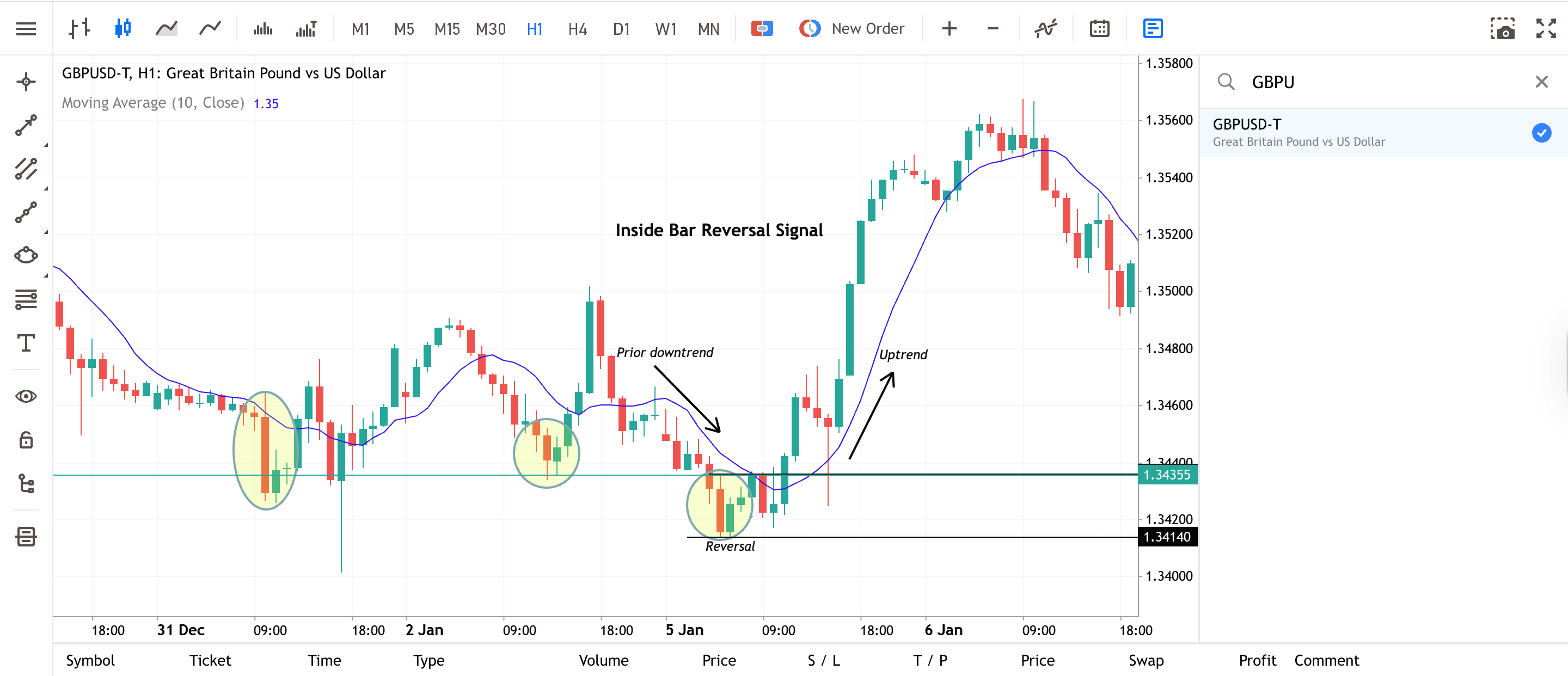
- The above image shows a reversal inside bar pattern during a downtrend, where price bounces as soon as it reaches near the support zone. The repeated failure to push price meaningfully lower, combined with the formation of inside bars, may indicate that the selling pressure is being absorbed and demand is gradually picking up.
- As price eventually breaks above the high of the mother bar, this could be looked at as an early confirmation that bearish momentum is weakening. In the example, price also begins to trade above the moving average. While this alone does not confirm a trend change, it can help support the idea that market participation may be shifting from sellers to buyers.
- Because reversal setups naturally involve more uncertainty, many traders prefer to wait for this type of confirmation where a bullish candlestick closes above the high of the mother bar, rather than entering while price is still consolidating.
Stop Loss Placement in a Reversal Inside Bar Strategy
- For bullish inside bar candle reversal setups, traders often place the stop-loss just below the low of the mother bar. For bearish inside bar reversal setups, it is placed just above the mother bar high.
- In some cases, traders may choose to place the stop-loss beyond a nearby support or resistance level, rather than sticking to the mother bar range.
How to Identify a Valid Inside Bar Setup
Here are a few things traders may check to help identify whether an inside bar setup is favourable or not.
Again, it’s better to remember that more favourable setups tend to emerge when multiple elements align together on a chart such as a clear trend, a well-defined mother bar, and a logical area for price to expand after consolidation and confirmation. But even when all of these conditions appear on the chart, future price action is never certain or guaranteed. By filtering inside bar setups using these criteria, traders may be able to reduce over-trading and avoid some common whipsaws like false breakouts or premature reversal entries.
Five Types of Inside Bar Setups
Inside bars can appear in several forms. Although the candle structure stays the same, different variations can change how traders read the pattern.
1. Single Inside Bar Pattern
This is the most basic form, where one candle forms entirely within the range of the mother bar.
2. Double Inside Bar Pattern
A double inside bar occurs when two consecutive candles remain within the range of the same mother bar. We saw this structure in both the examples above. This type of extension of the inside bar may suggest that volatility is contracting further, and it may sometimes lead to a stronger directional move once price breaks out of the range of the mother bar, though this is not always the case.
3. Triple Inside Bar Pattern (or Multiple Inside Bars)
When three or more inside bars form consecutively within the same mother bar, price is often said to be coiling. This structure could be seen in the inside bar breakout pattern example we saw above, where after continuation the price enters into a prolonged indecision. Many traders view this kind of compression as a sign that volatility may be building and could precede a stronger move, although this may or may not occur, and price may also continue to consolidate or break in the opposite direction.
4. Inside Bar Squeeze
An inside bar squeeze is similar to multiple inside bars but in this case the body becomes smaller candle by candle, showing tighter price compression. On a smaller time frame, it may look like a wedge or a triangle pattern and the price may eventually break out in either direction, depending on the market condition.
5. Inside Bar at Crucial Levels
Inside bars that form near major support or resistance levels tend to receive more attention from traders. In these zones, the pattern may act either as a potential continuation signal or a potential reversal setup, depending on the prevailing price action and confirmation.
Four Common Inside Bar Trading Mistakes in Forex
While the inside bar can be a useful tool for spotting potential market pauses and breakout opportunities, traders may sometimes misinterpret the pattern or apply it inconsistently. Being aware of these common pitfalls can help improve trading decisions and better manage risk.
- Entering a forex trade before price breaks the mother bar high or low can often lead to false breakouts, especially during low-liquidity sessions.
- Inside bars that form during sideways price action or within narrow ranges tend to lack momentum. In such situations many traders may prefer to wait for clearer direction or higher-quality setups before entering a trade.
- Placing stop-loss orders without accounting for the mother bar structure or recent volatility of a forex pair may result in premature stop-outs.
- While many Forex traders use the mother bar high or low as a stop loss, others may use the inside bar range or the support or resistance levels. Regardless of the method, maintaining a comfortable position size and risk management is of utmost importance.
The Bottom Line: Inside Bar Pattern in Forex
The inside bar forex setup could be a useful approach for forex traders. Several strategies are available for trading inside bars, and the one you choose may depend on your risk appetite, goals, and current level of experience. For beginners, it is often advisable to focus on learning and gaining a solid understanding of both the system and the forex market before trading more actively.
To practice the inside bar trading strategy, you can open a free demo account with Admirals which enables you to trade under simulated trading conditions, without risking your capital.
Other articles you may find interesting:
Frequently Asked Questions About the Inside Bar Pattern in Forex
What is the inside bar strategy in forex?
The inside bar trading strategy is a two-bar pattern where the second bar is within the high to low range of the prior bar. It signals potential market reversal or breakout. Traders may use it to anticipate price movements based on the pattern's context within a chart.
Which timeframe is suitable for trading inside bars in forex?
The daily chart timeframe is generally considered the most suitable for trading an inside bar Forex strategy. The reason is that on lower timeframes, inside bars can occur too frequently to be reliably traded. For example, in a day trading inside bar strategy on a 1-hour chart or lower, long strings of inside bars may form before a breakout, which can cause confusion and increase the chance of false breakouts.
Many traders find that attempting to trade inside bars on lower timeframes can be challenging. With experience, it may be possible to trade inside bars on a lower timeframe as well.
Can an inside bar be bullish or bearish?
An inside bar itself is neutral. It does not inherently indicate a bullish or bearish move. Its significance depends on the context in which it forms.
When an inside bar forms in an uptrend and signals a potential continuation or breakout to the upside, it is referred to as a bullish inside bar pattern. Conversely, when it appears in a downtrend and suggests a possible continuation or breakout to the downside, it is called a bearish inside bar pattern.
About Admirals
Admirals is a multi-award-winning, regulated Forex and CFD broker, offering trading on over 8,000 financial instruments via the world's most popular trading platforms: MetaTrader 4 and MetaTrader 5.
The given data provides additional information regarding all analysis, estimates, prognosis, forecasts, market reviews, weekly outlooks or other similar assessments or information (hereinafter “Analysis”) published on the websites of Admirals investment firms operating under the Admirals trademark (hereinafter “Admirals”) Before making any investment decisions please pay close attention to the following:
- This is a marketing communication. The content is published for informative purposes only and is in no way to be construed as investment advice or recommendation. It has not been prepared in accordance with legal requirements designed to promote the independence of investment research, and that it is not subject to any prohibition on dealing ahead of the dissemination of investment research.
- Any investment decision is made by each client alone whereas Admirals shall not be responsible for any loss or damage arising from any such decision, whether or not based on the content.
- With view to protecting the interests of our clients and the objectivity of the Analysis, Admirals has established relevant internal procedures for prevention and management of conflicts of interest.
- The Analysis is prepared by an analyst (hereinafter “Author”). The Author Amrita Kundu is a contractor for Admirals. This content is a marketing communication and does not constitute independent financial research.
- Whilst every reasonable effort is taken to ensure that all sources of the content are reliable and that all information is presented, as much as possible, in an understandable, timely, precise and complete manner, Admirals does not guarantee the accuracy or completeness of any information contained within the Analysis.
- Any kind of past or modelled performance of financial instruments indicated within the content should not be construed as an express or implied promise, guarantee or implication by Admirals for any future performance. The value of the financial instrument may both increase and decrease and the preservation of the asset value is not guaranteed.
- Leveraged products (including contracts for difference) are speculative in nature and may result in losses or profit. Before you start trading, please ensure that you fully understand the risks involved.