How to Use the Stochastic Oscillator

Whilst many technical indicators follow price, the stochastic oscillator attempts to measure the momentum behind it. Developed by George C. Lane in the late 1950s, it measures where an asset's closing price sits relative to its recent price range, expressing that relationship on a scale of 0 to 100. Traders can use the indicator to help identify shifts in momentum before they show up in the price itself.
This guide looks at the stochastic oscillator in depth, from how the indicator is calculated and how to read it, to the settings that suit different trading styles.
The information in this article is provided for educational purposes only and does not constitute financial advice. Consult a financial advisor before making investment decisions.
Table of Contents
- What Is the Stochastic Oscillator?
- How the Stochastic Oscillator Works
- How to Read the Stochastic Oscillator
- Stochastic Oscillator Settings
- How to Use the Stochastic Oscillator: 3 Key Approaches
- Stochastic Oscillator Strategy Example
- Stochastic Oscillator vs RSI
- Strengths and Limitations of the Stochastic Oscillator
- Conclusion
- Frequently Asked Questions
What Is the Stochastic Oscillator?
The stochastic oscillator is a momentum indicator that measures where an asset's closing price sits relative to its price range over a given period.
It operates on a scale of 0 to 100, with readings near the top of that range suggesting prices are closing consistently high and readings near the bottom suggesting the opposite. The logic behind it is straightforward: in a rising market, prices tend to close near the top of their recent range, whilst in a falling market, they tend to close near the bottom.
Consequently, when prices begin closing away from the extremes of the range despite the prevailing trend, it can indicate that momentum is fading. Because momentum tends to shift before price does, the indicator can act as an early signal of a potential reversal.
How the Stochastic Oscillator Works
The stochastic oscillator tracks where an asset's closing price falls within its recent price range to highlight whether momentum is strengthening or weakening. It achieves this by using two lines and a relatively simple calculation, both of which are worth understanding before looking at how to trade using the indicator.
The %K and %D Lines Explained
The stochastic oscillator plots two lines on a separate window below the main price chart, both moving within a range of 0–100.
The first is the %K line, which is the main reading of the indicator. It compares the most recent closing price to the high-low range over a set number of periods (often 14) and expresses that relationship as a percentage. A %K reading above 80 means the current close is near the top of the 14-period range; a reading below 20 indicates it is near the bottom.
The second is the %D line, which is a moving average of %K (typically 3-periods). Because it smooths out some of the short-term noise in the %K line, the %D line moves more slowly. Consequently, %K is sometimes referred to as the fast stochastic line and %D as the slow line. When the two lines cross, it may indicate a shift in momentum and is often interpreted as a signal by traders.
The Stochastic Oscillator Formula
In practice, trading platforms will calculate and plot both lines for you automatically. However, understanding the formula can be useful for interpreting what the indicator is actually telling you and for making decisions when adjusting its settings.
%K = [(C − L14) ÷ (H14 − L14)] × 100
Where:
- C = the most recent closing price
- L14 = the lowest price recorded over the past 14 periods
- H14 = the highest price recorded over the past 14 periods
If the most recent close is at the very top of the price range, %K will be close to 100. If it is at the very bottom, %K will be close to 0. The %D line is calculated as a simple moving average of %K.
The 14-period lookback used in the formula above is a common reference point for explaining the calculation, but many traders adjust the period to suit their timeframe and approach.
How to Read the Stochastic Oscillator
With the %K and %D lines plotted, the stochastic oscillator gives traders a visual representation of where price momentum currently stands. The sections below will take a look at some of the key thresholds and how those levels are often interpreted.
Overbought and Oversold Levels
The two most commonly watched levels on the stochastic oscillator are 80 and 20.
When both lines move above 80, the indicator is signalling that the asset is trading near the top of its recent price range, a condition often described as overbought. When both lines drop below 20, the asset is trading near the bottom of its range, which can be described as oversold.
These terms are widely used but frequently misunderstood. Overbought levels do not mean that price is about to fall, nor do oversold levels mean that price is about to rise. Both conditions can persist for extended periods, particularly in strongly trending markets where price can continue closing near either extreme for extended periods.
Therefore, rather than making decisions based solely on overbought and oversold levels, traders typically treat such readings as a signal that a reversal could be on the horizon. Traders can then look to confirm these signals using other evidence, such as a crossover of the %K and %D lines, a divergence from price or by using other indicators.
Above and Below 50
Although the 80 and 20 levels may be the most commonly watched, the 50 level can also carry significance.
A stochastic reading above 50 indicates that the asset is closing in the upper half of its recent price range, indicating upward momentum. A reading below 50 suggests the opposite: that price is closing in the lower half of its range, indicating downward momentum.
The 50 level may also be useful as a trend filter. For example, some traders may only consider a buy signal generated below 20 once the reading has subsequently crossed above 50, treating that move as confirmation that momentum has shifted.
Stochastic Oscillator Settings
When applying the stochastic oscillator on a trading platform, traders will encounter three configurable parameters: the %K period, the slowing value and the %D period.
The %K period determines the lookback window; the number of candles the indicator uses to calculate the current reading. A shorter %K period makes the indicator more reactive to recent price movements, whereas a longer period produces a smoother reading.
The slowing value controls the internal smoothing applied to the %K line before it is plotted. A slowing value of 1 applies no additional smoothing, leaving %K in its natural state. Higher values smooth the line, reducing sensitivity and filtering out short-term noise.
The %D period determines the moving average period applied to the %K line. This is typically set to 3 regardless of how the other parameters are configured.
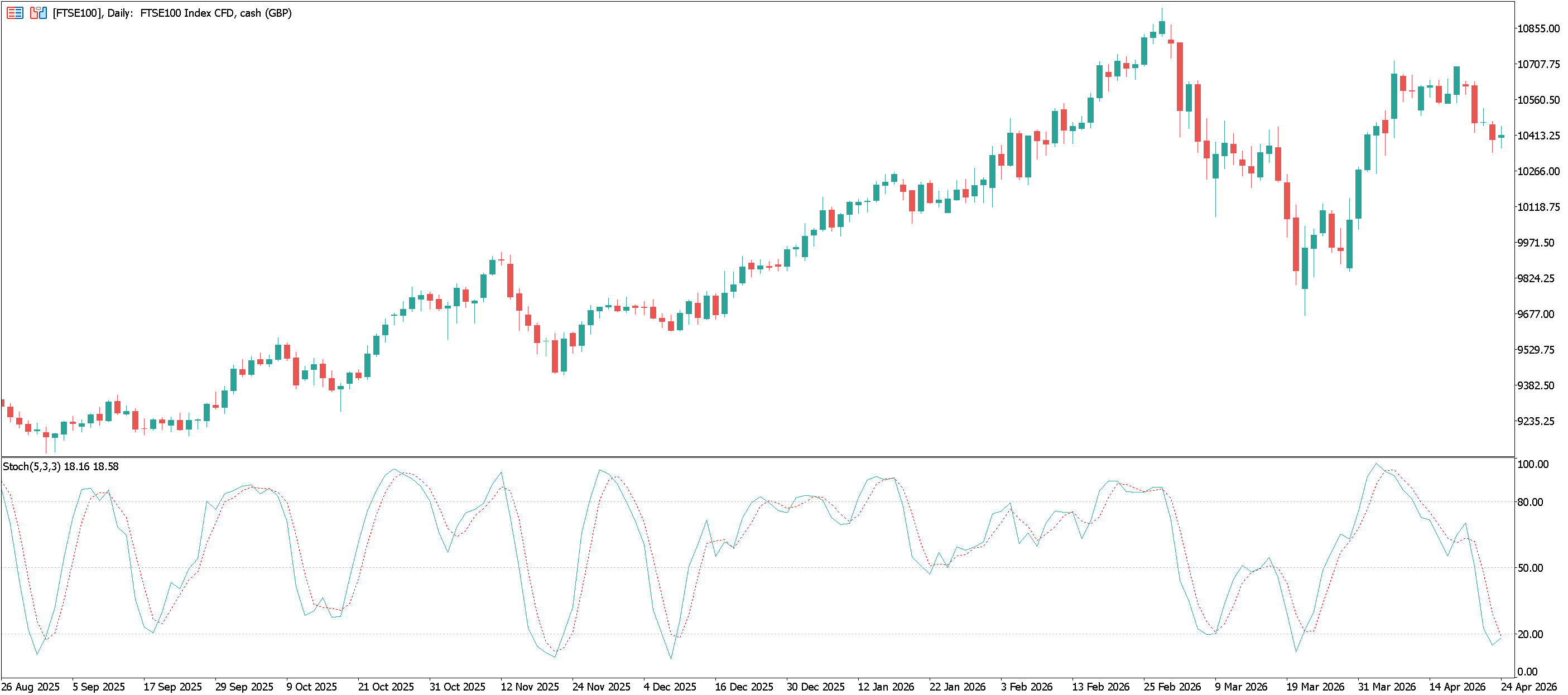
In the MetaTrader trading platforms, the default settings are 5, 3, 3 — meaning a five-period %K, a slowing value of 3 and a 3-period %D. From there, traders typically adjust the settings based on their trading style and the timeframe they are working on.
The table below outlines some of the stochastic oscillator settings traders commonly use as a starting point, depending on their trading style:
These are widely referenced starting points rather than fixed rules. The settings that suit one trader, instrument or market condition may not suit another.
Day Trading
For day trading on shorter timeframes traders may look at settings in the region of 5, 3, 3 or 14, 3, 3.
The 5, 3, 3 configuration produces a more responsive indicator that reacts quickly to intraday price movements. However, this comes with a higher volume of signals, some of which will inevitably be false.
The 14, 3, 3 setting applies a longer lookback period, which tends to reduce short-term noise whilst remaining responsive enough for intraday use. Traders who find the faster configuration too responsive on their chosen timeframe may find the latter a more workable starting point.
Swing Trading
Swing traders, who typically hold positions over several days or weeks, may gravitate towards longer timeframes such as 14, 3, 3 or 21, 5, 5.
The extended lookback period filters out short-term fluctuations and focuses the indicator on more sustained momentum shifts, which are typically more suitable to a longer-term trading approach.
On daily or weekly charts, longer lookback periods might help identify more meaningful overbought and oversold conditions rather than reacting to every short-term swing.
Scalping
Scalpers operate on very short timeframes and often favour faster configurations such as 5, 3, 3, prioritising responsiveness over smoothness.
The consequence is a higher noise level, meaning that scalpers generally combine the stochastic oscillator with other indicators and apply strict criteria for confirming signals.
It is worth noting that there is no universally correct set of parameters which will work for every trader and every strategy. Furthermore, settings that work well on one instrument or timeframe may perform differently on another. Many traders arrive at their preferred settings through testing, rather than relying on a fixed rule.
How to Use the Stochastic Oscillator: 3 Key Approaches
Traders may use the stochastic indicator in several distinct ways, each suited to different market conditions and trading styles. Three common approaches are outlined below.
Overbought and Oversold Signals
The most straightforward application of the stochastic oscillator is using the 80 and 20 thresholds as potential entry and exit markers.
When the indicator drops below 20 and then crosses back above it, some traders interpret this as a signal that selling pressure may be easing and a move higher could follow. Conversely, when the indicator rises above 80 and then crosses back below it, it can suggest that buying momentum is fading.
As discussed earlier, it’s important to note that overbought and oversold conditions can persist for extended periods in trending markets. For this reason, many traders may treat a return across the threshold as the more meaningful signal and also look for additional confirmation before acting.
Stochastic Crossovers
A stochastic crossover occurs when the %K line crosses the %D line. When the faster %K line crosses above %D, it might indicate building upward momentum; when it crosses below, it can suggest the opposite.
Crossovers that occur within the overbought or oversold zones are generally considered more significant. For example, %K crossing above %D whilst both lines are below 20 typically carries more weight with traders than when the same crossover takes place around the 50 level.
These signals may prove more reliable in a ranging market than a strongly trending market, when crossovers can produce frequent false signals as the indicator moves in and out of overbought/oversold territory without a reversal materialising.
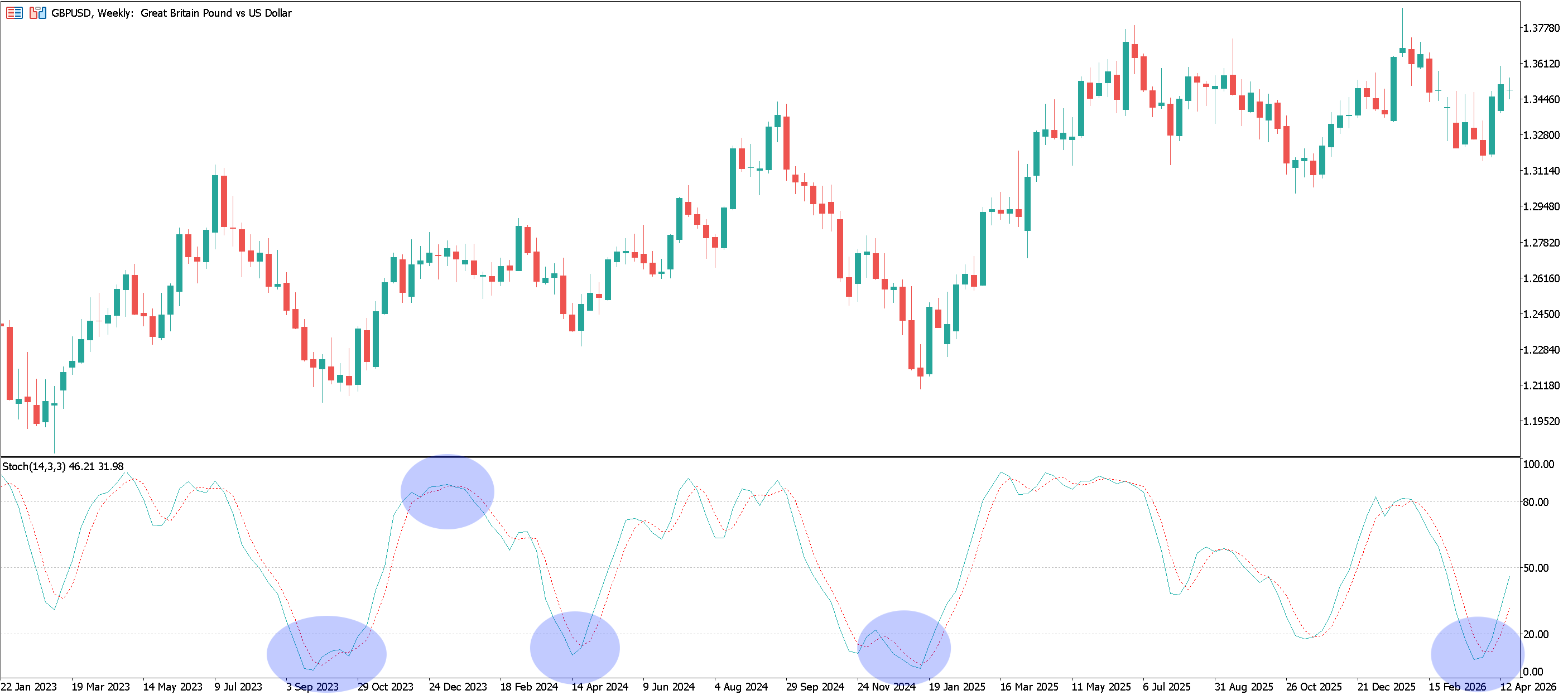
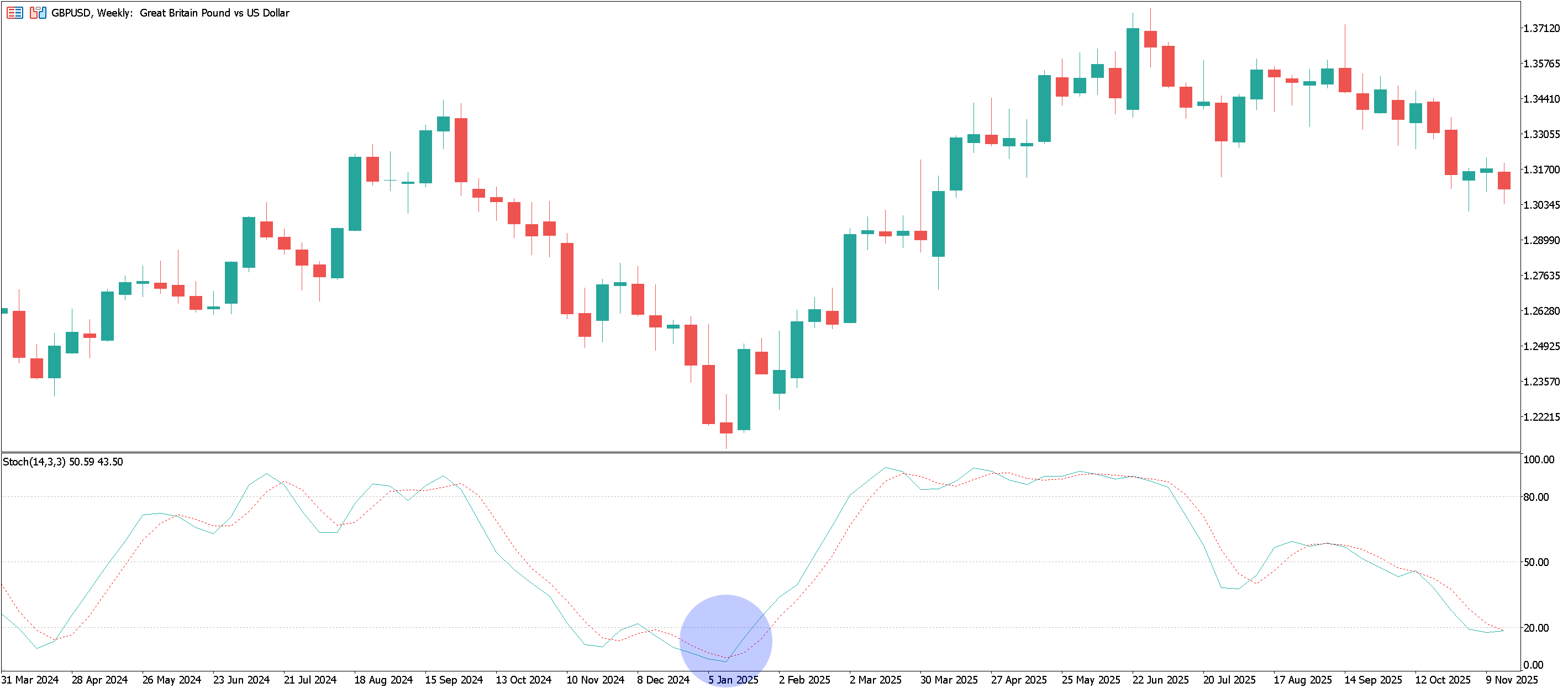
In the weekly GBPUSD chart below, we’ve highlighted several instances where a stochastic crossover has taken place in either overbought or oversold territory.
Stochastic Divergence
Divergence occurs when the direction of the stochastic oscillator and the direction of price start to move in different directions.
Bullish divergence occurs when price is making lower lows, but the stochastic starts making higher lows. This divergence suggests that, whilst price is still falling, downward momentum may be weakening.
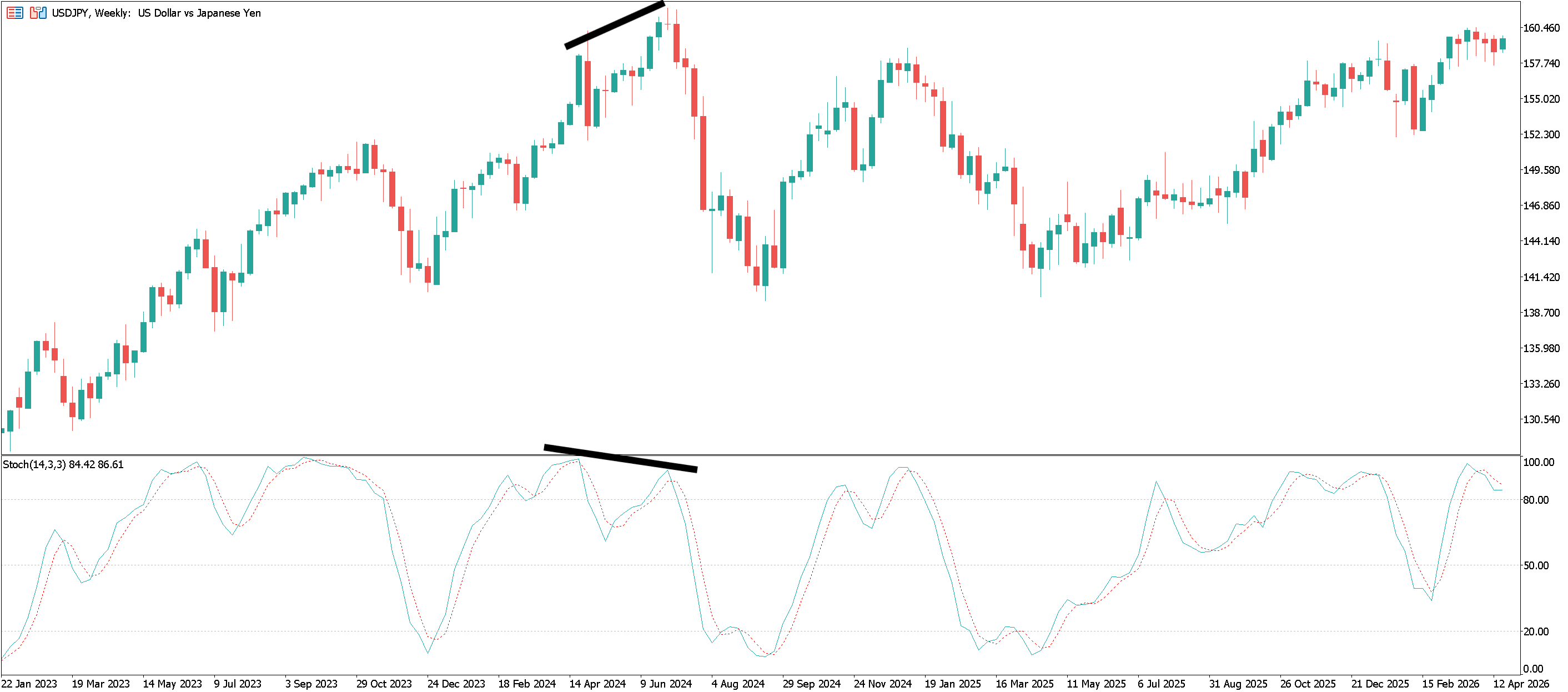
Bearish divergence is the opposite, taking place when an asset’s price continues making higher highs whilst the stochastic records lower highs. Similarly, this suggests that upward momentum may be fading even though price is still rising.
Divergence can develop over an extended period before price actually turns, if it turns at all. Consequently, divergence is usually treated as a warning sign of a potential reversal which is then confirmed using other technical analysis tools.
In the weekly chart of USDJPY below, an example of bearish divergence has been highlighted.
Stochastic Oscillator Strategy Example
The following example illustrates how the overbought/oversold reading and crossover signal might be used together, demonstrating the principle of waiting for confirmation before acting on an initial signal.
In the weekly chart of GBPUSD below, we can see that, after a downward move in price, the stochastic oscillator drops below 20. This indicates that the asset is trading in oversold territory.
Rather than acting on that reading alone, a trader might look for the following sequence of events before drawing any conclusions:
- The stochastic oscillator drops below 20, suggesting the asset is closing near the bottom of its recent price range and that downward momentum may be building.
- The %K line begins to turn upward whilst still below 20, indicating that momentum may be starting to shift.
- The %K line crosses above the %D line whilst both remain below 20 (highlighted in the chart above).
- Both lines subsequently cross back above 20, suggesting that oversold conditions may be easing
It is worth emphasising that no sequence of signals guarantees a particular outcome. The example above illustrates how traders might combine signals produced by the stochastic oscillator as part of a wider trading strategy.
Stochastic Oscillator vs RSI
The stochastic oscillator and the Relative Strength Index (RSI) are both momentum indicators which can be used to identify overbought and oversold conditions. Because they serve a similar purpose, they are often compared with each other. Here is how the two indicators differ:
- What They Measure: The stochastic oscillator reflects where an asset's closing price sits relative to its recent price range. On the other hand, the RSI compares recent gains to losses to measure the speed and magnitude of price movements.
- Threshold Levels: The stochastic oscillator traditionally uses 80 and 20 as overbought and oversold thresholds, whilst the RSI uses 70 and 30. Both may be adjusted depending on settings and market conditions.
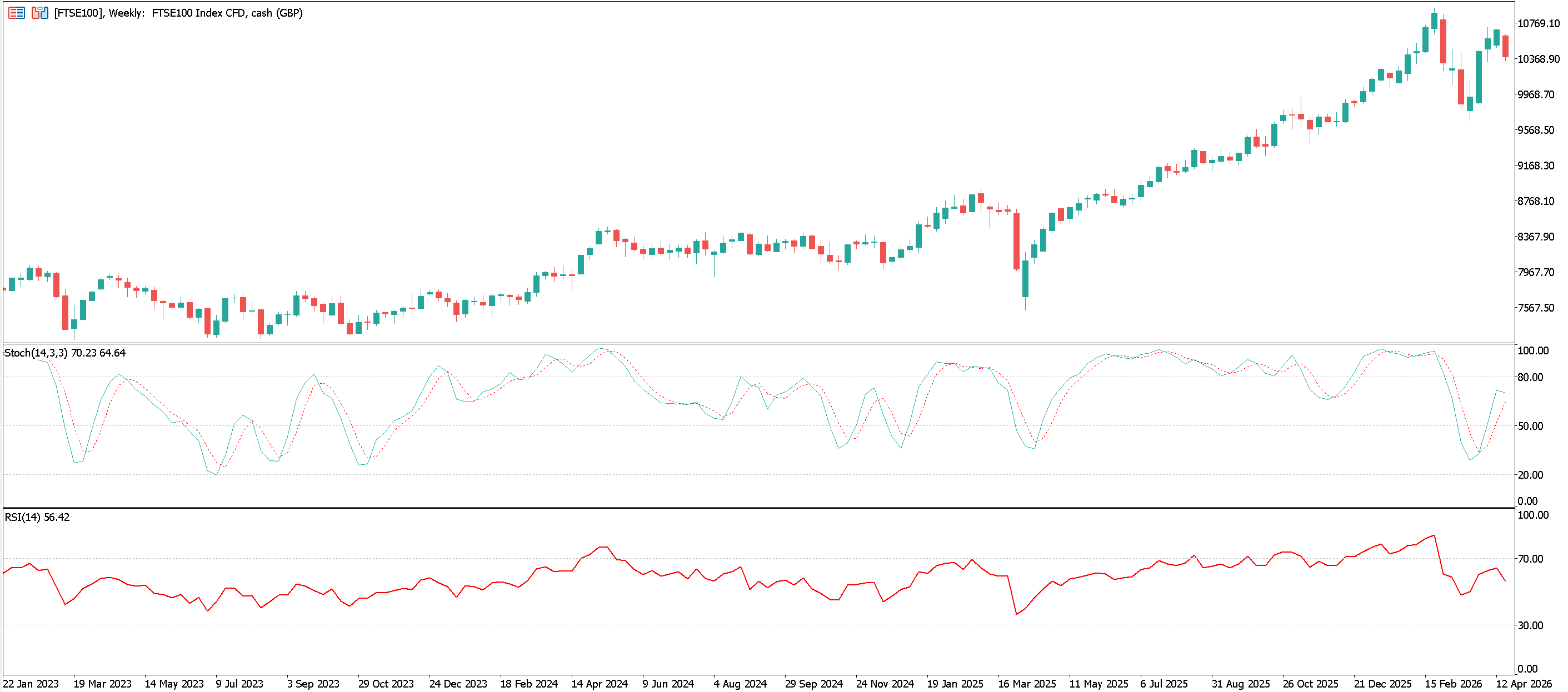
- Using Both Together: Some traders may choose to apply both indicators to the same price chart, treating agreement between them as stronger confirmation of a signal. However, because both are momentum-based they may move in the same direction, which limits the degree to which they offer genuinely independent perspectives.
Strengths and Limitations of the Stochastic Oscillator
Like all technical indicators, the stochastic oscillator performs better in some market conditions than others. The following summarises where it tends to be most and least effective:
Strengths
- Versatile across markets and timeframes: The indicator can be applied to forex, equities, commodities and indices, and works on any timeframe.
- Early momentum signals: Because momentum tends to shift before price does, the stochastic oscillator may flag potential reversals earlier than price-based indicators.
- Works well in ranging markets: When price is moving between defined highs and lows, overbought and oversold readings tend to correspond more closely with genuine turning points.
- Multiple signal types: The indicator generates several distinct types of signal, including overbought and oversold readings, %K and %D crossovers and divergence from price.
Limitations
- Less reliable in trending markets: During sustained trends, the indicator can remain in overbought or oversold territory for extended periods without a reversal materialising, generating misleading signals.
- False signals in choppy markets: In low-volatility or directionless conditions, the %K and %D lines can cross repeatedly without any meaningful follow-through.
- Measures momentum, not direction: The indicator shows where price sits within its recent range and whether momentum is building or fading, but does not indicate the direction or magnitude of any potential move.
- Lagging elements: The %D line, being a moving average of %K, introduces an element of lag. By the time a crossover is confirmed, some portion of the move it signals may already have occurred.
Conclusion
The stochastic oscillator is a momentum indicator that measures where an asset's closing price sits relative to its recent price range. It allows traders to derive a number of signals – including overbought and oversold readings, %K and %D crossovers and divergence from price.
However, its limitations are real and worth keeping in mind. In strongly trending markets it can generate frequent misleading signals. Indeed, used in isolation, it only offers traders an incomplete picture. As with most technical indicators, the stochastic indicator is generally more useful when used in conjunction with other technical analysis tools.
Frequently Asked Questions
What does the stochastic oscillator measure?
The stochastic oscillator measures where an asset's closing price sits relative to its historic price range over a set number of periods. It expresses this as a value between 0 and 100, with higher readings indicating price is closing near the top of its recent range and lower readings indicating it is closing near the bottom.
What is the difference between %K and %D?
%K is the primary line of the indicator, reflecting the current stochastic reading based on the most recent closing price relative to the predefined price range. %D is a moving average of %K, typically calculated over three periods, which smooths out short-term fluctuations. When the two lines cross, it may indicate a shift in short-term momentum.
What are the standard stochastic oscillator settings?
The default settings on the MetaTrader trading platforms are 5, 3, 3 – representing the %K period, the slowing value and the %D period, respectively. However, these are not set in stone; traders adjust the settings to suit their trading style and the timeframe they are using. Longer %K periods produce a smoother, less reactive indicator whilst shorter periods produce more frequent signals.
What is a stochastic RSI?
The stochastic RSI is a separate indicator that applies the stochastic oscillator formula to RSI values rather than to price. The result is an indicator which oscillates between 0 and 1. It’s typically used to identify overbought and oversold conditions, though its increased sensitivity also means it generates more signals – and, consequently, more false signals - than the stochastic oscillator.
How does the stochastic oscillator differ from the RSI?
The stochastic oscillator measures where price is closing relative to its recent range, whereas the RSI compares recent gains and losses to measure the speed and magnitude of price changes.
Is the stochastic oscillator reliable in trending markets?
The stochastic oscillator might be less reliable in strongly trending markets, when the indicator can remain in overbought or oversold territory for extended periods without a reversal taking place. In these conditions, traders may look to combine it with trend-following indicators to filter out signals that run counter to the prevailing direction.
What does a stochastic crossover signal indicate?
A stochastic crossover can indicate a shift in momentum. It occurs when the %K line crosses the %D line; %K crossing above %D can indicate building upward momentum, whereas %K crossing below %D can suggest the opposite. Crossovers that occur in overbought or oversold territory are typically considered more meaningful than those which occur elsewhere.
INFORMATION ABOUT ANALYTICAL MATERIALS:
The given data provides additional information regarding all analysis, estimates, prognosis, forecasts, market reviews, weekly outlooks or other similar assessments or information (hereinafter “Analysis”) published on the websites of Admirals investment firms operating under the Admirals trademark (hereinafter “Admirals”) Before making any investment decisions please pay close attention to the following:
- This is a marketing communication. The content is published for informative purposes only and is in no way to be construed as investment advice or recommendation. It has not been prepared in accordance with legal requirements designed to promote the independence of investment research, and that it is not subject to any prohibition on dealing ahead of the dissemination of investment research.
- Any investment decision is made by each client alone whereas Admirals shall not be responsible for any loss or damage arising from any such decision, whether or not based on the content.
- With view to protecting the interests of our clients and the objectivity of the Analysis, Admirals has established relevant internal procedures for prevention and management of conflicts of interest.
- The Analysis is prepared by an analyst (hereinafter “Author”), with the assistance of AI tools. The Author Roberto Rivero is a contractor for Admirals. This content is a marketing communication and does not constitute independent financial research.
- Whilst every reasonable effort is taken to ensure that all sources of the content are reliable and that all information is presented, as much as possible, in an understandable, timely, precise and complete manner, Admirals does not guarantee the accuracy or completeness of any information contained within the Analysis.
- Any kind of past or modelled performance of financial instruments indicated within the content should not be construed as an express or implied promise, guarantee or implication by Admirals for any future performance. The value of the financial instrument may both increase and decrease and the preservation of the asset value is not guaranteed. Leveraged products (including contracts for difference) are speculative in nature and may result in losses or profit. Before you start trading, please ensure that you fully understand the risks involved.