7 High Yielding UK Dividend Stocks

Dividend stocks allow investors to generate income from their portfolio, which can either be kept or reinvested for future growth. In this article, we’ll highlight 7 high yield UK dividend stocks and analyse their prospects.
The information in this article is provided for educational purposes only and does not constitute financial advice. Consult a financial advisor before making investment decisions.
Key Takeaways
- Legal & General, Taylor Wimpey and WPP are currently amongst the highest yielding UK dividend stocks.
- When looking for high dividend stocks, it’s important to look beyond the dividend yield and consider other metrics.
- Dividend yields which are too high may not be sustainable in the long-term.
- Remember that future dividends are never guaranteed.
7 of the Highest Dividend Stocks UK
The UK’s FTSE 100 and FTSE 250 indices are full of many dividend paying stocks. In the following sections, we’ll take acloser look at some of the highest yielding stocks across both indices.
However, before we start, it’s important to note that a high dividend yield can sometimes be a warning sign for investors. Dividend yields which are too high are unlikely to be sustainable in the long-term.
Furthermore, dividend yields are subject to daily change and future payouts are never guaranteed.
Dividend yields are approximate as of 17 February 2026. Please note that yields are subject to change on a daily basis, and future dividends are never guaranteed.
Legal & General (LGEN)
- Dividend Yield: 7.8%
- Dividends Declared in Last 12 Months: 21.48p
Legal & General (L&G) is a UK financial services company which provides a variety of products and services including insurance, pensions and investment management. At the time of writing, it’s the highest yielding stock on the FTSE 100.
One thing which might alarm dividend investors is the fact that, recently, L&G has been paying out more in dividends than it’s generated in net income. This is usually a red flag.
However, it’s worth noting that L&G’s net income is affected by accounting adjustments, which are tied to movements in bond and equity valuations. Consequently, fluctuations in the markets can weigh on L&G’s net income even if underlying cash generation is strong.
In terms of dividend cover, the more relevant metric is L&G’s Solvency II capital generation. In 2024, L&G generated £1.8 billion, which covered the £1.2 billion worth of dividends it distributed to shareholders.
However, this highlights that L&G operates in an industry which is sensitive to financial market movements. It’s also exposed to changes in interest rates, with lower rates potentially weighing on profitability.
Phoenix Group Holdings (PHNX)
- Dividend Yield: 7.2%
- Dividends Declared in Last 12 Months: 54.7p
Phoenix Group is a long-term savings and retirement business, managing over £290 billion in assets for around 12 million customers.
Similarly to L&G, alarm bells may start ringing when investors see that Phoenix reported a post-tax loss of £1.1 billion in 2024. Such a loss would typically call into question the sustainability of its dividend.
However, as we saw with L&G, this was primarily driven by non-cash accounting items. The underlying business remained cash generative, which helped support Phoenix’s dividend.
A key metric for dividend sustainability is its operating cash generation. In 2024, this rose to £1.4 billion, comfortably covering its total dividend distribution of £530 million, and helping secure its position as a high yield UK dividend stock.
Again, investors should bear in mind that Phoenix’s business, and dividend sustainability, is sensitive to interest rates and financial markets.
British American Tobacco (BATS)
- Dividend Yield: 5.7%
- Dividends Declared in Last 12 Months: 245.04p
British American Tobacco is a UK-based tobacco company which operates around the world, selling brands including Lucky Strike and Camel.
Many tobacco companies have long histories of rewarding shareholders through dividend payouts, and British American Tobacco is no exception. The cigarette company has hiked its annual payout for more than 25 years.
In general, tobacco companies tend to have large cash flows, which support their dividend records. Even though smoking has been in long-term decline, companies have been able to raise prices to offset falling sales volumes, maintaining high operating margins.
Nevertheless, this strategy may not work forever if smoking continues to decline. Although British American Tobacco is pivoting into non-cigarette products, it is not clear whether these will end up being as profitable as its legacy business. Furthermore, investing in tobacco companies may raise ethical questions for some investors.
WPP (WPP)
- Dividend Yield: 12.1%
- Dividends Declared in Last 12 Months: 31.9p
WPP is a UK-based advertising and marketing services company. At the time of writing, it has one of the highest dividend yields available across the FTSE 100 and FTSE 250.
However, this is an example of why it’s important to look beyond a big yield.
Dividend yield is calculated by dividing the annual payout per share by the current share price. That means that an increasing dividend yield can be a sign of a falling share price.
Unfortunately, that’s the case for WPP here. Share price has plunged by around 60% over the last year, and the company was recently relegated to the FTSE 250, as generative AI threatens to disrupt its business.
It cut its interim dividend in 2025 and is also expected to cut its final dividend as revenue and earnings come under pressure.
New management recently revealed a plan to turn things around, including introducing its own generative platform and simplifying its operations. However, challenges remain and investors should make sure they are fully aware of the risks before considering buying shares.
Taylor Wimpey (TW.)
- Dividend Yield: 8.0%
- Dividends Declared in Last 12 Months: 9.33p
Taylor Wimpey is a UK housebuilding company which was created from the merger of rivals Taylor Woodrow and George Wimpey in 2007.
The housebuilding stock has struggled since the pandemic, when completions plummeted, since which it has had to contend with high inflation and rising interest rates. Over the last five years, share price has fallen almost 30%.
Of course, this decline does not account for dividends, which it has consistently paid since 2011. Nevertheless, it cut its annual payout by a considerable margin in 2019 and cut its dividend once again in 2024. It also cut its interim dividend for 2025.
Furthermore, despite the dividend cut in 2024, its annual payout was not covered by earnings, meaning the housebuilder had to use some of its cash reserves to make shareholder payments. Naturally, that is not sustainable.
Earnings dipped again in the first half of 2025. If earnings don’t start to recover, Taylor Wimpey’s dividend could be under further threat.
The company’s future earnings prospects depend largely on the UK housing market, if interest rates continue to fall, this could aid Taylor Wimpey’s recovery.
Supermarket Income REIT (SUPR)
- Dividend Yield: 7.1%
- Dividends Declared in Last 12 Months: 6.15p
Supermarket Income REIT is a UK Real Estate Investment Trust which, as the name suggests, focuses on investing in supermarket property in the UK and France.
It rents these properties to big name tenants - including Tesco, Sainsbury’s and Carrefour – on long-term leases and has a 100% occupancy rate.
UK REITs are obligated to distribute at least 90% of profit from rental income as to shareholders as dividends. This can make them a popular choice for dividend investors.
The company was launched in 2017 and has increased its annual payout every year since.
However, it’s worth noting that share price has fallen over the last few years, although this appears to be a theme amongst UK REITs in general. Because REITs distribute most of their profit as dividends, it doesn’t leave them much to invest for future growth.
Consequently, REITs typically have to borrow in order to expand. With interest rates rising since the pandemic, REITs have seen borrowing costs increase, which may have been a factor weighing on share prices in recent years.
Primary Health Properties (PHP)
- Dividend Yield: 6.6%
- Dividends Declared in Last 12 Months: 7.15p
Next on our list of high UK dividend stocks is another REIT, Primary Health Properties (PHP).
PHP owns a portfolio of primary healthcare facilities across the UK and Ireland. Approximately 90% of its rent roll comes from the UK and Irish governments, which significantly lowers the risk of tenants not honouring the contracts.
Furthermore, an aging population is likely to fuel demand for healthcare in the coming years, which could provide a source of long-term growth.
In terms of dividends, PHP has hiked its annual payout for an impressive 30 years.
Recently, PHP completed the acquisition of rival Assura. Whilst this has resulted in PHP’s portfolio of healthcare properties increasing considerably, it has also increased the REIT’s net debt.
How to Pick High UK Dividend Stocks
We’ve highlighted in the article that it’s important to look beyond dividend yields when investing in dividend stocks. Amongst other things, it’s important to look for companies with strong fundamentals, as this is important in terms of dividend sustainability.
Here are a few tips for picking high dividend stocks in the UK.
Analyse Past Payments
In the first instance, look for companies which have a track record of paying out dividends.
Of course, just because a company has paid dividends in the past, that does not mean they will continue to do so in the future. There are plenty of examples of company’s cutting or suspending dividends.
However, looking at past payments will give you an idea of how much a company prioritises returning capital to shareholders. If a company has a long history of consistent payouts, management may think twice before breaking this track record unless necessary.
Look Beyond the Yield
The dividend yield is probably one of the first metrics you’ll look at when analysing dividend stocks. However, it shouldn’t be the only one.
Strong fundamentals are very important when assessing the sustainability of payouts. Importantly, are earnings sufficient to cover dividend payouts? And how much do they cover them by?
If earnings are declining and dividends remain the same or grow, this may start to become unsustainable.
Research Around the Company
Learn as much about the company and its operating environment as possible. Does it operate in an industry which is likely to do well in the future? Is it at threat of losing market share to competitors?
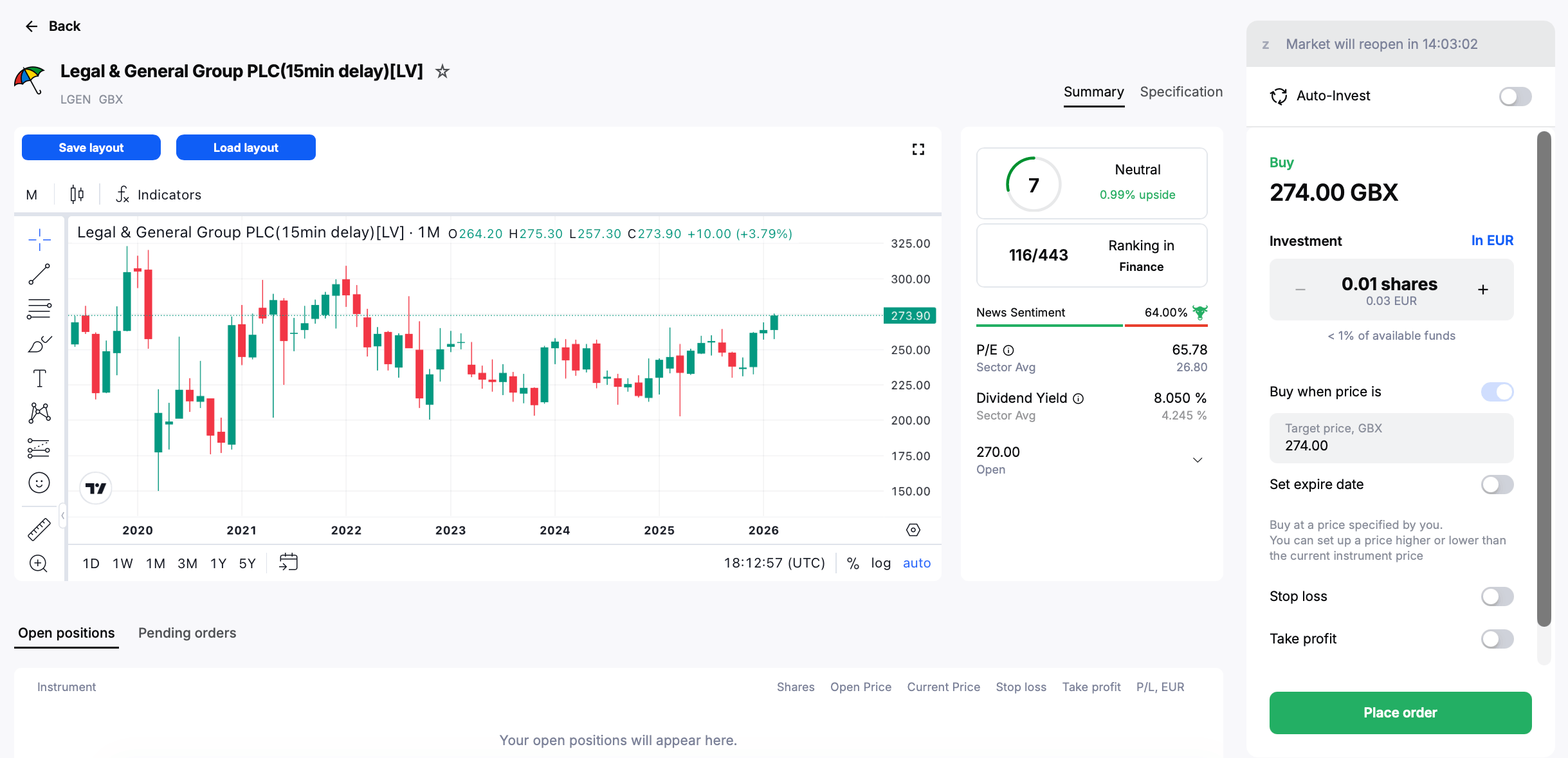
How to Invest in UK Dividend Stocks
Once you’ve learnt about dividend stocks and picked some candidates, here’s how investors can get started.
- Register for an investing account and complete the onboarding process
- Open the investing platform
- Search for your chosen UK dividend shares
- Create a new order, enter the number of shares you want to buy and send your order to the market.
Frequently Asked Questions
What are the highest yielding dividend stocks in the UK?
The highest yielding dividend stocks amongst FTSE 350 companies include Legal & General, WPP and Taylor Wimpey.
Are high yield dividend stocks risky?
They can be. A high dividend yield may act as a warning for some investors, as it may not be sustainable over the long-term. Furthermore, a high dividend yield may be a result of a falling share price.
How often do UK companies pay dividends?
This depends on the company in question. Dividend paying UK stocks tend to make payouts either monthly, quarterly, semi-annually or annually.
The given data provides additional information regarding all analysis, estimates, prognosis, forecasts, market reviews, weekly outlooks or other similar assessments or information (hereinafter “Analysis”) published on the websites of Admirals investment firms operating under the Admirals trademark (hereinafter “Admirals”) Before making any investment decisions please pay close attention to the following:
- This is a marketing communication. The content is published for informative purposes only and is in no way to be construed as investment advice or recommendation. It has not been prepared in accordance with legal requirements designed to promote the independence of investment research, and that it is not subject to any prohibition on dealing ahead of the dissemination of investment research.
- Any investment decision is made by each client alone whereas Admirals shall not be responsible for any loss or damage arising from any such decision, whether or not based on the content.
- With view to protecting the interests of our clients and the objectivity of the Analysis, Admirals has established relevant internal procedures for prevention and management of conflicts of interest.
- The Analysis is prepared by an analyst (hereinafter “Author”). The Author Roberto Rivero is a contractor for Admirals. This content is a marketing communication and does not constitute independent financial research.
- Whilst every reasonable effort is taken to ensure that all sources of the content are reliable and that all information is presented, as much as possible, in an understandable, timely, precise and complete manner, Admirals does not guarantee the accuracy or completeness of any information contained within the Analysis.
- Any kind of past or modelled performance of financial instruments indicated within the content should not be construed as an express or implied promise, guarantee or implication by Admirals for any future performance. The value of the financial instrument may both increase and decrease and the preservation of the asset value is not guaranteed.
- Leveraged products (including contracts for difference) are speculative in nature and may result in losses or profit. Before you start trading, please ensure that you fully understand the risks involved.