Investavimas į indeksus arba kaip prekiauti akcijų indeksais


Investing in indices. What are stock indices?
A stock index is made up of certain stocks.
|
A stock index is the average of the share prices of a group of the most important companies. A stock index reflects the value of that group of stocks and shows the overall current and historical performance of those stocks. |
The main purpose of indices is to provide investors with an easy way to assess the performance of an entire market, sector or region, rather than individual stocks. Thus, an index shows the performance of different entities, for example:
✅ By country: German index DAX , US index S&P 500, French index CAC40, Japanese index JP225 (Nikkei 225)
✅ By sector: for example, the US100 index, which reflects stocks and companies in the technology sector, or the TECDAX30 Germany Technology 30 index
How are stock indices calculated?
| Price method |
This is a method based on price estimation. In this case, the arithmetic average of current prices is used. The index changes depending on the change in the prices of the stocks included in it. This is how indices such as the DJIA and Nikkei are calculated.
This method has disadvantages because it does not take into account share fragmentation; a higher share price has a greater weight in the index, regardless of whether it is a large and fast-growing company or a young company with a small capitalization.
| Value method |
The initial market value ( capitalization ) of the stocks included in the index is calculated , which is used to calculate the index value. Large company stocks with a higher capitalization will have a greater impact on the index value than small company stocks.
| Unweighted method |
In this case, there is no weighting at all, meaning that all included stocks have the same weighting, regardless of price or capitalization level. It is assumed that the same amount is invested in each index stock.
The index changes are based on the arithmetic average of the percentage price changes of the index shares. Regardless of the size of the different share prices in the market, their percentage change is the same. The index can be calculated based on the arithmetic or geometric average of the individual percentage price changes.

? Let's take three companies: A, B, and C. The price of one share of each company is 10, 30, and 50 US dollars, respectively.
? To calculate the index value, we can simply add their values and we get: 10 + 30 + 50 = 90 index units.
? When the value of one or more shares increases, the index also increases: 12 + 31 + 53 = 96 index units. In this case, our index increased by 6.7% compared to the initial value.
? Ką daryti, jeigu mums atrodo, kad vienos įmonės akcijos daro didesnę įtaką ekonominei situacijai nei kitos akcijos? Tada akcijoms tame indekse galime suteikti skirtingus svorius.
? Jeigu A ir B akcijos mums yra svarbesnės nei C akcijos, suteikime joms atitinkamus svorius: 0,4; 0,4; 0,2. Šie koeficientai turi būti nuo 1 iki 100 %. Tada mūsų indeksas skaičiuojamas taip: 10 * 0,4 + 30 * 0,4 + 50 * 0,2 = 26.
? Jeigu A, B ir C akcijų kainos pasikeitė į 12, 31 ir 53, naujo indekso vertė bus 12 * 0,4 + 31 * 0,4 + 53 * 0,2 = 27,8. Indekso pokytis yra 6,9 % (tai yra daugiau nei 6,7 % pirmuoju atveju).
Kaip analizuojami akcijų indeksai?
Akcijų indeksų raidos analizė leidžia mums padaryti keletą išvadų apie investuotojų polinkį rizikuoti. Jeigu pagrindiniai akcijų rinkos indeksai kyla, tai reiškia, kad prekiautojai investuoja savo pinigus į gana rizikingą turtą, tai yra investuoja į akcijas.
Jeigu polinkis rizikuoti auga, gali sumažinti saugaus prieglobsčio aktyvų, pavyzdžiui, aukso, Šveicarijos franko ar Japonijos jenos, paklausa.
Be to, akcijų rinkos indeksų augimas gali rodyti padidėjusį atitinkamos šalies ekonomikos patrauklumą, o tai didina užsienio investuotojų paklausą jos valiutai. Pavyzdžiui, JAV ekonomikos atveju tai padidins JAV dolerio paklausą.
Kadangi indeksai atspindi labiau ilgalaikes tendencijas – fundamentinė analizė yra labiau naudotina. Techninė analizė tinkama įėjimo ir išėjimo iš rinkos taškams nustatyti.
Vienas svarbiausių fundamentinės analizės instrumentų – PMI indeksas. PMI (Purchasing Managers' Index) yra pirmaujantis indikatorius.
PMI – apklausos būdų surenkama informacija apie tam tikro segmento pirkimo vadybininkų lūkesčius, verslo sąlygas (darbuotojų darbo sąlygas, produkciją, naujų užsakymų skaičių, prekių atsargas ir tiekėjų prekių pristatymą).
SVARBU! PMI apima tik gamybos sektorių!
PMI skelbiami JAV, Europoje, Kinijoje – svarbiausiose ekonomikose kiekvieną mėnesį.
Kiti svarbūs rodikliai:
-
mažmeniniai pardavimai,
-
darbo užmokesčio augimas,
-
infliacija,
-
perkamoji galia,
-
gyventojų vartojimo nuotaikos.
Investavimas į indeksus. Pagrindiniai akcijų indeksai
Egzistuoja skirtingi pasaulio akcijų indeksai, tačiau kai kuriais jų prekiaujama daugiau nei kitais. Šioje lentelėje apžvelgsime pagrindinius akcijų indeksus:
|
Jungtinių Amerikos Valstijų akcijų indeksai |
|
|
Europos akcijų indeksai |
|
|
Azijos akcijų indeksai |
|
Šioje lentelėje pateikti devyni akcijų indeksai dažnai laikomi pagrindiniais ir svarbiausiais.
Europos akcijų indeksai
Euro zonos akcijų indeksas
The Euronext stock exchange is the main stock exchange in the Eurozone. The Euronext stock index is the Euro Stoxx 50. The Euro Stoxx 50 stock index consists of 50 companies ranked by their market capitalization in the Eurozone.
German stock index
One of the best known and most widely traded German stock indices is the DAX ! It is a global stock index that is highly regarded by global index traders.
The German DAX stock index, sometimes also known as the Frankfurt Stock Exchange Index, is associated with the large financial center of Frankfurt and occupies a very important place in global stock markets .
London Stock Market Index
The London Stock Exchange, which is one of the most famous in the world, also has its own English stock index - the FTSE 100 , which is of great importance in international index trading.
Spanish stock index
Although it is a somewhat lesser-known stock index on the European continent, a number of traders in Spain invest in this index.
The main Spanish stock index is called the IBEX 35, and it consists of 35 companies, weighted according to their market capitalization.
French stock index
The Paris Stock Exchange is one of the largest in the world and its index is the CAC 40 .
The CAC 40 stock index is composed of 40 continuously traded stocks, selected from the 100 companies with the highest number of transactions on the Euronext Paris exchange.
Other European stock indices
|
Norwegian stock index |
OBX 25 |
|
Netherlands stock index |
AEX 25 |
|
Swiss stock index |
SMI 20 |
|
Greek stock index |
ATHEX 20 |
|
Portuguese stock index |
PSI 20 |
|
Belgian stock index |
BEL 20 |
|
Italian stock index |
FTSE MIB |
|
Luxembourg Stock Index |
„LuxX" |
|
Irish Stock Index |
ISEQ |
|
Danish stock index |
"OMX Copenhagen 20" (KFX) |
|
Finnish stock index |
"OMX Helsinki 25" (OMXH25) |
|
Swedish stock index |
"OMX Stockholm 30" (OMXS30) |
American stock indices
Now let's move to the other side of the Atlantic, where there are also many different stock index markets. The American stock market is one of the largest in the world and has several major financial centers, although the most important is the NYSE (New York Stock Exchange).
The most well-known stock indices on this exchange are the Dow Jones and Nasdaq stock indices.
Dow Jones stock index
You've probably heard about this index from stock market news on TV or online. The Dow Jones Industrial Average is a widely traded index on the world's stock markets. It includes stocks of 30 major U.S. companies.
US index
The US index is one of the global indices well known to all index traders.It is a stock index representing 100 large-cap companies. The US index excludes financial companies and consists of the largest technology companies.
Asian stock indices
The truth is that we often talk about the Paris, London or American stock markets, but what about the Asian stock market? Let's discuss Asian stock indices!
Japan stock index
One of the most well-known Asian indices is the Japanese stock index Nikkei 225. This index, also known as the Tokyo Stock Index, consists of 225 companies and is the most important stock index in the Japanese stock market.
Chinese stock indices
➡️ In China, we would find the Chinese stock index – the SSE Composite Index. The SSE Composite Index is the most widely used stock index in China, reflecting the performance of the Shanghai Stock Exchange.
➡️ In addition to this, there is another Chinese stock index - CSI 300. The Chinese stock index CSI 300 is an index of the Shanghai Stock Exchange, consisting of the 300 companies with the largest market capitalization in the country.
These stock indices can sometimes be found under the common name Beijing Stock Index, which refers to the country's capital, even though the country's stock exchange is located in Shanghai.
➡️ Another Chinese stock index is the FTSE China 50, also called the Shanghai Stock Index or the Shenzhen Stock Index due to its composition, which is based on the Shanghai and Shenzhen stock markets.
Hong Kong Stock Index
The Hong Kong Stock Exchange Index – HSI50 – consists of the 50 largest companies in the country by market capitalization.
Russian stock index
The Russian stock index is also called the Moscow stock index, after the country's capital, the financial center. The Moscow stock index is MICEX.
African stock indices
The list of African stock indices is very long, so we only list the main stock indices here:
➡️ Moroccan Stock Index
➡️ Algerian stock index
➡️ Tunisian Stock Index
➡️ South African Stock Index
Investing in indices. How to trade stock indices
Trading stock indices has various characteristics.
1️⃣ Stock indices tend to grow in the medium and long term. The reason is that their composition is periodically adjusted, and the indices include only the most important and promising companies.
For this reason, opening short positions (selling) in index markets is very risky.
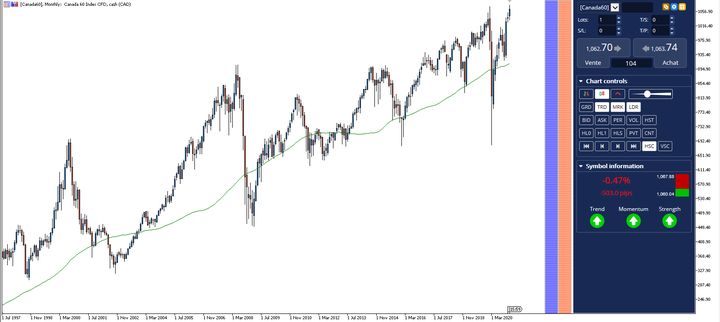
Source: Admirals MetaTrader 5, Canada 60 Stock Index Monthly Chart, July 1, 1997 - January 1, 2021. Data as of January 26, 2021. Please note that past performance is not a reliable indicator of future results.
Historical data shows that despite downward corrections, there is a high probability that the index price will rise again in the near future and reach new heights.
2️⃣ Many major indices frequently update their maximum values. In other words, they do not have a resistance level to aim for.
For this reason, traders use various analytical tools to predict a possible target level. For this purpose, various technical indicators can be used , such as Fibonacci levels.
Investing in indices. What are the advantages and disadvantages?
|
Advantages |
Disadvantages |
|
Access to the stock market |
Some stock markets are less liquid than the Forex market |
|
Some diversification compared to the stock market |
Trading fees may be higher for less traded indices |
|
Interesting trading strategies are applied |
Cannot trade 24/5 |
|
Low commission fees on major European exchanges |
As the market is closed for a period of time, more price gaps may occur |
|
Indices are established markets with little possibility of price manipulation |
|
|
Long-term trading opportunities |
|
|
We can trade in a familiar market: IBEX 35 in Spain, DAX in Germany or US-100 in the USA. |
|
Watch our video on day trading the S&P 500 index :
Investing in indices. Conclusion
If you are interested in investing in indices and trading global stock indices, we can advise you!
Before you start trading for real, open a demo account first to test your trading strategy. This account will allow you to test your ideas in real conditions without risking your own money!
☝️ Use available analysis tools
Other useful articles
About Admirals
As a regulated broker, we provide access to the world's most popular trading platforms and trade contracts for difference (CFDs), stocks and exchange-traded funds (ETFs).
Disclaimer: The data provided includes additional information about any analyses, calculations, forecasts or other similar assessments or information (hereinafter referred to as the " Analysis " ) published on the Admirals website. Please note the following before making any investment decisions:
- This is a marketing communication. This Analysis is published for informational purposes only and should not be construed as investment advice or recommendation in any way. This communication has not been prepared in accordance with legal requirements designed to promote the independence of investment research and is not subject to any prohibition relating to investment research.
- The investment decision is made by each client for their own account, and Admirals will not be held liable for any loss or damage resulting from such a decision, whether or not based on this Analysis.
- The analysis was prepared by an independent analyst based on his personal assessment.
- In order to ensure the protection of its clients' interests and maintain the objectivity of the Analysis, Admirals has developed appropriate internal procedures for the prevention and management of conflicts of interest.
- While every effort is made to ensure the reliability of all sources of the Analysis and to provide all information in a timely, understandable, accurate and complete manner, Admirals does not guarantee the accuracy or completeness of the information provided in the Analysis. The data provided, which relates to past performance, is not a reliable indicator of future results.
- The content of the Analysis should not be interpreted as an express or implied promise, guarantee or implication by Admirals that the client will make a profit by applying the strategies specified in the Analysis, and that the client's losses in connection therewith may be minimal or negligible.
- Any past or model performance relating to financial instruments presented in the Notice should not be construed as an express or implied promise, guarantee or implication by Admirals as to future performance. The value of a financial instrument may increase or decrease, and the maintenance of the value of the asset is not guaranteed.
- The projections included in the Analysis may be subject to additional taxes, fees or other charges, depending on the subject matter of the Report. The price list for the services provided by Admirals is publicly available on the Admirals website.
Leveraged instruments (including CFDs) are speculative instruments that can result in losses or profits. You should ensure that you understand all the risks involved before trading .