Investing in Uranium Stocks

Uranium is widely used as fuel for nuclear power plants and, therefore, is a critical component of producing nuclear energy. As demand for energy surges, nuclear energy appears to be making a comeback, having been maligned for more than a decade.
In this article, we will examine the prospects of a nuclear energy renaissance and highlight some of the top uranium stocks to watch in the year ahead.
The information in this article is provided for educational purposes only and does not constitute financial advice. Consult a financial advisor before making investment decisions.
Table of Contents
Investing in Uranium Shares
In 2011, the Fukushima Daiichi nuclear accident in Japan prompted many countries to dial back nuclear energy plans, phasing out reactors and abandoning new projects. More than a decade later, the outlook looks very different.
Nuclear energy looks set to play a big part in meeting growing electricity demand, driven largely by the rapid buildout of power-hungry AI data centres. That shift in outlook helps explain why uranium stocks have gained attention in recent years.
The IEA’s 2025 report The Path to a New Era for Nuclear Energy stated that global nuclear capacity was on track to rise more than 50% by 2050 and could more than double in that period if government pledges are met.
As nuclear capacity increases, demand for uranium is set to follow. According to the World Nuclear Association’s Reference Scenario, global reactor requirements for uranium are set to rise from 68,920 tU in 2025 to over 150,000 tU in 2040.
Years of low uranium prices kept production restrained and resulted in a lack of investment in exploration and development. Now demand is increasing and supply is not keeping pace. The market faces the possibility of a widening supply gap in the coming years, which could benefit uranium stocks.
Top Uranium Stocks to Watch
With nuclear energy poised to make a comeback, demand for uranium and nuclear fuel could increase in the coming years. If that happens, which companies could stand to benefit? In the following sections, we’ll examine five uranium stocks.
Cameco
Cameco is the largest publicly traded uranium company in the world by market capitalisation and the second largest producer of the commodity.
Amongst large uranium miners, it is also something of an anomaly. Of the world’s largest eight uranium mining companies in terms of production, Cameco is the only one which is not state-owned.
Cameco operates a number of uranium mines across Canada, the US and Kazakhstan. These operations include the McArthur River mine, which it calls “the world’s largest high-grade uranium mine”, and Cigar Lake, which it calls “the world’s highest-grade uranium mine”.
Besides mining, the company operates throughout the nuclear fuel cycle. Its non-mining operations include refining, conversion and nuclear fuel manufacturing. It also owns a 49% stake in Global Laser Enrichment (GLE), which is developing laser-based enrichment technology.
Cameco has paid a dividend to shareholders every year since going public in 1991. In 2025, it paid a total dividend of $0.24 per share; however, future dividends are never guaranteed.
Kazatomprom
Kazatomprom is the largest producer of uranium in the world, with its attributable production accounting for approximately 20% of global supply.
It is majority owned by Kazakhstan's sovereign wealth fund, Samruk-Kazyna, with the remaining 25% of its outstanding shares floating on the Astana International Exchange and the London Stock Exchange, the latter in the form of Global Depository Receipts (GDRs).
All the company’s mining operations are located in Kazakhstan, where it enjoys priority access to the country’s extensive uranium deposits. Through its subsidiary, Ulba Metallurgical Plant, it also produces nuclear fuel for nuclear power plants.
Kazatomprom has distributed a dividend to shareholders every year since it went public in 2018. Its latest dividend for the year 2025 was KZT 1,292.27 per share.
Centrus Energy
Unlike Cameco and Kazatomprom, Centrus Energy is not a uranium mining stock. Instead, it focuses on supplying enriched uranium fuel for civilian nuclear power reactors.
It produces low-enriched uranium (LEU) and is also pioneering the development of a higher performance fuel component called high-assay low-enriched uranium (HALEU), which is needed for many next generation reactors.
Indeed, the Centrus-operated American Centrifuge Plant in Ohio was the first facility to be licensed to produce HALEU in the US. Consequently, Centrus could be well-positioned to benefit from any increase in demand for nuclear energy in the US.
Yellow Cake
Yellow Cake is an entirely different proposition to the other uranium stocks we have looked at so far.
It doesn’t produce uranium or nuclear fuel. Instead, it is an investment company which buys and stores physical uranium, thus providing shareholders with direct exposure to uranium prices.
Whilst uranium mining stocks also offer investors exposure to uranium prices, they are also exposed to the execution risks and high capital expenditure associated with mining.
Consequently, Yellow Cake may appeal to investors who are strictly looking for exposure to uranium prices, without the operational risks that come with running a mine.
It has a Framework Agreement with Kazatomprom, allowing it to purchase up to $100 million of uranium each year until the end of 2027. As of 31 March 2026, Yellow Cake held more than 23 million lbs of uranium in storage facilities in Canada and France, with Cameco and Orano, respectively.
BHP
BHP is the largest mining company in the world in terms of market capitalisation and, again, represents a different prospect to the other uranium stocks on this list.
BHP has a diversified range of operations spanning copper, iron ore, coal, potash and nickel. It is also one of the world’s largest producers of uranium.
It produces uranium as a byproduct of its copper mining operation at its Olympic Dam in Australia. However, as a byproduct, it makes up a small percentage of total revenue, and BHP does not report uranium sales as a standalone segment in its financial reports.
The investment case for BHP is not centred around uranium, with the majority of its profits coming from copper and iron ore. Consequently, BHP is unlikely to appeal to investors who are strictly looking for exposure to uranium prices.
However, it may appeal to those who are interested in investing in a large, diversified miner which provides limited exposure to the uranium market.
Risks of Buying Uranium Stocks
Like any investment, uranium stocks carry risks as well as potential benefits. Some key risks to bear in mind include:
- Geographic Concentration: The vast majority of uranium mining takes place in just three countries, Kazakhstan, Canada and Namibia. This means that any disruption to supply in one of these countries could have an outsized impact on global supply.
- Long Development Timelines: Bringing new uranium mines into production, or restarting idle ones, can take a long time and a significant amount of capital. That means uranium mining stocks may struggle to respond quickly to market dynamics.
- Long Build Times for Nuclear Projects: Nuclear projects typically take a long time to build and bring online and are often subject to delays. This could impact the demand outlook for uranium, particularly if any advances in technology make alternative sources of clean energy more efficient in the meantime.
- Regulatory Risk: Sentiment around nuclear energy has shifted over time, and it could shift again. Any tightening of nuclear regulations or reversals of existing policies could have a negative impact on uranium demand.
How to Invest in Uranium Stocks
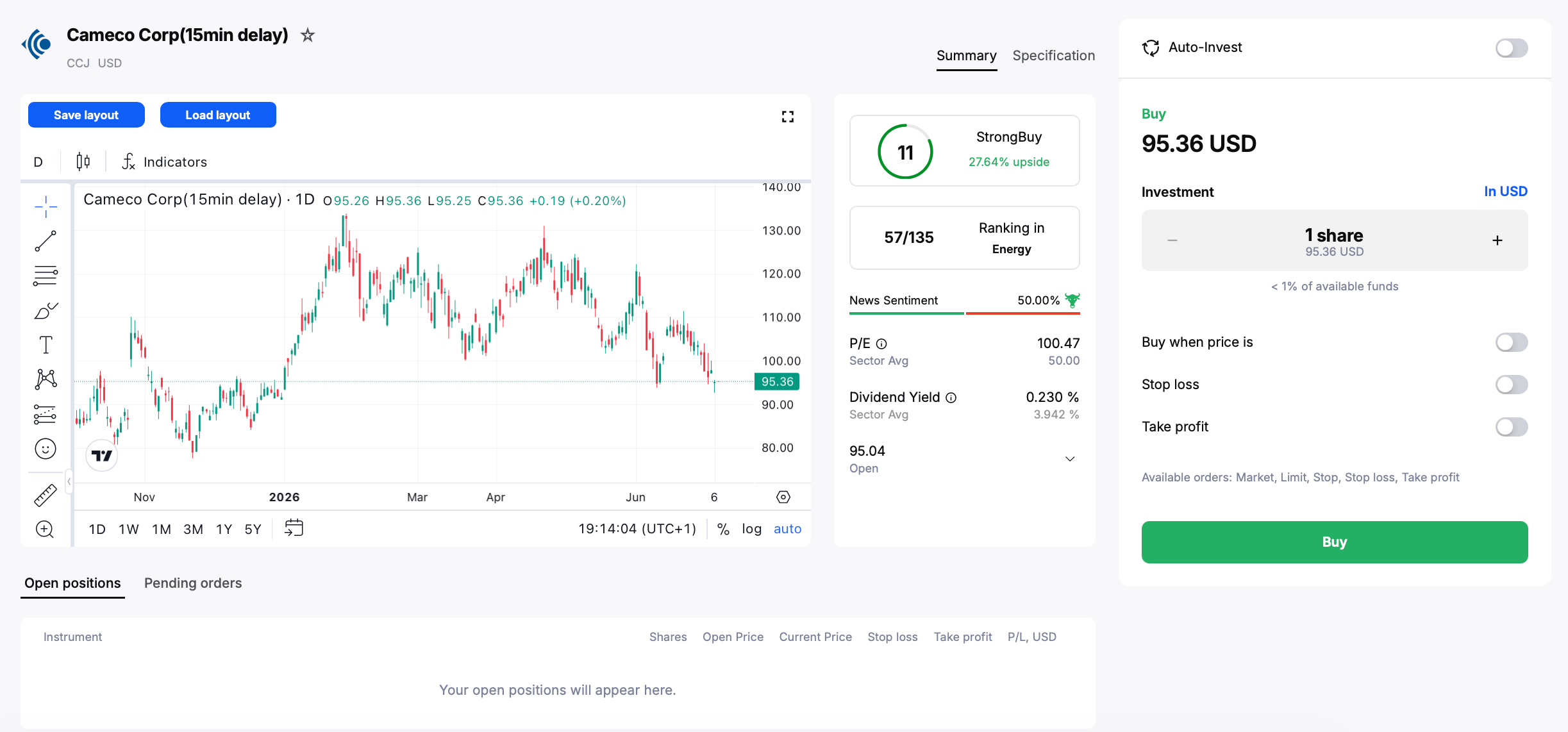
In order to get started, investors will need to open an account with a broker which offers access to the uranium stocks they’re interested in.
- Choose a broker
- Open an account and complete the onboarding process
- Log in to the investment platform
- Search for a stock and open the instrument page
- Select an order type: a market order to buy at the next available price or a limit order to buy at a predetermined price or better
- Send your order to market
Other Articles You Might Be Interested In:
Frequently Asked Questions
How can I invest in uranium?
The two main options available are to buy shares in companies which operate in the uranium industry or to invest in uranium ETFs.
What are uranium stocks?
Uranium stocks are shares in companies which operate in the mining, exploration, processing, refining and/or enriching of uranium.
What companies mine uranium?
The world’s five largest uranium miners in terms of production are Kazatomprom, Cameco, Orano, Uranium One and CGN. Cameco is the only one of these uranium mining companies which is not state-owned.
Are there any uranium ETFs?
Yes, there are a number of uranium ETFs available to investors. An example is the Global X Uranium UCITS ETF which tracks an index composed of companies engaged in uranium mining and the production of nuclear components.
Do uranium stocks pay dividends?
They can do, but it depends on the company in question. Cameco, Kazatomprom and BHP are all examples of uranium stocks which pay dividends.
The given data provides additional information regarding all analysis, estimates, prognosis, forecasts, market reviews, weekly outlooks or other similar assessments or information (hereinafter “Analysis”) published on the websites of Admirals investment firms operating under the Admirals trademark (hereinafter “Admirals”) Before making any investment decisions please pay close attention to the following:
- This is a marketing communication. The content is published for informative purposes only and is in no way to be construed as investment advice or recommendation. It has not been prepared in accordance with legal requirements designed to promote the independence of investment research, and that it is not subject to any prohibition on dealing ahead of the dissemination of investment research.
- Any investment decision is made by each client alone whereas Admirals shall not be responsible for any loss or damage arising from any such decision, whether or not based on the content.
- With view to protecting the interests of our clients and the objectivity of the Analysis, Admirals has established relevant internal procedures for prevention and management of conflicts of interest.
- The Analysis is prepared by an analyst (hereinafter “Author”). The Author Roberto Rivero is a contractor for Admirals. This content is a marketing communication and does not constitute independent financial research.
- Whilst every reasonable effort is taken to ensure that all sources of the content are reliable and that all information is presented, as much as possible, in an understandable, timely, precise and complete manner, Admirals does not guarantee the accuracy or completeness of any information contained within the Analysis.
- Any kind of past or modelled performance of financial instruments indicated within the content should not be construed as an express or implied promise, guarantee or implication by Admirals for any future performance. The value of the financial instrument may both increase and decrease and the preservation of the asset value is not guaranteed.
- Leveraged products (including contracts for difference) are speculative in nature and may result in losses or profit. Before you start trading, please ensure that you fully understand the risks involved.