The Top Performing Stocks Since the 2000s

Did you know that only 2.4%¹ of companies out of more than 64,000 global stocks accounted for the entire net stock market wealth creation between 1990 and 2020?
It is a striking reminder of just how concentrated wealth creation in the stock market truly is.
So how much in returns did these winning stocks actually deliver? And which companies would make the list in 2026? To explore this, we analysed widely traded companies across major global indices such as the S&P 500, FTSE 100, ASX 200, and DJIA to identify some of the top-performing stocks with highest returns since 2000.
Of course, these outcomes are only visible in hindsight. Markets are inherently uncertain, and while a few companies go on to create extraordinary wealth, many others never quite get there.
Also, past performance, no matter how impressive, can never guarantee what happens in the future. While this is not a definitive list of top performing stocks of all time, it does highlight several long-term winners that stand out in history.
With that context in mind, let's look at the list of top-performing stocks by absolute return. Along the way, we will also explore what makes top-performing stocks stand out.
The information in this article is provided for educational purposes only and does not constitute financial advice. Consult a financial advisor before making investment decisions.
.png)
Table of Contents
Top Performing Stocks as of 2026
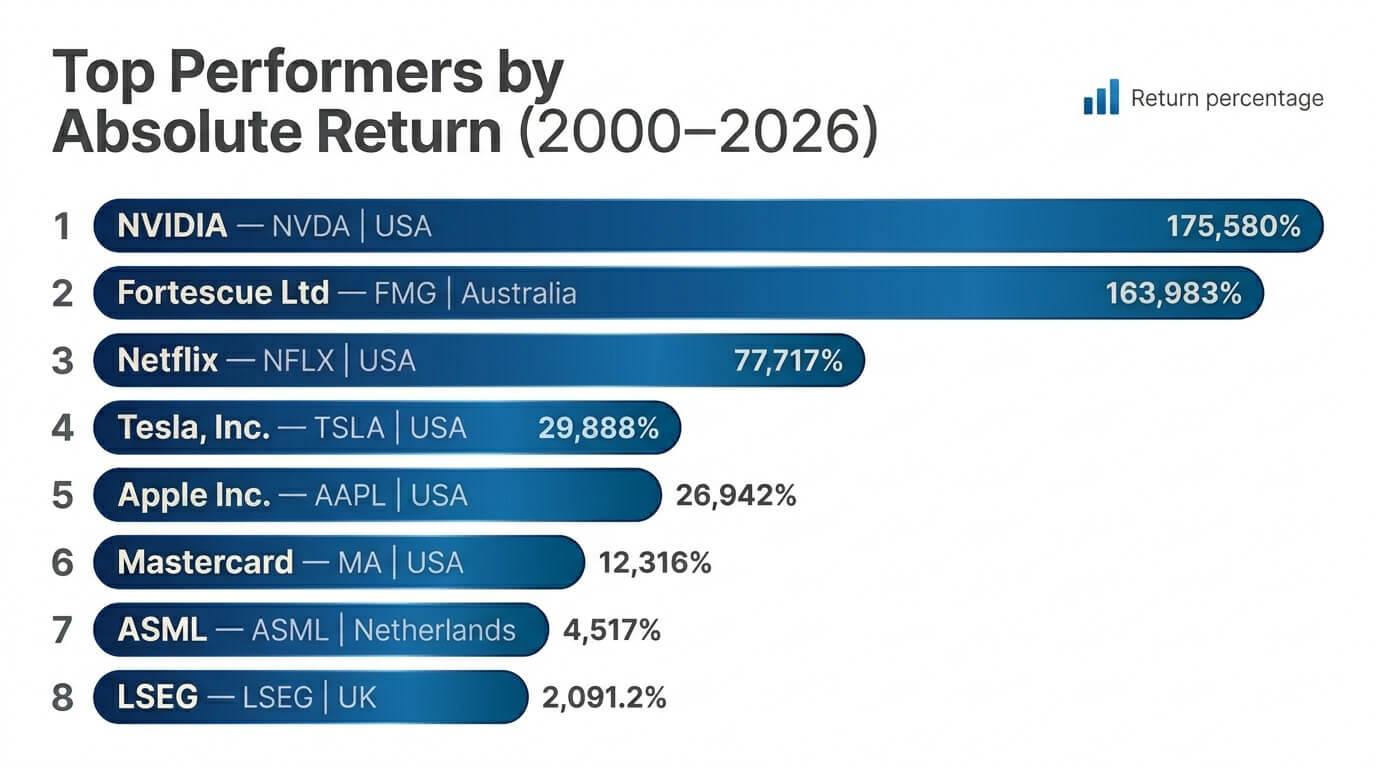
Here’s a snapshot of some of the top-performing stocks by return since 2000.
NVIDIA – A Market Leader in AI
(NVDA: NASDAQ) | US-100, S&P 500 | United States
When people talk about top-performing stocks in the market, Nvidia almost always comes up and for good reason. Rather than relying on a single breakthrough product, the company has managed to stay relevant as technology itself kept changing.
It originally built its name in gaming graphics. Over time, Nvidia has diversified to data centres, artificial intelligence, and high-performance computing. This expansion turned out to be a big move, especially after the demand for artificial intelligence started growing. Today, Nvidia's GPUs are used to train and run machine learning models.
If one were to look back to January 2000, an initial investment of merely $1 would have risen to around $1,756 after considering splits. This makes Nvidia one of the top performing growth stocks of the modern era and one of the top performing stocks in the last 25 years.
Nvidia is currently expanding in AI and data centers to cater to growing demand. At the same time, it is doing so in an increasingly competitive market.
Fortescue Ltd – A Mining Standout
(FMG: ASX) | ASX 200 | Australia
While Fortescue may not be as famous as some other names on the list, it’s a great example of a top-performing stock in the mining sector. The company is listed on ASX and is one of the leading producers of iron ore. Its growth has been driven by strong demand from countries like China.
In recent years, Fortescue has also started positioning itself around green energy. For investors who got in early, the returns have been remarkable. Roughly every AUD 1 invested around the year 2000 would now be worth over AUD 1,600.
.png)
Looking ahead to 2026, Fortescue’s performance is likely to depend on iron ore demand and broader commodity prices, while weaker demand from China or slower progress in its energy transition could act as potential headwinds.
Netflix – A Top-Performing Growth Stock
(NFLX: NASDAQ) | US-100, S&P 500 | United States
Netflix is a great example of how timing and strategic shifts can define a company’s success and why some stocks become top-performing over time. What began as a DVD rental business eventually transformed into one of the world’s leading streaming platforms.
In 2007, the company began shifting from DVD rentals to streaming. As its streaming model gained traction, Netflix expanded globally and started investing heavily in original content. This move reduced its dependence on third-party studios and helped it build a more defensible position in the market.
From an investment perspective, since its inception in 2002, every $1 invested would have grown to around $777 after adjusting for stock splits, making it one of the top-performing stocks in 25 years.
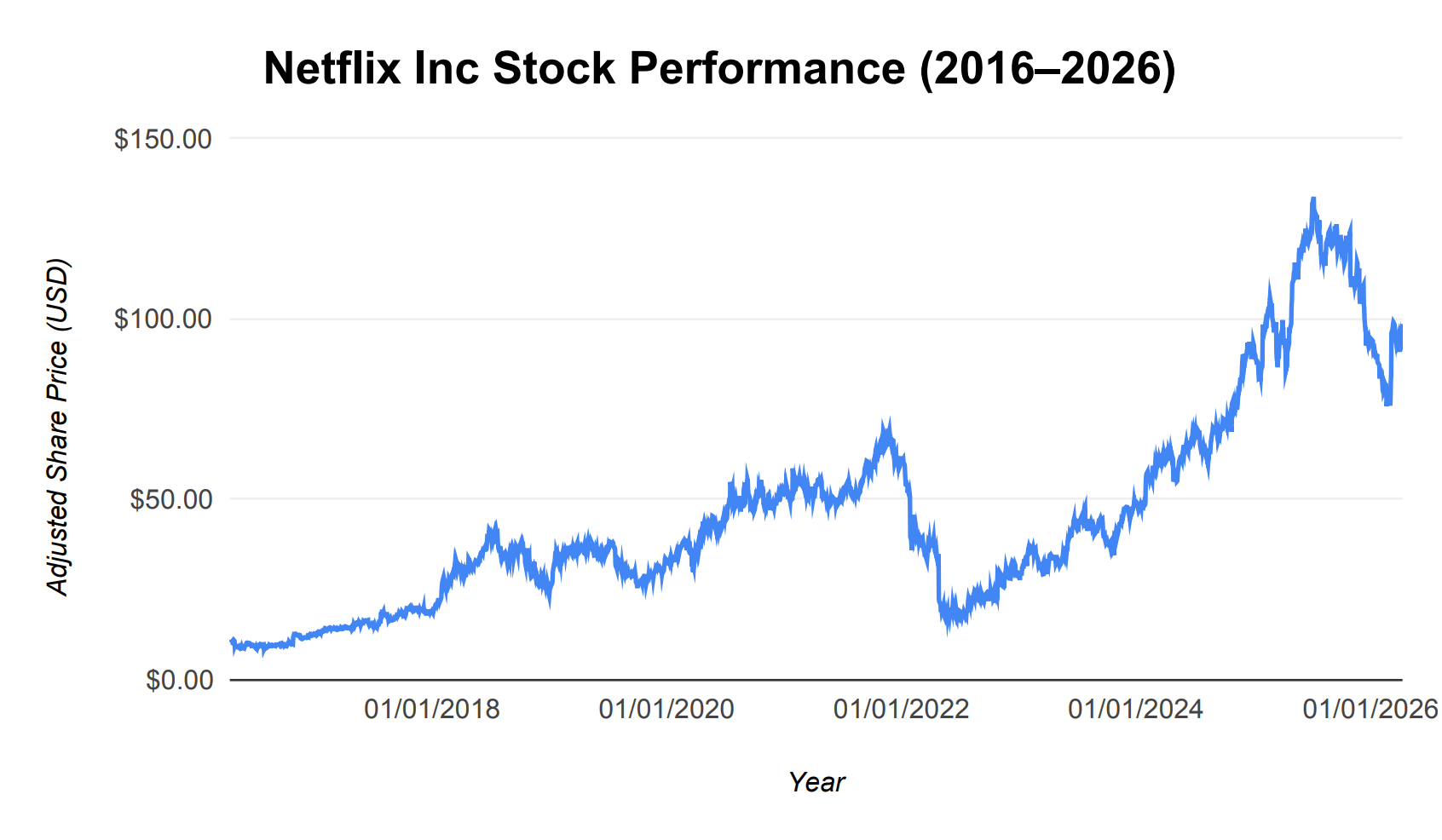
In 2026, Netflix is increasingly focusing on advertising-led monetisation alongside heavy investment in content and expanding into new formats such as live programming. However, competition and rising content and licensing costs could dampen profitability.
Recommended read: Should I Buy Netflix Shares or Not?
Tesla – One of the Top-Performing Stocks of the Last 15 Years
(TSLA: NASDAQ) | US-100, S&P 500 | United States
Tesla is one of those companies that almost doesn’t need an introduction. It is often considered one of the top-performing stocks in the last 15 years, not only because of its role in popularising EVs but also because of its ability to scale in the industry.
Its focus on software, vertical integration, and continuous product improvements helped it stand apart in a traditionally capital-intensive sector.
Since 2010, the company has delivered substantial returns, with every $1 now worth close to $299. Since 2020, the stock has grown rapidly, making it frequently mentioned among the top-performing large-cap US stocks in the last 5 years.
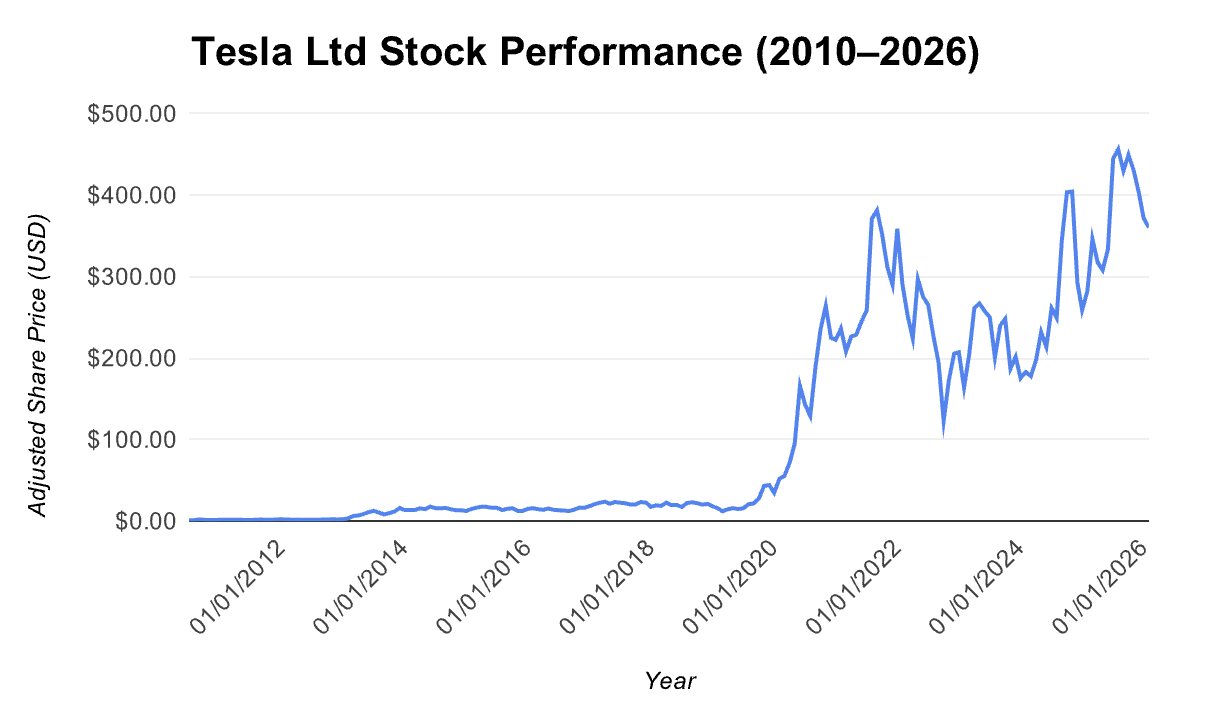
In 2026, Tesla is facing slower delivery growth and increasing competition in its core EV business. However, the company is shifting more of its focus towards areas such as autonomous driving and robotics.
Recommended read: Should I Invest in Tesla Shares?
Apple – A Top-Performing Tech Stock
(AAPL: NASDAQ) | DJIA, US-100, S&P 500 | United States
The giant computer company, Apple, saw its first wave of growth from the 1980s to the 1990s. But by 1996, the company had hit a rough patch, and its shares were worth a mere 91 cents after being adjusted for stock splits.
Things started to change as Apple strategically revived its business by launching a series of products such as the MacBook, iPhone, and iPad, combined with a robust software ecosystem through iOS. This helped the company reestablish itself as one of the top-performing tech stocks in history.
For long-term investors, someone who invested $1 in Apple in 2000 would have $270 today, making it one of the top performing tech stocks in history.
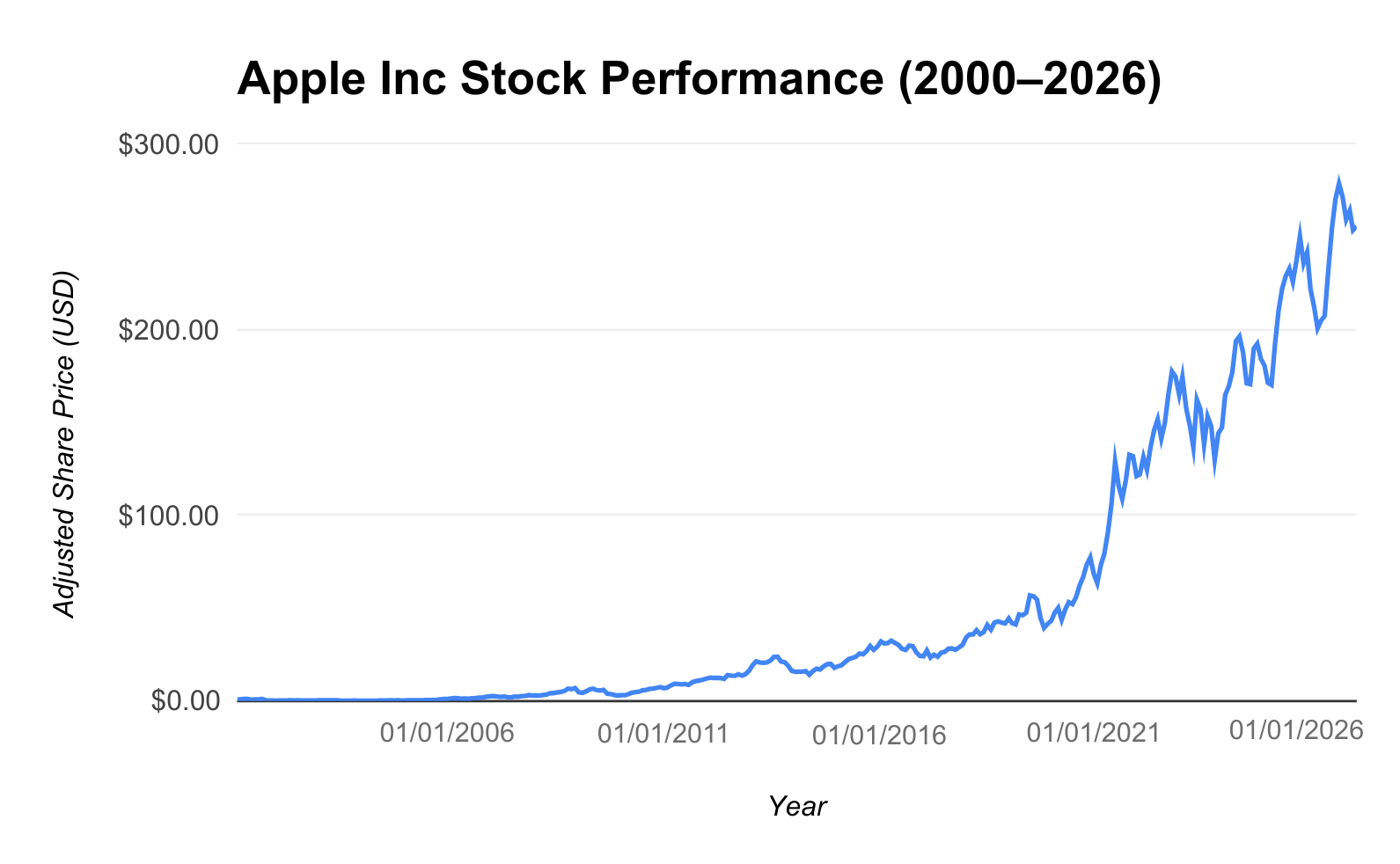
In 2026, Apple continues to build on its ecosystem while expanding its manufacturing footprint. However, softer consumer spending and regulatory pressures could create some challenges along the way.
Recommended read: Should I Invest in Apple?
Mastercard – A Top-Performing Stock Over the Last 20 Years
(MA: NYSE) | S&P 500 | United States
Mastercard’s growth story is tied to one of the most powerful shifts in the world when people moved from cash to digital payments.
What sets the business apart is its model. Mastercard doesn’t issue cards or lend money directly to consumers. Instead, it operates a network that connects banks, merchants, and cardholders. This approach helped the company scale without taking on the same credit risks as traditional lenders. Basically, the company benefits from increasing transaction volumes, a factor that contributed to the stock delivering stellar performance over the last 20 years.
For long-term investors, every $1 invested in the company in 2006 has grown to more than $120 over time.
.png)
Mastercard’s growth in 2026 may be supported by consumer spending and cross-border payments, alongside an expanding services business. Although the business could face some pressure if global spending weakens.
Recommended read: Should I Buy Visa or Mastercard Stock?
ASML Holding N.V. – A Top-Performing Semiconductor Stock
(ASML: Euronext Amsterdam) | AEX, Euro Stoxx 50 | Netherlands
The next stock on our list of top-performing stocks is ASML. The company plays a critical role in the global chip industry and manufactures advanced lithography machines that are essential for producing semiconductors.
It is one of the top-performing stocks listed on Euronext Amsterdam and has very few competitors. Its machines are indispensable for making the most advanced chips used in electronics that we use today.
As demand for chips has grown, especially with the rise of AI and cloud computing, their importance has only increased. If someone had invested €1 in 2001, it would have grown to €45 today.
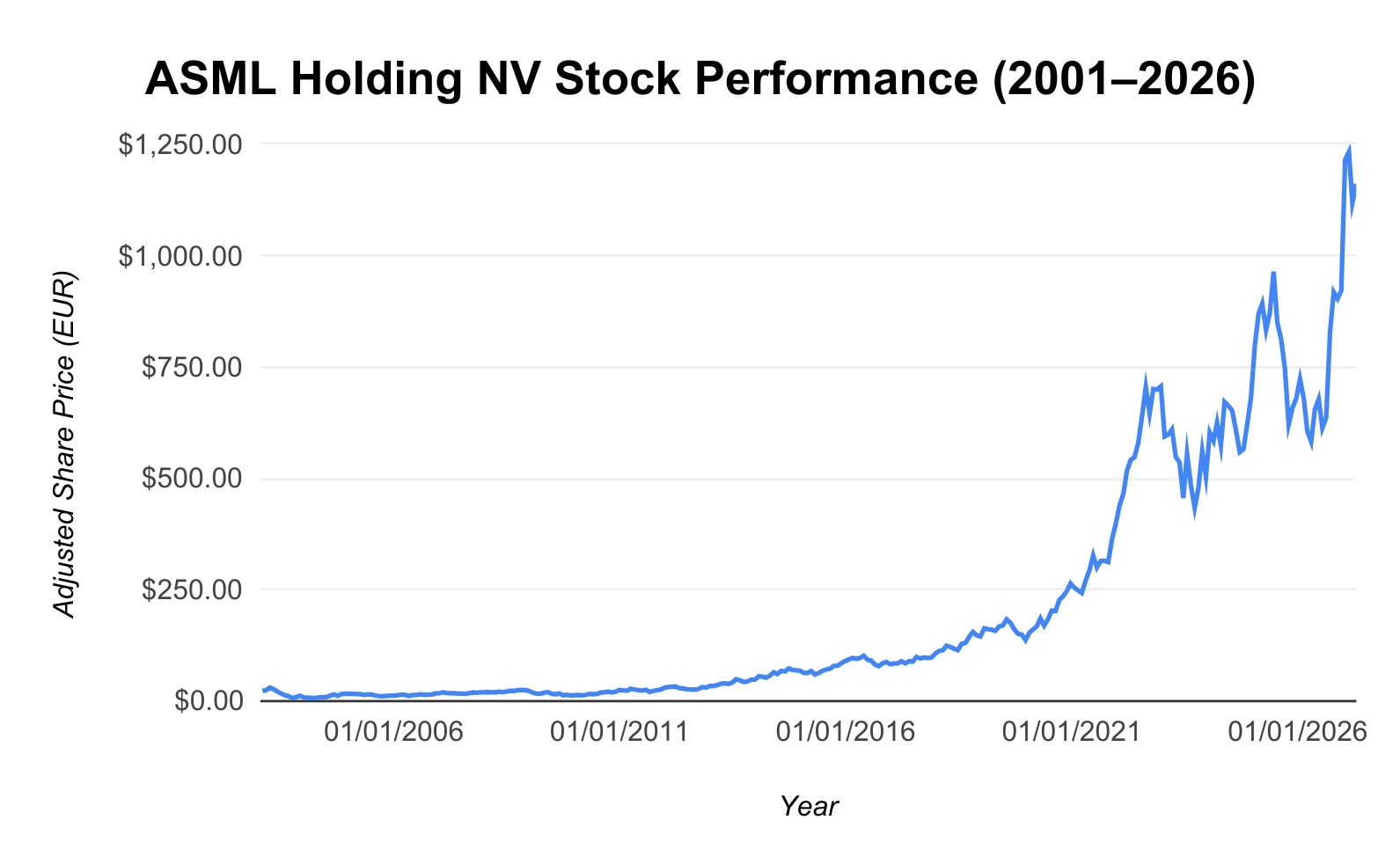
In 2026, ASML is focusing on engineering and innovation, but its performance may still depend heavily on semiconductor demand and capital spending. Industry cycles and geopolitical tensions could also affect sentiment.
London Stock Exchange Group Plc – One of the Top Performing FTSE 100 Stocks
(LSE: LSE) | FTSE 100 | United Kingdom
The last stock in this non-exhaustive list is LSE, one of the more notable names among top performing UK stocks.
What made LSE a classic example of a top-performing stock is its diversified business model and strategic acquisitions. The company’s revenue comes not just from trading volumes, but also from data and analytics, FTSE Russell indices, risk intelligence, and post-trade services.
The merger with Borsa Italiana in 2007 and the acquisition of Refinitiv in 2021 expanded LSE’s capabilities and global reach.
These initiatives, combined with its leadership in core markets, are a big part of why it remains one of the top performing UK stocks in the FTSE 100.
.png)
Looking ahead, LSE is focused on expanding its data and analytics business and rolling out AI-driven tools through its Microsoft partnership. However, its performance will continue to depend on overall market activity and the performance of its diversified operations.
How to Invest in the Top Performing Stocks?
For those who see top-performing stocks as potential good shares to buy and as good companies to invest in, there are generally two main approaches.
- Buying shares of individual companies
- Investing in an Exchange-Traded Fund (ETF) that tracks the index or sectors.
In either case, the process is broadly similar but it’s important to note that investing involves risk. Be sure to do your own research and fully understand these risks before getting started.
To invest, investors would typically need to:
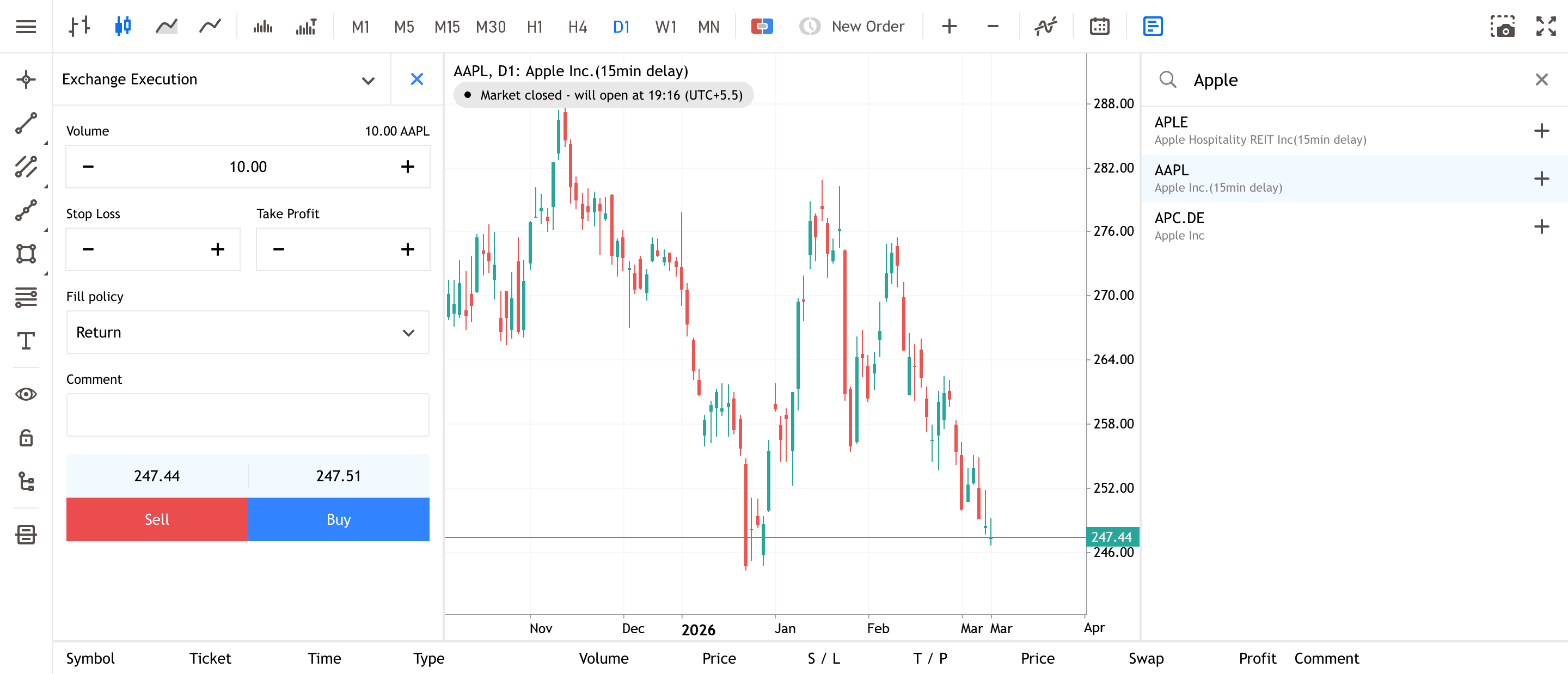
- Register for an investing account with a broker and complete the onboarding process. With Admirals, investors can invest through Invest.MT5 account.
- Log in and open the investing platform
- Search using the ticker (for example: AAPL, GOOG, NVDA, etc.)
- Open the instrument page, create a new order, and choose whether to proceed based on your own investment decision.
To find the top-performing stocks today, you can use tools such as Admirals’ Macroscope, which allows you to filter stocks based on factors like sector, analyst consensus, exchange, and market capitalisation.
Other articles you may find interesting:
Source:
Frequently Asked Questions on Top Performing Stocks
What if I invested $1000 in Coca-Cola 30 years ago?
The answer depends on a range of factors, including how returns are measured and whether dividends are reinvested.
Based on historical share price data, the split-adjusted absolute return over this period is estimated at around 265% (from April 1996 to April 2026), excluding dividends.
That suggests a $1,000 investment might have grown to roughly $3,650 over 30 years. It’s also worth noting that this figure does not include dividends, which have historically been a meaningful part of Coca-Cola’s overall returns. As always, past performance may not continue in the future.
Which stock will make me a millionaire in 10 years?
Well, there’s no particular stock that can make you a millionaire in 10 years. Such outcomes usually depend on a variety of factors.
So, instead of looking for a winning stock, it’s possible to look at how to identify top-performing stocks. However, this perspective is largely based on hindsight and outcomes may vary depending on market conditions.
What are the top performing stocks in the S&P 500?
The top performing stocks in the S&P 500 over 20 to 25 years have been Nvidia, Apple, Tesla, and Mastercard.
About Admirals
Admirals is a multi-award-winning, regulated Forex and CFD broker, offering trading on over 8,000 financial instruments via the world's most popular trading platforms: MetaTrader 4 and MetaTrader 5.
The given data provides additional information regarding all analysis, estimates, prognosis, forecasts, market reviews, weekly outlooks or other similar assessments or information (hereinafter “Analysis”) published on the websites of Admirals investment firms operating under the Admirals trademark (hereinafter “Admirals”) Before making any investment decisions please pay close attention to the following:
- This is a marketing communication. The content is published for informative purposes only and is in no way to be construed as investment advice or recommendation. It has not been prepared in accordance with legal requirements designed to promote the independence of investment research, and that it is not subject to any prohibition on dealing ahead of the dissemination of investment research.
- Any investment decision is made by each client alone whereas Admirals shall not be responsible for any loss or damage arising from any such decision, whether or not based on the content.
- With view to protecting the interests of our clients and the objectivity of the Analysis, Admirals has established relevant internal procedures for prevention and management of conflicts of interest.
- The Analysis is prepared by an analyst (hereinafter “Author”). The Author Amrita Kundu is a contractor for Admirals. This content is a marketing communication and does not constitute independent financial research.
- Whilst every reasonable effort is taken to ensure that all sources of the content are reliable and that all information is presented, as much as possible, in an understandable, timely, precise and complete manner, Admirals does not guarantee the accuracy or completeness of any information contained within the Analysis.
- Any kind of past or modelled performance of financial instruments indicated within the content should not be construed as an express or implied promise, guarantee or implication by Admirals for any future performance. The value of the financial instrument may both increase and decrease and the preservation of the asset value is not guaranteed.
- Leveraged products (including contracts for difference) are speculative in nature and may result in losses or profit. Before you start trading, please ensure that you fully understand the risks involved.