Top UK Blue Chip Stocks Explained

UK blue chip stocks are shares in large, well-established companies, which have a long history of stability and consistent performance. In the UK specifically, blue chip companies are generally associated with the FTSE 100, those businesses at the larger end of the index which have maintained their position there for years.
Whilst these types of stocks can appeal to investors for their relative stability and income potential, like any equity, they also carry risks. In this article, we examine what distinguishes blue chips from other companies, weigh the benefits and risks, and highlight 8 top UK blue chip stocks from the FTSE 100.
The information in this article is provided for educational purposes only and does not constitute financial advice. Consult a financial advisor before making investment decisions.
Table of Contents
What Are Blue Chip Stocks?
Blue chip stocks are companies which are large, well-established, financially sound and which have a strong reputation.
Key Characteristics of a Blue Chip Stock
- Large market capitalisation
- Industry-leading position in its sector
- Strong, widely recognised brand
- History of consistent earnings
- Regular dividend payments
- Long history in a major stock market index
In the UK, blue chip stocks can be found in the FTSE 100 index, which is composed of the 100 largest companies listed on the London Stock Exchange. However, it should be noted that not every member of the index is necessarily a blue chip stock.
Benefits and Risks of Investing in Blue Chip Stocks
Due to their characteristics, blue chip stocks are a common consideration for investors building a long-term portfolio. However, whilst they are associated with a number of potential benefits, like any investment, they also carry risks.
Potential Benefits
- Relative Stability: They tend to be less volatile than other stocks, particularly during periods of market turbulence.
- Income Potential: Many UK blue chips have long track records of paying regular dividends.
- Competitive Moats: Blue chip companies often have competitive advantages which help protect their business from rivals.
- Financially Sound: They often have strong balance sheets, placing them in a better position to survive downturns or recessions.
Potential Risks
- Not Risk-Free: One of the often-cited benefits of blue chip stocks is that they are less risky than other stocks. However, risk still exists; blue chip companies can, and do, experience declines during difficult periods.
- Slower Growth Potential: Due to their historic success and subsequently large market cap, they have less room to grow than smaller businesses.
- Valuation Risk: The popularity of blue chips means they may trade at premium valuations.
- Dividend Risk: No matter how long a company's track record is, future dividends are never guaranteed. During periods of financial pressure, blue chips may cut or suspend payouts.
8 Top Blue Chip Stocks in the UK
In the following sections, we will examine 8 UK blue chip companies from the FTSE 100, representing a range of different sectors.
AstraZeneca
AstraZeneca is currently the largest company on the London Stock Exchange by market capitalisation.
It’s a pharmaceutical and biotechnology company with a portfolio focused on oncology, biopharmaceuticals, rare diseases and vaccine and immune therapies. It’s probably best known for developing a Covid-19 vaccine with Oxford University which was used around the world during the pandemic.
AstraZeneca has consistently paid a dividend for more than 20 years. Whilst its dividend remained flat for much of that time, it has raised its payout twice in the last couple of years.
HSBC
HSBC is one of the ‘Big Four’ UK banks and is the largest bank in Europe in terms of both market cap and total assets.
Although the bank is listed in London, it generates the majority of its revenue from Asia. Indeed, in the last few years, the bank has purposely focused on fast growing markets in this region.
HSBC has a long history of distributing dividends, having consistently made payouts for more than 20 years. However, it has reduced its dividend on a number of occasions, most recently in response to the pandemic in 2020. Since then, it has increased its annual payout each year.
Shell
Shell is one of the largest energy companies in the world in terms of both market cap and revenue.
The oil and gas giant’s operations span the full energy supply chain, from upstream exploration to downstream distribution. After expanding into renewables and low-carbon technology, Shell recently pivoted its strategy back to focusing on oil and gas to maximise value for shareholders.
Whilst Shell still generates sizeable revenue from its Renewables & Energy Solutions segment, the majority of both revenue and earnings is derived from fossil fuels.
Shell has a long history of consistently distributing dividends to shareholders. However, in the face of the pandemic, it cut its payout for the first time since World War II. This illustrates clearly that even the longest history of dividend payments is no guarantee against adverse market conditions.
Unilever
The next on our list is consumer goods giant and FTSE 100 constituent Unilever.
If you haven’t heard of the company itself, you will have almost certainly heard of some of their brands, which include Dove, Hellmann’s and Vaseline.
Last year, Unilever spun off its ice cream division, creating a new company named The Magnum Ice Cream Company which has its primary listing on the Euronext Amsterdam. It also recently announced that it was selling its food division, of which Hellmann’s is part, to McCormick & Company.
For more than 25 years, Unilever has either maintained or increased its annual dividend to shareholders.
Diageo
Formed by the merger of Guinness and Grand Metropolitan in 1997, Diageo is a major company in the alcoholic beverage industry. Like Unilever, it’s possible you haven’t heard of the company itself, but you’re likely to be familiar with some of its products.
Besides Guinness, it owns and operates a vast range of other globally renowned brands including Smirnoff, Johnnie Walker, Gordon’s and Baileys. It also owns a 34% stake in the Moët Hennessy drinks division of the French luxury company LVMH.
However, the company currently faces a number of headwinds. Cost of living pressures have weighed on sales, whilst consumer habits are shifting amidst the rise of weight loss drugs and as younger generations drink less. Consequently, whilst Diageo has consistently paid a dividend since its formation, it slashed its interim payout earlier this year.
Legal & General
Founded in 1836, Legal & General is a financial services company, with products including insurance, pensions and investment management. Its asset management business is one of the largest in Europe in terms of assets under management.
L&G has also become a global leader in the Pension Risk Transfer (PRT) market, which is when a company transfers its pension plan’s liabilities to an insurance company.
The company’s share price performance has been weak for some time. At the time of writing, L&G shares trade at roughly the same level they did back in 2014.
However, despite the lack of share price appreciation, the stock currently has a trailing dividend yield of more than 8%, which is currently the highest on the FTSE 100. It has also hiked or maintained its annual payout since 2010.
London Stock Exchange Group
The London Stock Exchange Group (LSEG) owns and operates the exchange upon which itself and the other seven companies here are listed. Through its subsidiary FTSE Russell, it also maintains and calculates the FTSE 100, of which it is in the top 20 largest constituents.
However, much of LSEG’s revenue now comes from another source: data. In 2021, the group acquired Refinitiv, a major provider of financial data, transforming the stock market operator into a global leader in financial data and infrastructure.
For more than ten years, LSEG has increased its annual dividend distribution, with its payout growing more than sixfold since 2014.
Tesco
Tesco is the largest supermarket chain in Britain, with a market share of around 28%, placing it well ahead of competitor Sainsbury’s, which has a share of 15%. It’s also the second largest chain in Ireland, with a market share of almost 24%.
Despite facing increased pressure from low-cost retailers Aldi and Lidl, whose combined market share has grown rapidly in recent years, Tesco has managed to maintain its position as the dominant supermarket in the UK.
After drastically slashing its dividend in 2015 and then scrapping it entirely the following year, Tesco reinstated its payout in 2018 and has increased or maintained it every year since.
How to Invest in UK Blue Chip Companies
There are a couple of different ways that investors can gain exposure to blue chip companies in the UK:
- Buying blue chip stocks directly; or
- Investing in Exchange-Traded Funds (ETFs) which track a blue chip index, such as the FTSE 100
Either way, the process of investing in UK blue chips is largely the same:
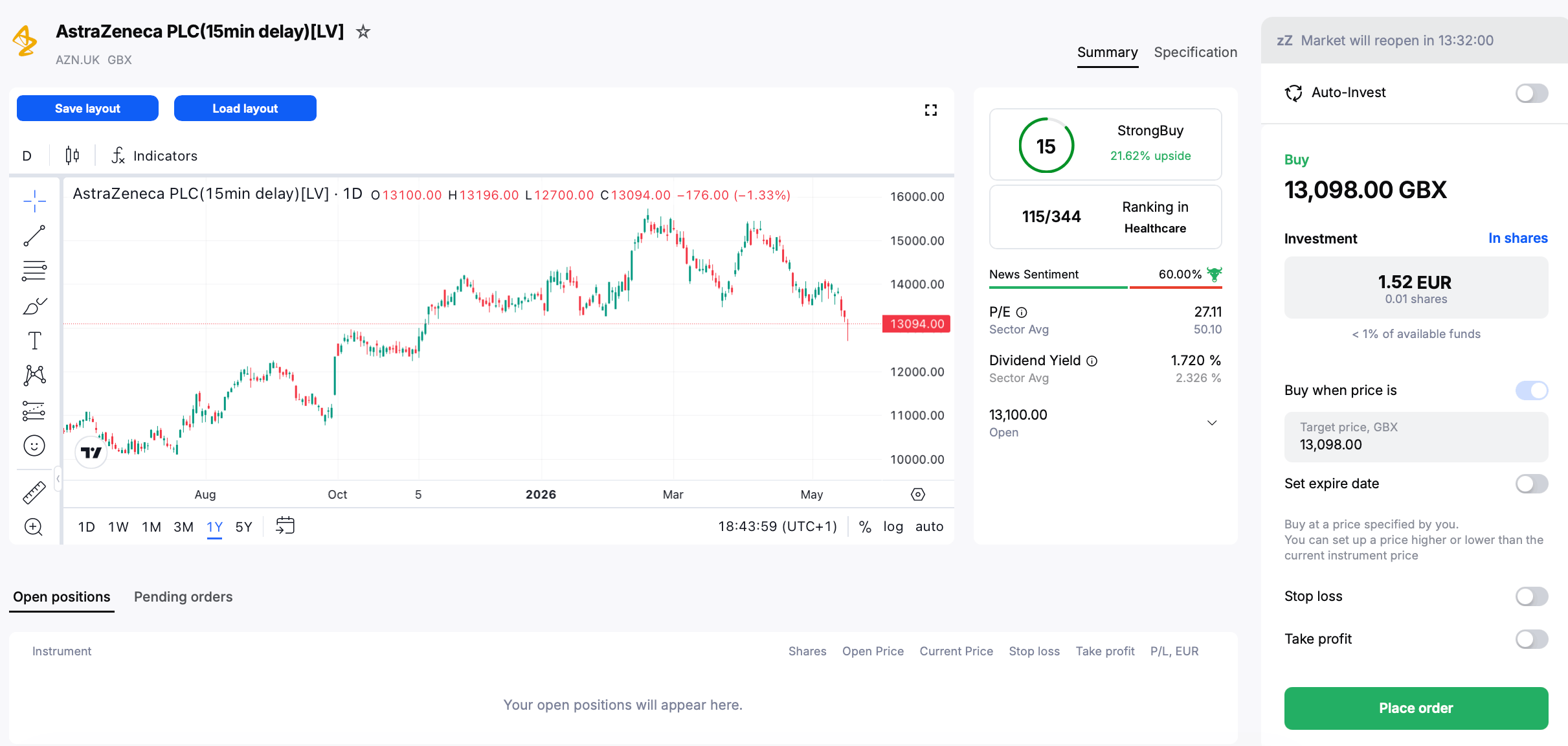
- Register for an investing account with a broker which provides access to blue chip stocks and ETFs and complete the onboarding process.
- Log in to your account and open the trading platform.
- Search for the stock or ETF you want to invest in and open the instrument page.
- Create a new order, enter the number of shares you want to buy and send your order to the market.
Other Articles You Might Be Interested In:
Frequently Asked Questions
What are UK blue chip stocks?
UK blue chip stocks are shares in large, well-established companies with long records of financial stability, consistent earnings and, in most cases, regular dividend payments.
What are examples of blue chip stocks?
Examples of blue chip stocks in the UK include AstraZeneca, HSBC, Shell, Unilever and Legal & General.
Do blue chip stocks pay dividends?
Yes, most blue chip stocks pay dividends to shareholders, and many have a history of increasing these payouts over time. However, it should be noted that future dividends are never guaranteed.
What is the difference between a blue chip stock and a growth stock?
Blue chip stocks are typically large, mature companies which are financially sound and often distribute dividends. By contrast, growth stocks are typically younger companies which are expected to grow at an above-average rate; they typically prioritise future growth, reinvesting profits back into the business rather than distributing them to shareholders.
The given data provides additional information regarding all analysis, estimates, prognosis, forecasts, market reviews, weekly outlooks or other similar assessments or information (hereinafter “Analysis”) published on the websites of Admirals investment firms operating under the Admirals trademark (hereinafter “Admirals”) Before making any investment decisions please pay close attention to the following:
- This is a marketing communication. The content is published for informative purposes only and is in no way to be construed as investment advice or recommendation. It has not been prepared in accordance with legal requirements designed to promote the independence of investment research, and that it is not subject to any prohibition on dealing ahead of the dissemination of investment research.
- Any investment decision is made by each client alone whereas Admirals shall not be responsible for any loss or damage arising from any such decision, whether or not based on the content.
- With view to protecting the interests of our clients and the objectivity of the Analysis, Admirals has established relevant internal procedures for prevention and management of conflicts of interest.
- The Analysis is prepared by an analyst (hereinafter “Author”). The Author Roberto Rivero is a contractor for Admirals. This content is a marketing communication and does not constitute independent financial research.
- Whilst every reasonable effort is taken to ensure that all sources of the content are reliable and that all information is presented, as much as possible, in an understandable, timely, precise and complete manner, Admirals does not guarantee the accuracy or completeness of any information contained within the Analysis.
- Any kind of past or modelled performance of financial instruments indicated within the content should not be construed as an express or implied promise, guarantee or implication by Admirals for any future performance. The value of the financial instrument may both increase and decrease and the preservation of the asset value is not guaranteed.
- Leveraged products (including contracts for difference) are speculative in nature and may result in losses or profit. Before you start trading, please ensure that you fully understand the risks involved.