Investing in European Defence Stocks

European defence stocks have attracted a lot of attention in the last few years as governments around the continent pledge to spend more on their militaries. In this article, we will examine 3 of the largest defence companies in Europe, look at their recent performances and highlight what to look out for in the future. We’ll also take a look at risks and considerations for those thinking about investing in the industry.
The information in this article is provided for educational purposes only and does not constitute financial advice. Consult a financial advisor before making investment decisions.
Table of Contents
Investing in European Defence Shares
After the end of the Cold War, global military spending decreased significantly, as many countries took advantage of the peace dividend.
However, owing to increased global tensions, defence spending around the world has risen significantly in recent years. In Europe, this increase has been particularly sharp.
In 2025, European NATO members spent an estimated $611.5 billion on defence, which represented an 18% increase in real terms from the previous year. And this wasn’t a one-off; indeed, between 2014 and 2025, European NATO members have more than doubled their annual military expenditure in real terms.
As a result, European defence stocks have received increased interest from investors, many of whom had previously avoided the sector. This has led to share prices rising significantly, resulting in many European defence companies trading at historically high valuations.
Top European Defence Stocks to Watch
In the following sections, we’ll examine three top defence stocks from three different European countries.
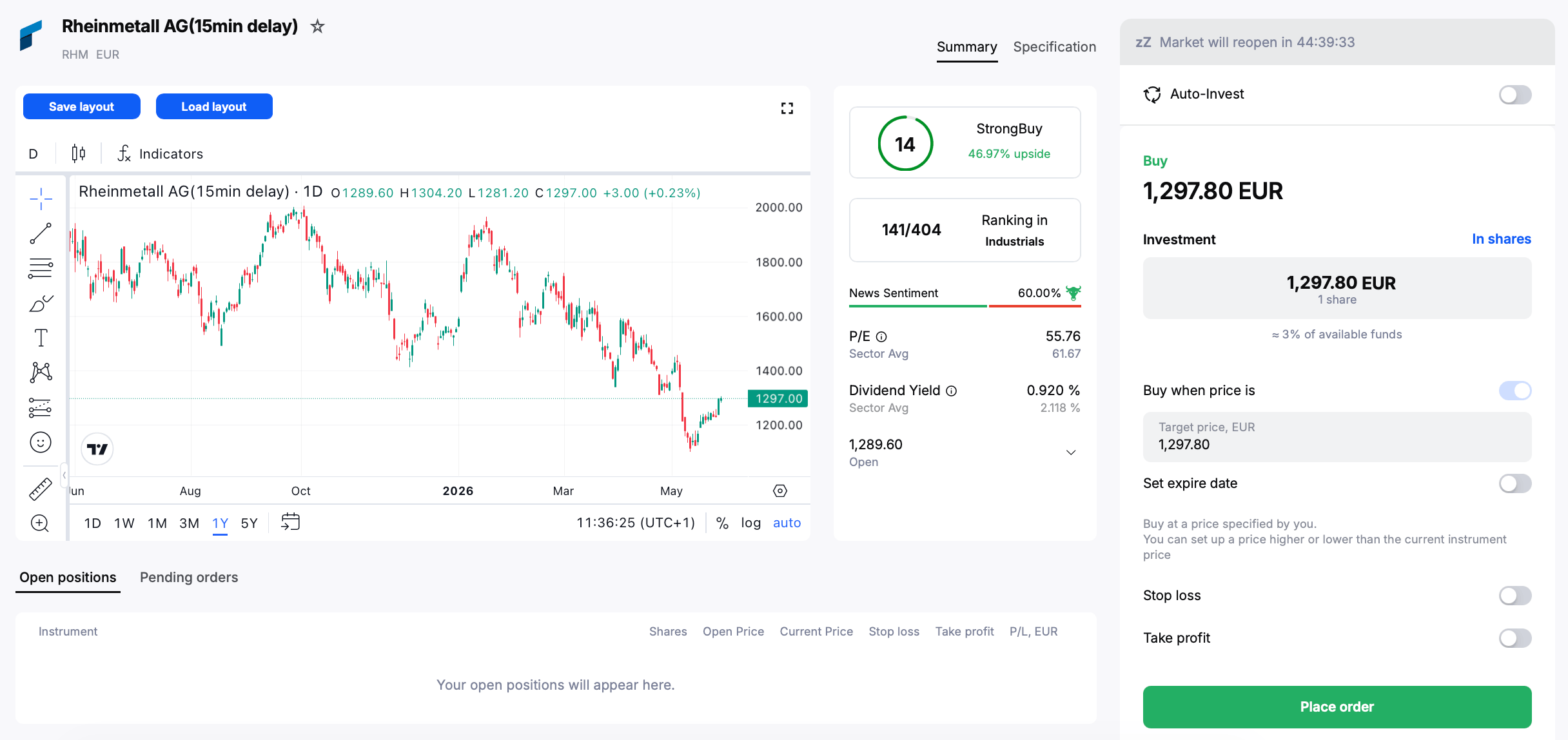
Rheinmetall
Rheinmetall was founded in 1889 and is the largest publicly traded defence company in Germany.
Having long fallen short of NATO’s 2% target, Germany has ramped up defence spending in recent years. In 2025, it was the fourth largest military spender in the world, with its defence budget rising 24% year on year to €86 billion (2.3% of GDP). By 2030, it plans to almost double its budget to €152 billion.
As Germany’s largest defence contractor, Rheinmetall potentially stands to benefit from this significant increase in military spending.
In December 2025, it announced the planned sale of its civil business division, Power Systems, allowing the company to focus exclusively on defence operations. Consequently, Rheinmetall is one of the largest pure-play defence stocks in Europe, generating revenue across five divisions:
- Air Defence: Focused on ground-based air defence systems.
- Digital Systems: Command and control systems, infantry equipment, drone technology, and simulation and training.
- Naval Systems: Shipbuilding across four shipyards in northern Germany.
- Vehicle Systems: Diverse portfolio of logistic and tactical vehicles, including a range of military trucks and the Lynx infantry fighting vehicle.
- Weapon and Ammunition: Large and medium calibre weapons and munitions, propulsion systems and protection systems.
However, this structure in its current format is relatively new. The Air Defence and Digital Systems divisions were created at the beginning of 2026 by splitting the former Electronic Solutions division. Shortly after, the Naval Systems division was formed after the acquisition of NVL which completed in March 2026.
In 2025, group sales rose 29% to €9.9 billion, with Vehicle Systems contributing roughly half of this figure (€5.0 billion) and Weapon and Ammunition contributing around a third (€3.5 billion). Its operating result in 2025 climbed 33% to €1.8 billion and, at the end of Q1 2026, its order backlog stood at €73.0 billion, 31% higher than the previous year.
Rheinmetall has a long history of paying dividends to shareholders. However, it should be noted that future dividends are never guaranteed and, whilst Rheinmetall has consistently paid dividends for many years, it has cut its payout on a number of occasions, most recently during the pandemic. At the time of writing, it has increased its annual payout for the last five years.
Thales
Thales is a French aerospace, defence and technology group, which is partially owned by the French state and operates across three segments:
- Defence: Defence solutions including air defence systems, weapon systems, drone warfare, electronic warfare and communication systems.
- Aerospace: Avionics including cockpit systems for civil and military aircraft, as well as satellites and other space infrastructure through its joint venture Thales Alenia Space.
- Cyber & Digital: Global cybersecurity, digital identity and connectivity solutions.
Of these segments, Defence is the largest in terms of revenue. Defence sales rose more than 12% to €12.2 billion in 2025, with total group sales rising 8% to €22.1 billion. Adjusted EBIT (Earnings Before Interest and Tax) rose 13% to €2.7 billion, and the group’s total order book rose 5% to €55.3 billion.
With a significant portion of revenue coming from civil business, Thales is a more diversified option than a pure-play defence stock like Rheinmetall. For those exclusively seeking exposure to the defence sector, this diversification may not be appealing.
However, it means that Thales is not totally reliant on one source of income. The company provides meaningful exposure to defence and potentially stands to benefit from rising European defence budgets. At the same time, its defence income is supplemented by other segments, which could be growth stories in their own right.
For example, in 2025, Thales signed an agreement with Airbus and Leonardo for the three companies to merge their space businesses into a single entity. The new European space company, of which Thales will own 32.5%, will be operational in 2027 and is expected to generate €6.5 billion in annual revenue.
Thales has a long history of distributing dividends. Like Rheinmetall, it cut its dividend during the pandemic but has increased its annual payout every year in the five years since.
Saab
Saab is a Swedish aerospace and defence company which provides solutions across air, land and sea. Its operations are divided into four business areas:
- Aeronautics: Most notably responsible for the Gripen fighter jet.
- Dynamics: Ground combat weapons, missile systems, training systems and camouflage systems.
- Surveillance: Sensor solutions and systems integration for airborne, ground and naval platforms.
- Kockums: Saab’s naval and submarine division.
In 2025, sales rose 24% to SEK 79.1 billion. Of its four divisions, Surveillance contributed the most revenue, accounting for 33% of sales, with Dynamics, Aeronautics and Kockums accounting for 26%, 24% and 12%, respectively.
Saab’s operating income jumped 42% to SEK 8.1 billion and, at the end of the year, its order backlog stood at SEK 274.5 billion, an increase of 47% from the start of the year. Its order book benefitted from new Gripen jet orders from Colombia and Thailand, and there have been a couple of announcements recently that may see its backlog grow more in the coming months.
In May, Ukraine announced it will acquire 20 Gripen fighter jets from Saab, having signed a letter of intent in 2025 with Sweden to purchase up to 150 of the jets. Around the same time, Canada also announced it would be purchasing a fleet of Saab’s early warning plane, GlobalEye.
Saab’s long-term dividend policy is to distribute 20-40% of its net income to shareholders over a business cycle. Since 2021, Saab has increased its annual payout each year; however, its distributions remain lower than they were pre-pandemic.
Risks and Considerations of Defence Stocks
As with any investment, there are risks and considerations which investors should be aware of before deciding whether or not to invest in European defence stocks.
- Valuations: Defence stocks have received a lot of attention from investors in the last couple of years. This has led to many, including the three above, trading at historically high prices relative to their earnings, meaning that a lot of the potential upside may already be priced in. It also means that any change in outlook could lead to significant price corrections.
- Political Risk: Defence companies' revenues rely on government spending. Whilst many governments in Europe have pledged to higher defence spending in the years ahead, governments change and so too do priorities. Future administrations may re-evaluate commitments to military spending, which could negatively impact the outlook for demand.
- Ethical Concerns: Many investors choose to avoid defence companies on ethical grounds. One result of this is that defence stocks are excluded from a number of investment funds and portfolios, which can limit the pool of potential buyers.
How to Invest in European Defence Stocks
For those interested in investing in European defence stocks, the process broadly follows five steps:
- Choose a broker, register for an account and complete the onboarding process
- Log in to the investment platform
- Search for the defence stock you’re interested in and open the instrument page
- Create a new order, enter your position size and press buy.
Other Articles You Might Be Interested In:
Frequently Asked Questions
What are the biggest defence companies in Europe?
In terms of market capitalisation, the largest defence companies in Europe include Safran, Rheinmetall, Thales, Leonardo, Saab and Kongsberg Gruppen.
How does European defence spending compare to the United States?
The US is by far the largest defence spender in the world. In 2025, US military expenditure reportedly totalled $980 billion, by contrast, the 29 European NATO members spent a combined total of $611.5 billion.
Is there an ETF for European defence?
Yes. WisdomTree listed the world's first European defence ETF in March 2025, called the WisdomTree European Defence UCITS ETF (WDEF). Since then, various others have been created, including the iShares Europe Defence UCITS ETF (DFEU).
The given data provides additional information regarding all analysis, estimates, prognosis, forecasts, market reviews, weekly outlooks or other similar assessments or information (hereinafter “Analysis”) published on the websites of Admirals investment firms operating under the Admirals trademark (hereinafter “Admirals”) Before making any investment decisions please pay close attention to the following:
- This is a marketing communication. The content is published for informative purposes only and is in no way to be construed as investment advice or recommendation. It has not been prepared in accordance with legal requirements designed to promote the independence of investment research, and that it is not subject to any prohibition on dealing ahead of the dissemination of investment research.
- Any investment decision is made by each client alone whereas Admirals shall not be responsible for any loss or damage arising from any such decision, whether or not based on the content.
- With view to protecting the interests of our clients and the objectivity of the Analysis, Admirals has established relevant internal procedures for prevention and management of conflicts of interest.
- The Analysis is prepared by an analyst (hereinafter “Author”). The Author Admirals is an employee /a contractor for Admirals. This content is a marketing communication and does not constitute independent financial research.
- Whilst every reasonable effort is taken to ensure that all sources of the content are reliable and that all information is presented, as much as possible, in an understandable, timely, precise and complete manner, Admirals does not guarantee the accuracy or completeness of any information contained within the Analysis.
- Any kind of past or modelled performance of financial instruments indicated within the content should not be construed as an express or implied promise, guarantee or implication by Admirals for any future performance. The value of the financial instrument may both increase and decrease and the preservation of the asset value is not guaranteed.
- Leveraged products (including contracts for difference) are speculative in nature and may result in losses or profit. Before you start trading, please ensure that you fully understand the risks involved.