5 Stocks Under £1 to Watch

Searching for stocks under £1 will quickly lead you into penny stock territory. However, just because a company has a share price below 100p, that doesn't necessarily make it a penny share. As a matter of fact, there are a number of UK-listed stocks trading under £1 which are household names and constituents of major indices.
In this article, we'll take a look at the distinction between a penny stock and a stock under £1 before taking a closer look at five FTSE 350 stocks which currently trade at less than 100p per share.
The information in this article is provided for educational purposes only and does not constitute financial advice. Consult a financial advisor before making investment decisions.
Table of Contents
Stocks Under £1 vs Penny Stocks
Whilst a penny stock is a stock whose share price trades under £1, that’s not its only attribute. Typically, a UK penny stock is defined by two main characteristics:
- Share price under 100p; and
- Market capitalisation of less than £100 million.
Consequently, a stock can have a share price below £1 yet not be considered a penny stock.
Whilst it’s not exactly the norm, it’s possible for stocks under £1 to be mid-cap or large-cap companies. Indeed, there are a number of such companies in both the FTSE 100 and FTSE 250 indices.
5 FTSE 350 Stocks Under £1 to Watch
The five companies featured below are all current constituents of either the FTSE 100 or FTSE 250, spanning a range of sectors from banking to media. Whilst they are all stocks under £1, the reasons for their low price and the outlook for each business differ considerably.
Lloyds Banking Group
Lloyds Banking Group is the UK's largest retail bank by current accounts and a stalwart of the FTSE 100 index. However, since the global financial crisis in 2008, the bank’s shares have mostly traded below 100p.
The bank has recorded solid earnings growth recently, resulting in share price more than doubling over the last couple of years. In full-year 2025, net income and underlying profit both rose 7% to £18.3 billion and £6.8 billion, respectively.
Higher profits led to the bank launching a new share buyback programme, under which it will repurchase up to £1.75 billion of its own shares in 2026. It also hiked its annual dividend payment for the fifth year running, with its yield currently standing at around 3.7%.
However, there are some risks to consider with this stock. First and foremost, the war in the Middle East has worsened the outlook for the UK economy. Banks are typically amongst the first to be hit when the economy suffers and, as a UK-focused lender, Lloyds may be more vulnerable to a slowing UK economy than many of its peers.
Furthermore, the Financial Conduct Authority (FCA) recently announced a total compensation figure of £9.1 billion for borrowers following its investigation into historic car loan misconduct. Lloyds have already set aside around £2 billion to deal with this, but it could end up costing more.
Taylor Wimpey
Taylor Wimpey is one of the largest housebuilders in the UK, which was previously a constituent of the FTSE 100. However, a falling share price resulted in it being relegated to the FTSE 250 in September last year and the stock has continued its downward trajectory since.
The housebuilder faces a number of issues which have weighed on sentiment:
- Costs: Higher energy and commodity prices are forcing up costs for housebuilders.
- Interest Rates: Resurgent inflation means that interest rates are likely to fall more slowly than previously anticipated. Indeed, they may go up. Higher rates mean more expensive mortgages, which is a barrier for people entering the housing market.
- Dividend Cut: As earnings continued to come under pressure, Taylor Wimpey slashed its annual payout in 2025. Even after the cut, Taylor Wimpey paid out considerably more in dividends than it earned over the year, meaning future payouts could be at further risk.
Nevertheless, the UK has a significant housing shortage, with many adults unable to access the housing they need. This may act as a long-term tailwind for UK housebuilders such as Taylor Wimpey, who could help address this shortfall.
ITV
ITV is the UK’s largest privately owned free-to-air broadcaster and is a business which finds itself in transition.
Linear television advertising, once ITV’s core revenue stream, faces continuing structural decline as viewers migrate to online streaming platforms. Consequently, the media company has refocused its attention on its production arm, ITV Studios, and on expanding its digital offering, ITVX.
In a sign of this transition, the majority of ITV’s revenue is now generated by ITV Studios and its digital Media & Entertainment (M&E) business – which accounted for a combined two-thirds of total revenue in 2025.
ITV Studios revenue rose 5% last year to £2.1 billion and the division reported relatively flat adjusted EBITDA of £297 million. However, the group’s total revenue dipped slightly, adjusted EPS fell 11% and net debt rose significantly. Nevertheless, the media company maintained its dividend at 5p per share for the fourth year running.
It’s worth noting that ITV is currently in discussions regarding the potential sale of its M&E business (linear and digital) to Sky. If such a deal were to materialise, it would essentially leave ITV Studios as a standalone business.
Supermarket Income REIT
As the name suggests, Supermarket Income REIT is a Real Estate Investment Trust (REIT) which makes money by leasing a portfolio of grocery stores.
Its portfolio consists of around 130 stores in the UK and France, which are occupied by major supermarket chains, including Tesco, Sainsbury’s, Waitrose and Carrefour.
Grocery retail is defensive by nature; supermarkets sell a range of necessities which consumers tend to continue buying regardless of changes in the wider economy. For Supermarket Income REIT(SUPR), this translates into reliable tenants who provide predictable rental income.
REITs are obliged to distribute at least 90% of their pre-tax income to shareholders as a dividend. Whilst this can hinder growth and result in high levels of debt, it can also produce relatively high dividend yields, as is the case here.
At the time of writing, SUPR has a dividend yield of around 7.5% and has hiked its annual payout every year since its Initial Public Offering (IPO) in 2017.
Nevertheless, it’s worth bearing in mind that, like most UK REITs, SUPR’s share price has been under pressure for the last few years. One of the major causes of this is the high-interest rate environment of the last few years, which has increased the cost of servicing debt.
Primary Health Properties
Another REIT, Primary Health Properties manages a portfolio of over 1,100 healthcare facilities across the UK and Ireland.
Its properties are primarily let to government tenants, with 76% of its income funded directly or indirectly by the UK and Irish governments in 2025. Such tenants mean that rent collection is reliable and the risk of rent defaults is very low.
This reliability is reflected in its dividend history. Primary Health Properties has increased its annual payout for more than 25 years and currently has a dividend yield of around 7.7%. However, it’s important to note that future dividends are never guaranteed.
Like SUPR, Primary Health Properties’ share price has been under significant pressure over the past few years, which helps explain the high dividend yield.
Moreover, in 2025, Primary Health Properties acquired Assura, another UK healthcare REIT. Whilst this acquisition more than doubled the number of properties in its portfolio, it also significantly increased the REIT’s leverage. Its Loan to Value ratio jumped to 57% at the end of 2025, up from 48% the previous year, and its average cost of debt rose to 3.7%.
What to Consider When Looking at Stocks Under £1
A share price below 100p may be a starting point for research, but it shouldn't be the conclusion.
When investing in individual stocks, it’s always important to conduct research of the company in question. However, there are several specific factors worth bearing in mind when assessing any stock in this price range:
- Price vs value: Share price and value are not always the same thing. A stock trading at 80p is not necessarily better value than one at £8. Market capitalisation, earnings and other fundamentals are more meaningful measures than share price alone.
- Why is the price where it is?: A sub-100p price may reflect a company's capital structure or long-term share price decline and genuine financial stress.
- Liquidity: The ease with which shares can be bought and sold varies considerably. FTSE 350 companies will generally have liquid markets whereas smaller companies may have thinner trading volumes and wider spreads.
- Dividends: Some stocks under £1 may carry notable dividend yields. An attractive yield can be a positive signal, but it can also simply reflect a falling share price. It’s worth checking other dividend-related metrics, such as dividend cover, rather than just looking at the yield.
How to Invest in Top Stocks Under £1
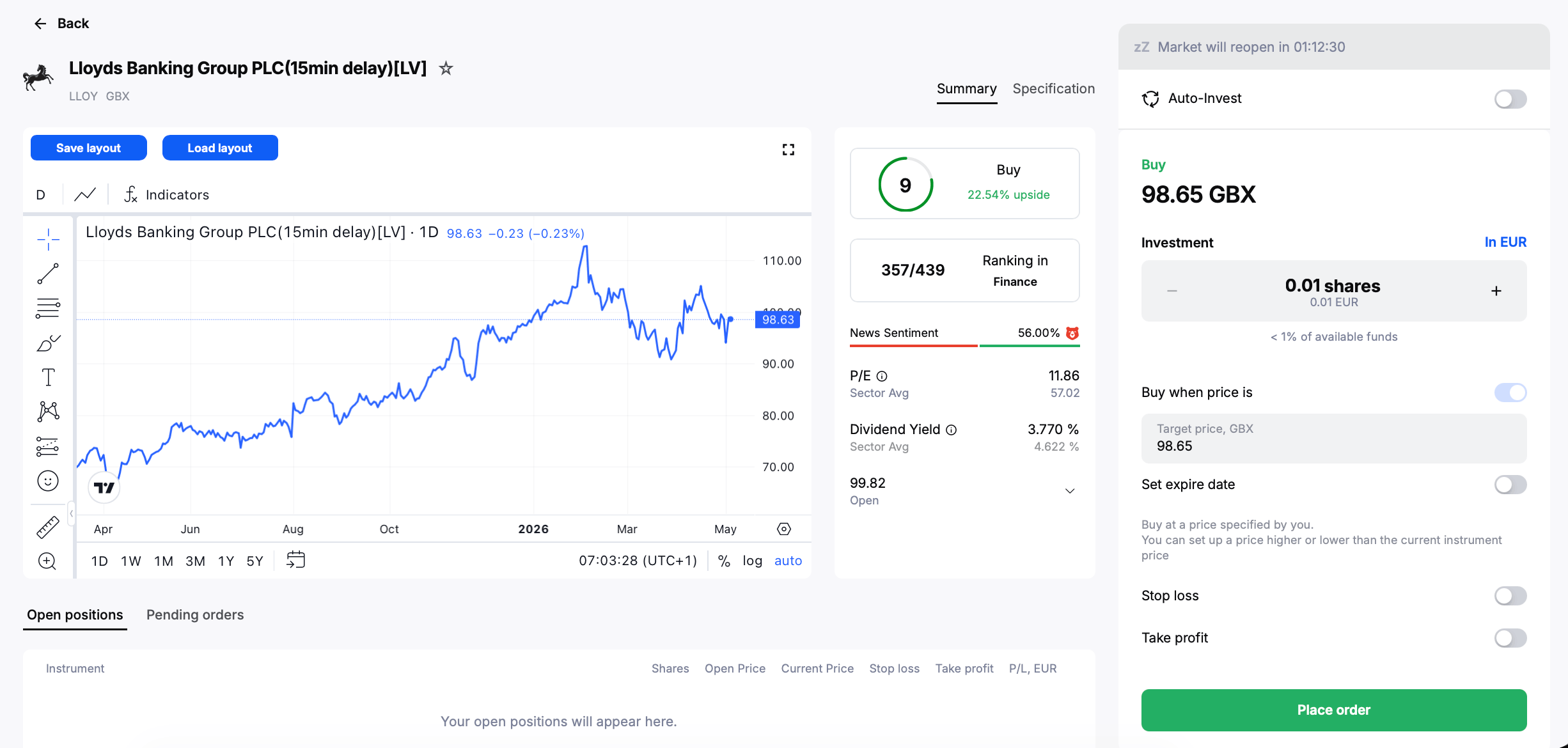
Investing in shares under £1 is no different to buying any other stock. Investors will need to firstly choose a broker which offers access to the UK markets. Once they’ve done so, the steps to get started are typically as follows:
- Register for an investing account and complete the onboarding process.
- Log in to the investing platform.
- Search for a stock and open the instrument page.
- Create a new order, enter the number of shares you want to buy and send your order to the market
- Monitor your position.
Other Articles You Might Be Interested In:
Frequently Asked Questions
What happens if a stock falls below £1?
For stocks listed on the London Stock Exchange (LSE), there is no penalty for share price falling below £1. Unlike the New York Stock Exchange and the Nasdaq, where a stock falling below $1 triggers a delisting clock, stocks listed on the LSE can, and do, trade at levels below 100p for extended periods.
How long can a stock be below £1?
Indefinitely. There are a number of stocks listed on the FTSE 100 and FTSE 250 which have traded under £1 for several years.
Are all stocks under £1 penny stocks?
No. Penny stocks are typically defined as having a share price below 100p and a market capitalisation below £100 million. A stock can trade under £1 and still be a constituent of a major index like the FTSE 100 or FTSE 250, with a market capitalisation running into billions of pounds.
What is the difference between share price and market capitalisation?
Share price is the cost of a single share, whereas market capitalisation is the total value of all shares in issue. Market cap is calculated by multiplying the share price by the total number of shares in issue. It is a far more meaningful measure of a company's overall size than share price alone.
The given data provides additional information regarding all analysis, estimates, prognosis, forecasts, market reviews, weekly outlooks or other similar assessments or information (hereinafter “Analysis”) published on the websites of Admirals investment firms operating under the Admirals trademark (hereinafter “Admirals”) Before making any investment decisions please pay close attention to the following:
- This is a marketing communication. The content is published for informative purposes only and is in no way to be construed as investment advice or recommendation. It has not been prepared in accordance with legal requirements designed to promote the independence of investment research, and that it is not subject to any prohibition on dealing ahead of the dissemination of investment research.
- Any investment decision is made by each client alone whereas Admirals shall not be responsible for any loss or damage arising from any such decision, whether or not based on the content.
- With view to protecting the interests of our clients and the objectivity of the Analysis, Admirals has established relevant internal procedures for prevention and management of conflicts of interest.
- The Analysis is prepared by an analyst (hereinafter “Author”). The Author Roberto Rivero is a contractor for Admirals. This content is a marketing communication and does not constitute independent financial research.
- Whilst every reasonable effort is taken to ensure that all sources of the content are reliable and that all information is presented, as much as possible, in an understandable, timely, precise and complete manner, Admirals does not guarantee the accuracy or completeness of any information contained within the Analysis.
- Any kind of past or modelled performance of financial instruments indicated within the content should not be construed as an express or implied promise, guarantee or implication by Admirals for any future performance. The value of the financial instrument may both increase and decrease and the preservation of the asset value is not guaranteed.
- Leveraged products (including contracts for difference) are speculative in nature and may result in losses or profit. Before you start trading, please ensure that you fully understand the risks involved.