Top FTSE 250 Dividend Stocks: 4 Companies to Watch

Whilst the FTSE 100 often draws income-focused investors, its mid-cap rival, the FTSE 250, has plenty of dividend stocks to choose from as well. In this article, we’ll examine 4 top FTSE 250 dividend stocks, all of which have an above average yieldand a track record of increasing or maintaining shareholder payments.
The information in this article is provided for educational purposes only and does not constitute financial advice. Consult a financial advisor before making investment decisions.

Table of Contents
4 FTSE 250 Dividend Stocks to Watch
In order to compile this list of FTSE 250 dividend stocks, we looked for FTSE 250 constituents:
- Which have a dividend yield above the FTSE 250 average (around 2.9% at the time of writing)
- Which have a track record of maintaining or growing dividends over time
- Where the dividend appears reasonably well covered by earnings
Whilst these stocks may have track records of paying consistent dividends, it’s important to remember the risks involved. Future payouts are never guaranteed.
Dividend yields as of 21 August 2026. Yields are subject to change on a daily basis.
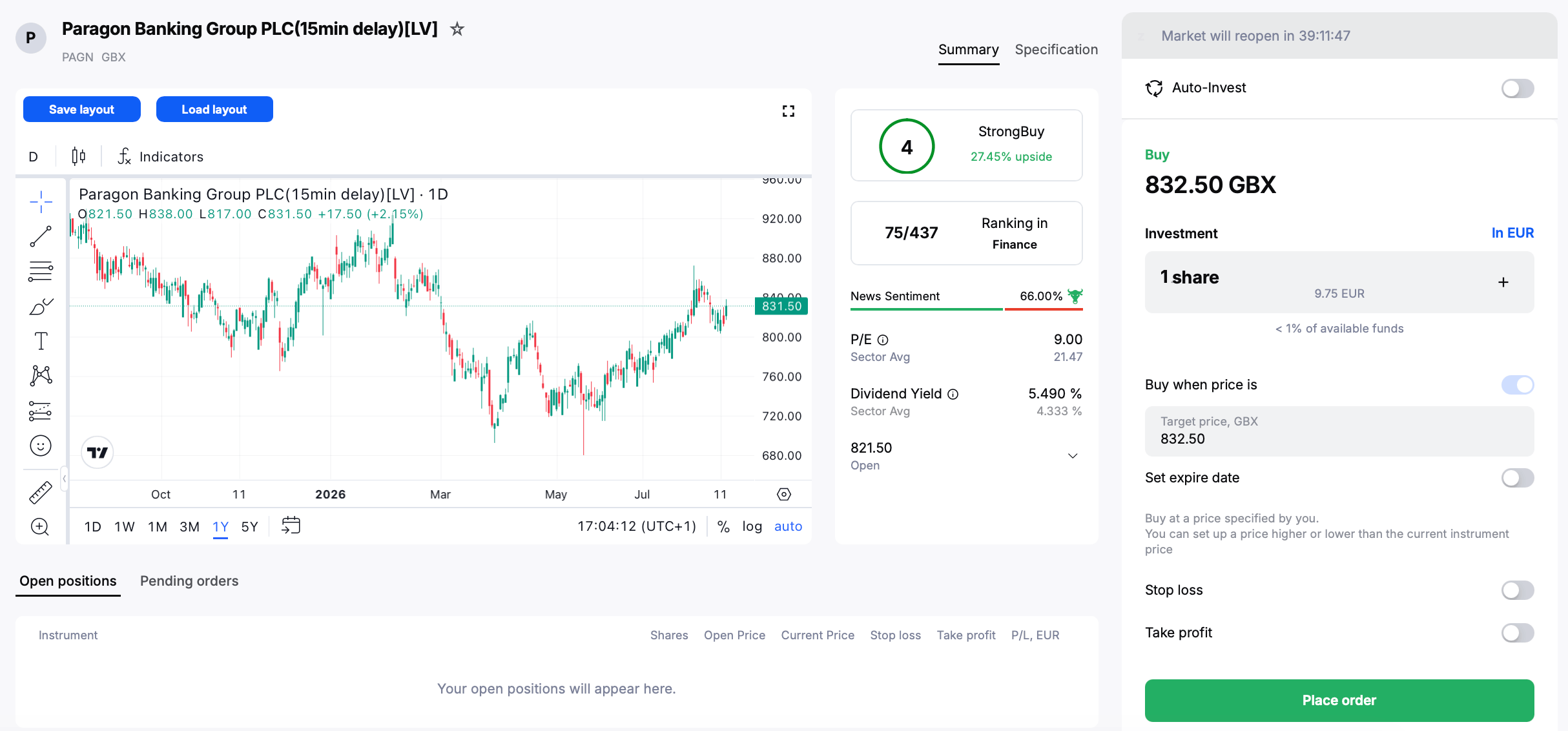
Paragon Banking Group
Paragon is a specialist UK lender offering buy-to-let mortgages for landlords and commercial loans for SMEs. Its lending activities are mostly funded from retail savings deposits, with the bank holding more than £15 billion in retail deposits as of 31 March 2026.
Paragon has increased its annual dividend every year since 2008, with the exception of 2020, when it cancelled its interim dividend due to economic uncertainty caused by the Covid-19 pandemic.
Over this time, its annual dividend has increased from 3.00p per share in 2008 to 43.90p in 2025, with this most recent payout covered more than two times by full-year earnings.
Its loan book is heavily skewed towards its mortgage lending operations. That means that the majority of its loans are secured against property, which can lower losses per default. However, it also means that Paragon is more exposed to the UK property market, specifically rental properties, than a more diversified lender.
Hikma Pharmaceuticals
Hikma Pharmaceuticals is a global pharmaceutical company which supplies more than 825 generic and branded products. It operates across three segments:
- Injectables: manufactures and supplies generic injectable medicine across North America, Europe and MENA (Middle East and North Africa).
- Branded: supplies branded generics and in-licensed products across MENA.
- Hikma Rx: supplies oral and other non-injectable generic and specialty products in the US.
Hikma has increased its annual payout to shareholders every year since its listing in 2005, in which time its total annual dividend has grown from 7.00 US cents per share in 2006 to 84.00 US cents in 2025. Its 2025 dividend was covered around 2.2 times by full-year earnings.
However, whilst its dividend history may look attractive, its share price has experienced a degree of volatility over the last year or so. Injectables, its largest segment in terms of revenue, has seen its margins compressed due to higher costs and, in February 2026, share price tanked after the pharma company cut its full-year guidance.
City of London Investment Trust
The City of London Investment Trust is an actively managed investment trust which aims to provide long-term growth in income and capital. Its dividend history is impressive, having hiked its annual payout for 59 consecutive years, the longest track record of any investment trust.
This is a different prospect to the other FTSE 250 dividend shares we’ve examined so far. Its income is generated primarily from dividends paid by the holdings in its portfolio, the majority of which are FTSE 100 companies.
Part of the reason behind the investment trust’s impressive dividend history is its revenue reserve, which is built up in stronger years and can be drawn on to top up the dividend in years where the payout isn't covered. At the end of 2025, its revenue reserve stood at £39.4 million, or approximately 7.8p per share.
As this is an actively managed investment trust, it has an ongoing charge of 0.36% a year. Fairly unusually for an investment trust, it currently trades at a 2.20% premium to its net asset value; in other words, its share price is higher than net value of its underling holdings per share.
Big Yellow Group
Big Yellow Group is a Real Estate Investment Trust (REIT) which owns and operates 113 self-storage spaces across the UK.
Since 2010, Big Yellow Group has either increased or maintained its annual dividend, during which time its dividend has grown from 4.00p per share in 2010 to 47.20p per share in the year ended 31 March 2026. Its 2026 dividend was covered around 1.3 times by adjusted earnings.
This dividend cover is tighter than some of the other companies examined above; however, that’s not necessarily a warning sign in this case. In order to qualify as a REIT, companies must distribute at least 90% of their property income profits to shareholders. That means that, by definition, REITs often have fairly narrow dividend cover.
Like most UK REITs, Big Yellow Group’s share price has come under pressure in recent years. This is largely due to higher interest rates, which have weighed on property valuations, increased the cost of servicing debt and made REITs’ dividend yields less competitive against other investments.
How to Invest in FTSE 250 Dividend Stocks
Investors can buy shares in FTSE 250 dividend stocks through most brokers which offer access to the UK stock market.
Alternatively, for those who want to invest in the index without picking individual shares, a FTSE 250 ETF which tracks the index offers investors exposure to the entire FTSE 250. In either case, the steps involved are similar:
- Open an account with a broker which offers access to the UK markets and complete the onboarding process.
- Log in and open your broker’s trading platform.
- Search for FTSE 250 dividend stock or an ETF which tracks the index.
- Create a new order, enter the number of shares you wish to purchase and send the order to market.
- Monitor your position over time.
Frequently Asked Questions
What is the FTSE 250 index?
The FTSE 250 is a UK mid-cap stock index which is composed of the 101st to 350th largest companies by market capitalisation listed on the London Stock Exchange (LSE). The index is reviewed on a quarterly basis, at which point companies may move in and out of the index depending on their valuations.
What counts as a high dividend yield in the FTSE 250 index?
This is somewhat subjective; however, anything above the FTSE 250’s average dividend yield can be considered high relatively speaking. At the time of writing, August 2026, the FTSE 250’s average yield is around 2.9%.
When are FTSE 250 dividends paid?
Most London-listed companies which pay dividends do so twice a year: an interim dividend followed by a final dividend, the latter of which is typically declared alongside the annual report. However, it can vary depending on the company in question; some companies make payments once a year, others make payouts quarterly and, of course, some don’t pay dividends at all.
The given data provides additional information regarding all analysis, estimates, prognosis, forecasts, market reviews, weekly outlooks or other similar assessments or information (hereinafter “Analysis”) published on the websites of Admirals investment firms operating under the Admirals trademark (hereinafter “Admirals”) Before making any investment decisions please pay close attention to the following:
- This is a marketing communication. The content is published for informative purposes only and is in no way to be construed as investment advice or recommendation. It has not been prepared in accordance with legal requirements designed to promote the independence of investment research, and that it is not subject to any prohibition on dealing ahead of the dissemination of investment research.
- Any investment decision is made by each client alone whereas Admirals shall not be responsible for any loss or damage arising from any such decision, whether or not based on the content.
- With view to protecting the interests of our clients and the objectivity of the Analysis, Admirals has established relevant internal procedures for prevention and management of conflicts of interest.
- The Analysis is prepared by an analyst (hereinafter “Author”). The Author Roberto Rivero is a contractor for Admirals. This content is a marketing communication and does not constitute independent financial research.
- Whilst every reasonable effort is taken to ensure that all sources of the content are reliable and that all information is presented, as much as possible, in an understandable, timely, precise and complete manner, Admirals does not guarantee the accuracy or completeness of any information contained within the Analysis.
- Any kind of past or modelled performance of financial instruments indicated within the content should not be construed as an express or implied promise, guarantee or implication by Admirals for any future performance. The value of the financial instrument may both increase and decrease and the preservation of the asset value is not guaranteed.
- Leveraged products (including contracts for difference) are speculative in nature and may result in losses or profit. Before you start trading, please ensure that you fully understand the risks involved.