Exchange-Traded Funds (ETFs): What They Are and How They Work

An Exchange-Traded Fund, or ETF, is a fund that holds a basket of assets and trades on a stock exchange in the same way a company’s shares do. That means they can be bought or sold throughout the trading day at a price that is constantly updating in real time.
This article covers how ETFs work, the different types available, how they compare to mutual funds, their advantages and their shortcomings.
The information in this article is provided for educational purposes only and does not constitute financial advice. Consult a financial advisor before making investment decisions.
Table of Contents
How Do ETFs Work?
When you buy a share in an ETF, you are buying a portion of a fund that holds a collection of underlying assets. The assets an ETF holds depends on its defined objective, which might be to track a stock market index, target a specific sector or follow an actively managed approach.
Unlike a mutual fund, which is only priced once a day after the market has closed, an ETF trades throughout the day on a stock exchange, with its price fluctuating based on supply and demand.
When trading, you'll notice a bid price (what you can sell at) and an ask price (what you can buy at). The gap between these two prices is known as the spread and will typically be narrower for ETFs with larger trading volumes.
As well as its market price, an ETF also has a Net Asset Value (NAV), which represents the total value of its holdings. An ETF's market price generally tracks its NAV through a mechanism which is designed to keep them aligned.
The Creation and Redemption Mechanism
In order to keep an ETF's market price aligned with its NAV, the fund can create new shares when demand pushes the price too high or redeem existing shares when it falls too low.
The ability to create and redeem shares as and when required keeps ETF prices from drifting significantly away from the underlying value of the fund’s holdings.
It’s what distinguishes ETFs from closed-ended funds, such as investment trusts, where the share count is fixed and price discrepancies from the NAV can, and often do, persist for much longer.
Types of ETFs
ETFs cover a wide range of asset classes and objectives. The main categories you’re likely to encounter include:
- Equity ETFs: funds that hold shares, often tracking a stock market index.
- Bond ETFs: funds that provide exposure to government and/or corporate bonds.
- Commodity ETFs: funds linked to physical goods such as gold, silver or oil.
- Sector and Thematic ETFs: funds focused on a specific industry or investment theme.
- Active ETFs: funds where a manager actively selects holdings rather than passively tracking an index.
- Leveraged and Inverse ETFs: short-term trading products designed to amplify or move opposite to daily benchmark returns.
Equity ETFs
Equity ETFs are the most widely traded type. They hold a basket of shares and often track a broad market index, such as the S&P 500. In fact, the world's three largest ETFs in terms of assets under management are all S&P 500 trackers.
Some equity ETFs focus on a specific region (such as emerging markets or Europe), whilst others might target a particular type of stock, such as dividend-paying stocks or small-cap companies.
Bond ETFs
Bond ETFs provide exposure to fixed-income securities without the need to buy individual bonds directly.
They can track government bonds, corporate bonds or a mixture of both. Often, they are grouped by credit quality or duration, the length of time until the bonds in the fund mature. Because they trade on an exchange like any other ETF, they tend to be more accessible and more liquid than investing in individual bonds.
Commodity ETFs
Commodity ETFs give investors exposure to goods such as gold, silver, oil and natural gas.
Some hold the physical commodity directly, such as gold ETFs backed by physical bullion, whilst others may gain exposure through futures contracts. The distinction matters, as futures-based ETFs can behave differently from the spot price of the underlying commodity over time.
Sector and Thematic ETFs
Rather than tracking a broad index, sector ETFs focus on a specific industry, such as technology, healthcare, mining and energy.
Thematic ETFs take an even narrower approach, targeting a particular investment theme such as artificial intelligence or clean energy. These can offer more targeted exposure than a broad market fund, though that tends to result in less diversification.
Active ETFs
The majority of ETFs are passively managed, designed to track an index and aim to mirror its performance rather than beat it.
Conversely, active ETFs aim to outperform a benchmark, employing fund managers to make decisions about which assets to buy and sell. As a result of their more hands-on approach, they typically carry higher fees than their passive counterparts.
Leveraged and Inverse ETFs
Leveraged ETFs use financial derivatives to amplify the daily returns of an index. For example, you might see a 2x leveraged ETF, which is essentially aiming to double the daily return of its benchmark. It’s important to note that this magnifying effect happens regardless of which direction the index moves in, meaning that losses are magnified to the same degree as potential gains.
Inverse ETFs are designed to move in the opposite direction to their benchmark, making them a tool sometimes used to hedge against falling markets. For example, if traders think the S&P 500 is going to fall, they may choose to buy shares in an inverse S&P 500 ETF to attempt to profit from the downward move.
Both types are primarily designed for short-term trading rather than long-term holding. Because they reset their exposure daily, the effects of compounding mean their performance over longer periods can diverge significantly from a simple multiple of the index's return.
ETFs vs Mutual Funds
ETFs and mutual funds both pool money from investors to buy and hold a collection of assets. However, beyond this they differ in some important ways.
The most significant difference is how they are traded. Mutual funds are priced once a day, after the market closes, at their net asset value. Consequently, all investors who buy or sell on any given day will receive the same price. Investors can place a buy or sell order at any time of day, but it won’t be executed until the fund has calculated its end-of-day NAV.
This is in contrast to ETFs which trade continuously on a stock exchange throughout the day, with prices constantly fluctuating according to demand and supply.
The two structures can also differ on cost and management approach. As already mentioned, most ETFs passively track an underlying index, aiming to replicate its returns. Mutual funds are more commonly associated with active management, with a fund manager making decisions about which assets to hold. Active management typically comes with higher annual fees than passive management.
However, the lines aren't quite so distinct these days. Active ETFs have grown as a category, and there are many passively managed mutual funds available to investors to choose from. The table below summarises the main differences.
ETF vs ETC: What's the Difference?
An exchange-traded commodity, or ETC, is a product that primarily provides exposure to a single commodity, such as gold, silver, oil or agricultural goods. Like ETFs, ETCs trade on a stock exchange throughout the day and can be bought and sold like shares.
The key difference lies in the structure. An ETF is a fund; it holds assets and investors own a share of that fund. An ETC is a debt instrument, more specifically an unsecured note issued by the provider. Rather than owning a slice of a fund, ETC shareholders hold a debt security whose value is tied to the performance of the underlying commodity.
Under UCITS regulations, the framework that governs investment funds in the EU and UK, a fund must hold a diversified basket of assets. Consequently, ETFs in the EU and UK are restricted from investing in a single commodity, which is why the ETC structure was developed as an alternative.
In practice, many ETCs backed by physical commodities hold the underlying asset in a vault, which provides a degree of security. Futures-based ETCs do not hold the physical commodity and instead use futures contracts to track the price.
Generally speaking, the practical difference between owning shares in an ETF and an ETC is modest. However, the structural distinction is worth being aware of, particularly in terms of assessing counterparty risk, the risk that the issuer of the debt instrument defaults.
Accumulating vs Distributing ETFs
When an ETF holds assets that generate income (dividends from shares or interest from bonds), that income is either distributed or accumulated.
As the name suggests, a distributing ETF pays income out to investors directly, typically at regular intervals. On the other hand, an accumulating ETF reinvests that income back into the fund automatically.
The underlying investment performance of the two structures should be the same over time. The difference is simply in how income is handled. A distributing ETF puts cash directly into your investment account, whilst an accumulating ETF compounds that income within the fund itself.
Which structure suits you will depend on your investing goals. Those who want regular income from their investments may find distributing ETFs more practical. Those focused on long-term growth may prefer the automatic compounding of accumulating ETFs, which removes the need to manually reinvest dividend payments.
Advantages and Disadvantages of ETFs
Like any investment, ETFs have both strengths and limitations which are worth understanding before investing:
Advantages
- Diversification: An ETF can provide exposure to hundreds or even thousands of securities through a single investment, spreading risk across a wide range of assets.
- Low Cost: Because many ETFs passively track an index, ongoing costs are generally low, particularly when compared with actively managed funds.
- Flexibility: ETFs trade throughout the day, meaning you can buy or sell at any point during market hours.
- Transparency: ETFs publish their holdings daily, so investors can see exactly what assets the fund holds and in what proportion at any given time.
- Accessibility: They can be bought through most standard investing accounts, and the minimum investment is typically the cost of a single share.
Disadvantages
- Tracking Error: A passively managed ETF aims to replicate its benchmark index but typically doesn't do so perfectly. The gap between the ETF's return and the index's return is known as tracking error, and it will vary between different products. It is worth comparing tracking error when evaluating ETFs that follow the same index.
- Trading Costs: Buying and selling ETFs typically incur broker commissions and bid/ask spreads. For investors making frequent small transactions, these costs can accumulate.
- Complexity in Some Products: Whilst index-tracking ETFs are relatively straightforward, products such as leveraged or inverse ETFs are considerably more complex, with risks that are not always immediately obvious.
- No Control Over Holdings: When you buy an ETF, you take on exposure to everything the fund holds. There is no ability to exclude individual companies or sectors. Furthermore, holding multiple overlapping ETFs may result in unintentional concentration in the same underlying assets.
How to Invest in ETFs
Investing in ETFs follows the same basic process as buying shares. However, before you start investing, it is worth knowing what to look for when evaluating a fund.
How to Choose an ETF
- Annual Fees: The Total Expense Ratio (TER) or Ongoing Charge is the annual cost of holding the fund, expressed as a percentage of your investment. A fee of 0.50% may not sound like much, but compounded over a long holding period it can meaningfully reduce the overall potential returns. Cost may often be the deciding factor when choosing between two funds which track the same index.
- The ETF’s Objective: Understanding the objective of the ETF is and what it actually holds is important. This is particularly true for sector or thematic funds where the scope may vary significantly between providers.
- Fund Size: Larger, more widely traded ETFs tend to be more liquid, have narrower bid/ask spreads and are less likely to be wound down by the provider.
- Replication Method: ETFs which track an index do so in different manners. Some hold the underlying assets directly, known as physical replication, whilst others use derivatives to replicate index performance, known as synthetic replication. Physically replicated ETFs are generally considered more straightforward, whilst synthetic ETFs can introduce counterparty risk: the possibility that the other party to the derivatives contract defaults.
How to Buy an ETF
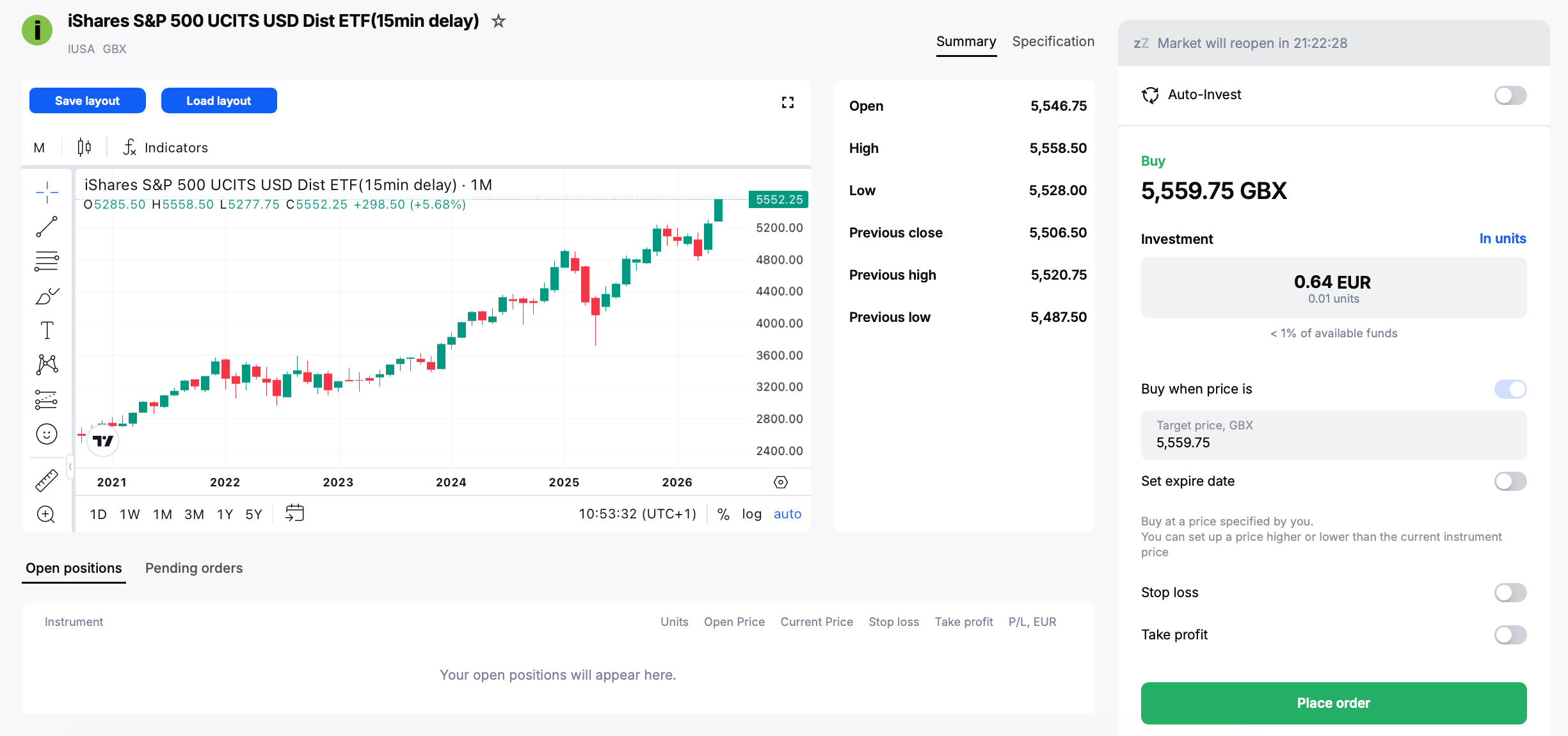
- Choose a broker that provides access to the stock exchange on which the ETF is listed and complete the onboarding process.
- Search for the ETF by its name or ticker symbol.
- Review the key details - annual charge, index tracked, fund size and replication method - before committing.
- Place a buy order and monitor your investment.
Other Articles You Might Be Interested In:
Frequently Asked Questions
What does ETF stand for?
ETF stands for Exchange-Traded Fund. It is a fund that holds a basket of assets and trades on a stock exchange in the same way a company's shares do.
What is the difference between an ETF and a mutual fund?
The main difference is how they trade. ETFs trade continuously on a stock exchange throughout the day at a live price. On the other hand, mutual funds are only priced once a day, after the market closes; all orders placed that day are executed at that single end-of-day price.
What is an index fund?
An index fund is a fund designed to track the performance of an index, such as the S&P 500 or FTSE 100. The term can refer to either an index-tracking ETF or an index-tracking mutual fund. The two share the same passive investment approach but differ in how they are structured and traded.
What is a UCITS ETF?
UCITS stands for Undertakings for Collective Investment in Transferable Securities - the regulatory framework that governs investment funds in the EU and UK. ETFs listed and sold in these markets are required to meet UCITS standards, which set rules around diversification, liquidity, and investor protections. For most investors in the EU and UK, the ETFs they encounter will be UCITS-compliant by default.
What fees do ETFs charge?
The main ongoing cost of holding an ETF is the ongoing charge, sometimes referred to as the Total Expense Ratio (TER). This is expressed as an annual percentage of the value of your investment and is deducted from the fund rather than charged separately. Passive index-tracking ETFs tend to have lower ongoing charges than actively managed funds. When buying or selling, investors may also incur commissions and a bid/ask spread.
Can you lose money with an ETF?
Yes. The value of an ETF can fall as well as rise, depending on the performance of its underlying assets. Leveraged and synthetic ETFs carry further complexity and risk beyond standard index-tracking products.
What is the difference between an ETF and a stock?
A stock represents ownership in a single company. An ETF represents ownership in a fund that holds a basket of assets - such as shares, bonds or commodities - providing exposure to multiple holdings with a single investment.
INFORMATION ABOUT ANALYTICAL MATERIALS:
The given data provides additional information regarding all analysis, estimates, prognosis, forecasts, market reviews, weekly outlooks or other similar assessments or information (hereinafter “Analysis”) published on the websites of Admirals investment firms operating under the Admirals trademark (hereinafter “Admirals”) Before making any investment decisions please pay close attention to the following:
- This is a marketing communication. The content is published for informative purposes only and is in no way to be construed as investment advice or recommendation. It has not been prepared in accordance with legal requirements designed to promote the independence of investment research, and that it is not subject to any prohibition on dealing ahead of the dissemination of investment research.
- Any investment decision is made by each client alone whereas Admirals shall not be responsible for any loss or damage arising from any such decision, whether or not based on the content.
- With view to protecting the interests of our clients and the objectivity of the Analysis, Admirals has established relevant internal procedures for prevention and management of conflicts of interest.
- The Analysis is prepared by an analyst (hereinafter “Author”), with the assistance of AI tools. The Author Roberto Rivero is a contractor for Admirals. This content is a marketing communication and does not constitute independent financial research.
- Whilst every reasonable effort is taken to ensure that all sources of the content are reliable and that all information is presented, as much as possible, in an understandable, timely, precise and complete manner, Admirals does not guarantee the accuracy or completeness of any information contained within the Analysis.
- Any kind of past or modelled performance of financial instruments indicated within the content should not be construed as an express or implied promise, guarantee or implication by Admirals for any future performance. The value of the financial instrument may both increase and decrease and the preservation of the asset value is not guaranteed.
- Leveraged products (including contracts for difference) are speculative in nature and may result in losses or profit. Before you start trading, please ensure that you fully understand the risks involved.