Investing in Oil Stocks

Despite the growing focus on renewable energy, oil continues to play a critical role in the world’s energy needs. For investors looking to get involved, oil stocks represent an accessible way to gain exposure to this important commodity.
In this article, we will take a look at 6 of the top oil stocks, including some of the world’s largest oil companies. We’ll also highlight some of the advantages of investing in oil stocks and the risks to watch out for.
The information in this article is provided for educational purposes only and does not constitute financial advice. Consult a financial advisor before making investment decisions.
Table of Contents
Key Takeaways
- •Many top oil companies have long histories of paying dividends to shareholders.
- •ConocoPhillips, ExxonMobil and Shell are some of the top oil stocks to watch.
- •Oil prices can be volatile, which may negatively impact the performance of oil shares.
Top Oil Stocks to Watch
The oil industry is made up of a wide number of companies, with many operating across multiple parts of the energy value chain. In the following sections, we’ll take a look at some of the most influential and largest oil companies in the world.
Data as of 13 March 2026. Market capitalisation and dividend yield figures are subject to change on a daily basis. Net debt to capital ratio [net debt / (net debt + shareholder equity)] is calculated based on most recent annual financial results.
ExxonMobil
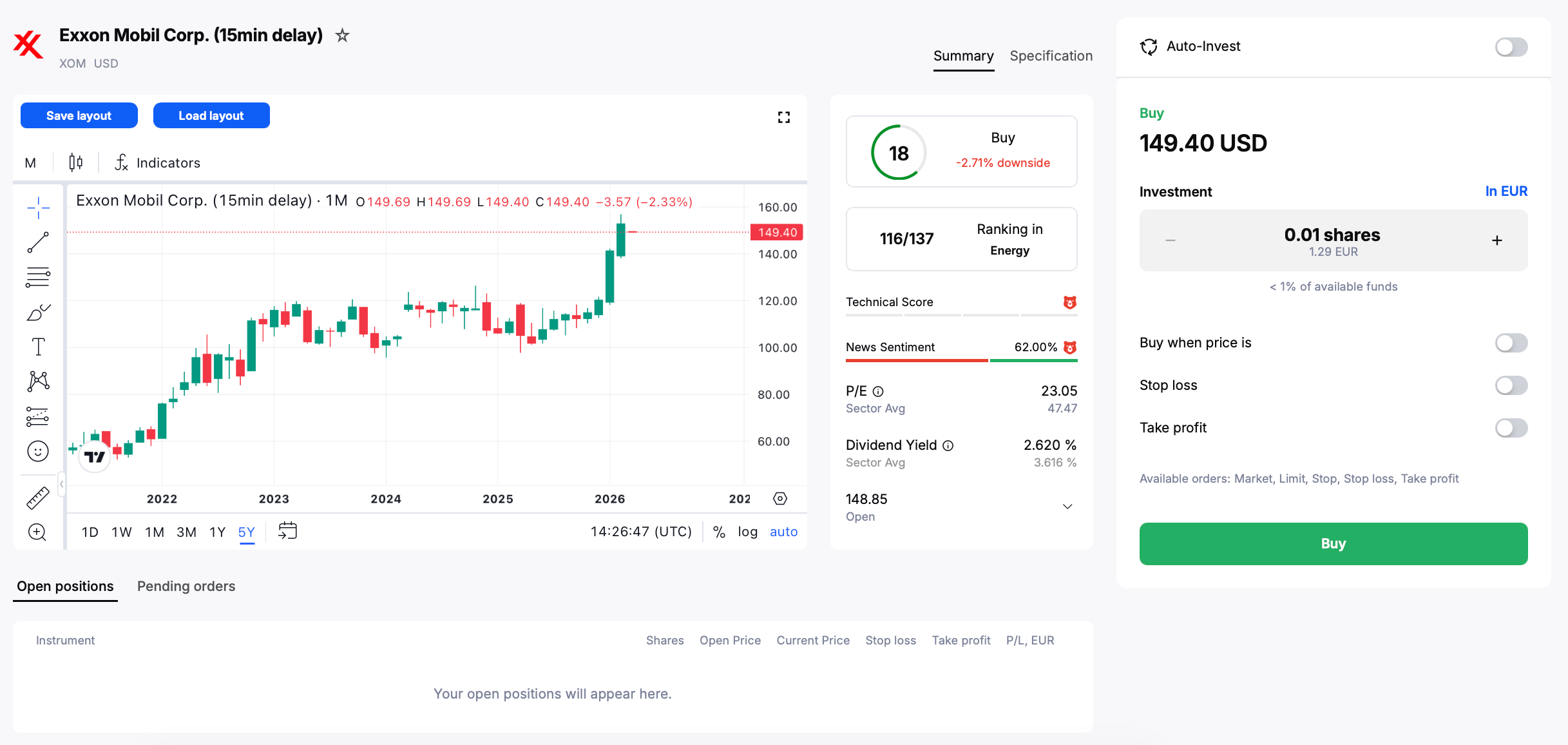
By some distance the largest company on our list and one of the biggest publicly traded energy companies in the world, ExxonMobil is a fully integrated oil and gas major headquartered in the US.
It operates across the entire oil and gas industry, including upstream exploration and production, midstream transportation and downstream refining.
Its diversified business provides the oil and gas major with multiple sources of revenue. However, its Upstream segment - which includes major operations in the US, Canada and Guyana - generates the lion’s share of earnings, accounting for roughly 74% of earnings in 2025.
Total revenue fell around 5% from the previous year and, although lower costs helped soften the impact on ExxonMobil’s bottom line, net income declined by 14%.
The oil major boasts a strong balance sheet and has an impressive track record when it comes to paying dividends, having increased its annual payout per share for 43 consecutive years. However, it should be noted that future dividends are never guaranteed.
Chevron
Also headquartered in the US, Chevron Corporation is vertically integrated within oil and gas, from upstream exploration and production to downstream refining and retail.
Like ExxonMobil, Chevron’s upstream operations form the core part of its business, with its most significant operations taking place in the Permian Basin in Texas and New Mexico.
In full-year 2025, total earnings declined 30% to $12.30 billion as Upstream earnings fell 31% to $12.82 billion, offsetting losses elsewhere. Nevertheless, Chevron raised its annual dividend per share for the 39th consecutive year.
Shell
Shell is a UK oil and gas major and the largest energy company in Europe. It operates across the full energy value chain, including oil and gas exploration and extraction, refining, petrochemicals, and retail sales. It also selectively invests in renewable generation and storage systems.
Again, the majority of Shell’s income is generated by its upstream business, which operates major projects in the North Sea, the Americas and Asia Pacific. In 2025, growing Upstream income was offset slightly by weaker performance in the Chemicals and Products segment, as total income declined 8% year on year.
After a long history of either maintaining or increasing its dividend every year, Shell slashed its annual payout in 2020 in response to the global pandemic. Although it has grown its dividend per share every year since, it remains below pre-pandemic levels.
TotalEnergies
TotalEnergies is headquartered in France and, after Shell, is the largest oil and gas company in Europe in terms of market capitalisation.
Its operations span the entire oil and gas value chain, from oil and gas exploration and production to power generation, transportation and refining. Its upstream operations extract oil and gas from projects in Africa, the Middle East and the North Sea, as well as from offshore projects in Brazil and Guyana.
It also invests in renewable energy, with renewable sources accounting for the majority of its power production and capacity.
In 2025, net income dropped 17% as operating income in the Exploration & Production and Integrated LNG segments dropped. Whilst the French oil company maintains a solid balance sheet, it’s worth noting that net debt increased 85% from the previous year, rising from $10.9 billion to $20.2 billion.
TotalEnergies has either increased or maintained its base dividend every year for more than 30 years. This doesn’t include the special interim dividend paid in 2022 as a result of exceptionally high oil and gas prices.
ConocoPhillips
Unlike the other oil stocks we’ve looked at so far, ConocoPhillips focuses on upstream activities as opposed to operating throughout the chain. The company is engaged in hydrocarbon exploration and extraction around the world, with major production operations in North America, Norway and Australia.
Because its operations focus on exploration and production, ConocoPhillips’s financial performance tends to be even more closely linked to global oil and gas prices than the integrated companies we’ve looked at so far.
In 2025, total revenue rose 8%; however, higher costs contributed to net income declining 13% year on year. In recent years, ConocoPhillips has prioritised improving its balance sheet, which was evident in its latest results as net debt declined almost 10% to around $17 billion.
ConocoPhillips has paid a dividend every year since it was established in its current form in 2002. However, it has cut its dividend on a number of occasions, most recently in 2023.
Phillips 66
Although ConocoPhillips is now focused on exploration and production, that wasn’t always the case.
The company was formed by a merger between Conoco and Phillips Petroleum in 2002, creating one of the largest integrated energy companies in the world at the time. However, in 2012, ConocoPhillips spun off its downstream operations into a new company, Phillips 66.
Phillips 66 is a leading oil refining company, which also has midstream operations and partners with Chevron on chemicals through a 50/50 joint venture named Chevron Phillips Chemical. It is also engaged in researching and developing lower-carbon emerging energy sources.
Consequently, Phillips 66 allows investors to gain exposure to fuel demand without direct exposure to upstream operations which, as we’ve highlighted, are more sensitive to global oil prices. Instead, oil refiners' profits depend mainly on refining margins, which is the difference between the cost of crude oil and the value of the refined products produced from it.
In 2025, considerably lower crude oil costs led to net income more than doubling to $4.4 billion, despite revenue falling by around 6% during the same period. Phillips 66 also increased its annual dividend, which it has done every year since its formation in 2012.
Advantages and Risks of Investing in Oil Companies
Oil stocks may offer returns during periods of strong energy demand, but there are also a number of risks associated with investing in oil companies. Investors must consider both the advantages and risks before making any decisions.
Advantages
✅ Shareholder Returns: Many of the major oil companies have good reputations for returning capital to shareholders through dividends and share buybacks.
✅ Potential Inflation Hedge: Energy prices typically rise during periods of inflation, which can support the revenue of oil companies. This can result in oil stocks performing well in inflationary environments.
✅ Diversification: Oil stocks can form part of a diversified investment portfolio.
✅ Exposure to Commodities: Allow investors to potentially benefit from periods of rising energy prices.
Risks
❌ Volatility: Oil prices can be volatile, which can impact the performance and share prices of oil companies.
❌ Cyclical: Energy markets are very cyclical. When the global economy is growing, energy prices tend to follow suit. However, they can be hit hard during periods of uncertainty or economic contraction.
❌ Geopolitical Uncertainty: Oil prices are sensitive to geopolitical uncertainty or conflicts involving oil producing nations.
❌ Energy Transition: Governments and companies are increasingly investing in renewable energy projects with the goal of reducing reliance on fossil fuels.
❌ Capital Intensive: Developing oil fields and extracting crude oil requires large upfront investments.
How to Pick the Top Oil Stocks
As with any investment, it’s important to conduct independent research before investing in oil companies. Here are some of the things to consider looking out for when picking oil stocks:
- Business Model: Is the company integrated, operating throughout the energy supply chain? Or is it focused on upstream exploration and extraction? Integrated companies such as ExxonMobil or Shell have more diversified revenue, whereasproducers such as ConocoPhillips are more sensitive to global energy prices.
- Geographic Diversification: Oil companies with operations in multiple regions may be less exposed to geopolitical disruption.
- Operating Costs: Companies which can produce oil at lower costs may be better positioned when oil prices fall.
- Strong Balance Sheets: Oil companies with lower debt and higher levels of cash are typically better placed to weather downturns in oil prices and to fund new projects.
- Shareholder Returns: Many energy companies return capital to shareholders through dividends and share repurchases; this will be an important consideration for income-focused investors.
How to Buy Oil Stocks
For those interested in investing in oil stocks, here’s how you can get started:
- Register with a broker and complete the onboarding process.
- Log in to your broker’s investment platform.
- Search for the oil company you wish to invest in and open the instrument page.
- Create a new order, enter the number of oil shares you want to buy and send your order to the market.
Other Articles You Might Be Interested In:
Frequently Asked Questions
Are oil stocks a good investment?
Oil stocks can perform well during periods of strong energy demand or rising crude prices, as higher prices can increase the revenues and profits of oil producers. Many large oil companies also pay dividends, although future payouts are never guaranteed. However, there are risks which need to be considered. For example, oil prices can be volatile, which may negatively impact the performance of oil companies.
Do oil stocks pay dividends?
Many large oil companies, such as Chevron and ExxonMobil, have reputations for returning capital to shareholders through regular dividend payments and share buybacks. However, it should be noted that dividends are never guaranteed.
What affects the price of oil stocks?
The share prices of oil stocks are influenced by many factors but, primarily, their performance tends to depend largely on global oil prices. Company specific factors, such as operating costs and management decisions, can also impact share price performance.
Are oil stocks risky?
Like all investments, oil stocks carry risks. Energy prices can be volatile, and the profitability of oil companies often rises and falls with these prices. In addition, oil producers face geopolitical risks, regulatory scrutiny and the transition towards cleaner energy sources.
The given data provides additional information regarding all analysis, estimates, prognosis, forecasts, market reviews, weekly outlooks or other similar assessments or information (hereinafter “Analysis”) published on the websites of Admirals investment firms operating under the Admirals trademark (hereinafter “Admirals”) Before making any investment decisions please pay close attention to the following:
- This is a marketing communication. The content is published for informative purposes only and is in no way to be construed as investment advice or recommendation. It has not been prepared in accordance with legal requirements designed to promote the independence of investment research, and that it is not subject to any prohibition on dealing ahead of the dissemination of investment research.
- Any investment decision is made by each client alone whereas Admirals shall not be responsible for any loss or damage arising from any such decision, whether or not based on the content.
- With view to protecting the interests of our clients and the objectivity of the Analysis, Admirals has established relevant internal procedures for prevention and management of conflicts of interest.
- The Analysis is prepared by an analyst (hereinafter “Author”). The Author Roberto Rivero is a contractor for Admirals. This content is a marketing communication and does not constitute independent financial research.
- Whilst every reasonable effort is taken to ensure that all sources of the content are reliable and that all information is presented, as much as possible, in an understandable, timely, precise and complete manner, Admirals does not guarantee the accuracy or completeness of any information contained within the Analysis.
- Any kind of past or modelled performance of financial instruments indicated within the content should not be construed as an express or implied promise, guarantee or implication by Admirals for any future performance. The value of the financial instrument may both increase and decrease and the preservation of the asset value is not guaranteed.
- Leveraged products (including contracts for difference) are speculative in nature and may result in losses or profit. Before you start trading, please ensure that you fully understand the risks involved.