Investing in Lithium Stocks

Lithium stocks are shares in companies that mine or process lithium, the metal which is used in batteries for electric vehicles, energy storage and consumer electronics. In order to gain exposure, investors can buy shares in lithium stocks or invest in lithium ETFs.
This article explains what drives the lithium market, and highlights five lithium stocks and an example of a lithium ETF. It also covers the main risks and how investors can get started.
The information in this article is provided for educational purposes only and does not constitute financial advice. Consult a financial advisor before making investment decisions.
Key Takeaways
- Lithium stocks include both miners and companies that process lithium into battery-grade material
- Investors can gain exposure through individual lithium shares or lithium ETFs, which hold a basket of related companies
- Australia, Chile, China and Zimbabwe account for the bulk of global lithium production
- Lithium prices have historically been volatile, with demand driven primarily by the battery sector
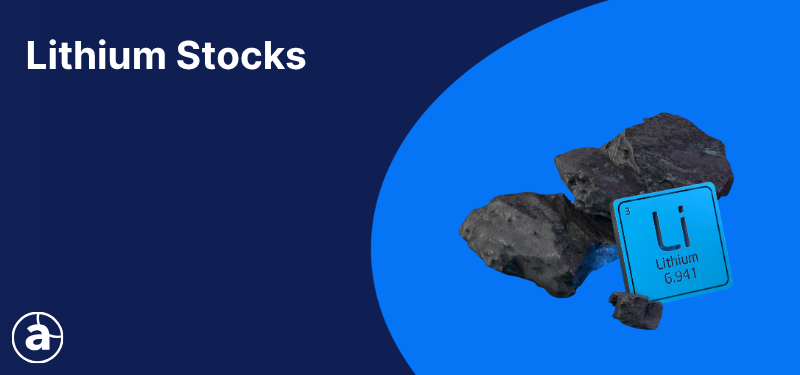
Table of Contents
The Lithium Market
The prices of most commodities tend to be volatile; however, even in an asset class where volatility is expected, lithium has proved an extreme case.
In the last few years, the balance between supply and demand has swung dramatically. Understanding these shifts and what caused them helps explain why lithium prices have behaved as they have.
Why Lithium Prices Are Volatile
New mining and processing capacity can take several years to move from investment decision to production. When prices rise, producers respond by investing in new supply, but by the time that supply arrives, several projects often reach production at once, overshooting what demand actually needs and pushing prices back down.
This lag between rising prices and new supply coming online is common across all commodities which are mined or extracted, but lithium is particularly exposed to this dynamic.
It lacks the highly liquid markets that commodities such as gold and oil enjoy, meaning that its price can react more violently to minor imbalances in supply and demand. Furthermore, the vast majority of demand is driven by the battery sector, which means that any changes in this one industry can severely impact prices.
This has played out clearly over the last five years. After soaring for more than a year, lithium prices peaked towards the end of 2022 but soon plummeted drastically as supply outstripped demand. However, in 2026, supply tightened, causing prices to sharply climb once again.
What Drives Demand for Lithium
- Electric vehicle batteries remain the largest single source of demand
- Grid-scale energy storage is a growing use case
- Consumer electronics account for a far smaller share
It’s worth noting that battery technology is also evolving. Potential alternatives, such as sodium-ion batteries, are emerging that could end up reducing reliance on lithium in some applications. However, lithium-ion remains the dominant technology for now.
Where Lithium Is Produced
Global lithium production is concentrated in a small number of countries, with the top four producers accounting for more than 80% of total global production in 2025.
Source: USGS – Lithium 2026
Top Lithium Stocks to Watch in 2026
Whilst some lithium companies extract lithium from ore or brine, others focus on refining the raw material into lithium carbonate or hydroxide, which is then used to make batteries. Some of the largest lithium stocks do both, extracting the raw metal and then processing it.
The table below lists 5 lithium stocks operating at different points in the value chain and in different geographies. They have been included to highlight the different ways in which companies can operate in the lithium market.
Albemarle
Albemarle is a US-headquartered specialty chemicals manufacturing company, and one of the largest lithium mining stocks in the world by production.
It currently extracts lithium from brine in Chile and the US and from hard-rock spodumene in Australia. Brine refers to naturally occurring underground water, which is highly concentrated with dissolved lithium salts. After extracting the lithium, Albemarle then processes it for use in a range of industries, including EV batteries.
Besides lithium, the company also produces bromine, a common element in flame retardants with a wide range of other applications. Albemarle pays a quarterly dividend and has either increased or maintained its annual payout for more than 30 years. However, it should be noted that future dividends are never guaranteed.
SQM
Sociedad Quimica y Minera de Chile is a Chilean mining company which operates over five segments:
- Lithium and Derivatives
- Iodine and Derivatives
- Specialty Plant Nutrition
- Potassium
- Industrial Chemicals
Of these, its lithium segment is the largest, contributing around half of total revenue in 2025.
Its lithium operations are primarily based in northern Chile, where it extracts lithium from brine in the Salar de Atacama before converting it into lithium carbonate and hydroxide at its chemical plant in Antofagasta. The company estimates that it accounts for approximately 14% of global lithium chemical sales by volume.
After suspending its dividend in 2024 due to reporting a loss that year, SQM resumed distributions in 2025.
Rio Tinto
Rio Tinto is a diversified mining major, which is the second largest mining company in the world in terms of market capitalisation.
Although perhaps better known for iron ore, which accounts for roughly half of sales, it became a significant lithium producer after its acquisition of Arcadium Lithium in 2025.
Indeed, this deal transformed Rio Tinto from a miner with no commercial-scale lithium production into the third largest lithium producer in the world, with one of the largest lithium resource bases in the world.
It reports lithium combined with aluminium under the Aluminium and Lithium segment. In 2025, this segment accounted for roughly 30% of the company’s total sales revenue.
As a diversified miner, Rio Tinto may not appeal to those looking purely for exposure to lithium, as its performance is heavily influenced by its iron ore, copper and aluminium operations.
Rio Tinto has consistently paid a dividend for more than 20 years. However, since 2021, it has cut its annual payout on several occasions.
PLS Group
PLS Group, formerly known as Pilbara Minerals, is an Australian lithium stock which owns and operates the Pilgangoora hard-rock lithium operation in Australia.
Unlike the three companies examined so far, PLS Group primarily produces and sells spodumene concentrate (high-purity lithium ore) to third-party refiners rather than processing it into battery-grade lithium itself. However, it does hold an 18% stake in a lithium hydroxide plant in South Korea, to which it supplies spodumene concentrate.
Being primarily a lithium miner, which produces no other commodities or chemicals, its performance is tied more directly to the price of spodumene than any of the more diversified or integrated producers covered above.
PLS Group has a stated policy of targeting a dividend payout of 20% to 30% of free cash flow but hasn't paid a dividend since 2023.
Lithium Americas
Lithium Americas is a Canadian mining company which was created in 2023 after separating from its Argentina operations (which now trade independently as Lithium Argentina).
It is currently a development-stage company, focused on developing the Thacker Pass project in Nevada, which it states hosts the largest known measured lithium resource and reserve.
Lithium Americas holds a 62% stake in the project, with General Motors holding the remaining 38%. GM has a 20-year offtake agreement for up to 100% of Phase 1 and up to 38% of Phase 2 production volumes.
Phase 1 construction is underway, which it anticipates will be completed late 2027 with initial production capacity of 40,000 tonnes a year of battery-quality lithium carbonate.
Because its sole asset is still under construction, Lithium Americas does not yet generate any revenue from its operations, making it a highly speculative investment with a very different risk profile to the companies examined above.
Lithium ETFs
Lithium Exchange-Traded Funds (ETFs) offer diversified exposure to the sector through a single investment, spreading risk across a basket of companies rather than depending on the fortunes of one.
An example is the Global X Lithium & Battery Tech ETF (LIT) which tracks the Solactive Global Lithium Index, a stock index composed of companies which are active in the exploration and/or mining of lithium or the production of lithium batteries.
However, despite offering diversified exposure to lithium stocks, the ETF is heavily concentrated in just one company. Following Rio Tinto’s acquisition of Arcadium Lithium, it has become by far LIT’s largest holding, accounting for more than 20% of the fund.
Consequently, despite calling itself a lithium ETF, LIT is now heavily influenced by a company which actually generates most of its revenue from iron ore, aluminium and copper.
Risks of Investing in Lithium Stocks
As with any investment, investing in lithium stocks carries several risks:
- Volatility: the lithium market has experienced fairly dramatic price swings in recent years.
- Revenue Concentration: many lithium companies generate the majority of revenue from a single commodity. Whilst this offers direct exposure to lithium price, it also means a company's share price can fall sharply during a downturn in the lithium market, with no other business to cushion the impact.
- Geographic Concentration: lithium production is concentrated in a small number of countries, so a disruption in a single location could have an outsized effect on global supply and prices.
- Long Project Lead Times: bringing a new mine into production typically takes years and requires a substantial investment. Any delays or issues with execution can be costly.
- Substitution: other technology such as sodium-ion batteries are emerging as a potential alternative for some lithium-ion applications. Any meaningful shift in battery chemistry could reduce demand growth for lithium over time.
How to Invest in Lithium Stocks
There are two main ways to gain exposure to the lithium sector:
- Buying shares individual lithium stocks; or
- Holding a lithium ETF, which provides more diversified exposure.
The practical process for investing in either follows a similar sequence:
- Open an investment account: choose a broker, complete the onboarding process and fund your account.
- Research the company or ETF: before investing, make sure you understand how the company operates and also examine its financials. When looking at ETFs, research its holdings and take into consideration the ongoing fees.
- Decide on position size: consider the sector's volatility and how much exposure you want to the industry within a diversified portfolio.
- Place the trade: choose from a market order, which execute at the next available price, or a limit order, which only executes at a specified price or better.
- Monitor the holding over time: given how sharply lithium prices have swung historically, checking in on a position periodically is generally more relevant here than for less cyclical sectors.
Frequently Asked Questions
What are examples of Australian lithium stocks?
PLS Group (formerly Pilbara Minerals) and Rio Tinto, covered above, are both examples of Australian lithium stocks. Other companies operating in the Australian lithium industry include IGO Limited and Mineral Resources.
Is lithium carbonate the same as lithium?
No. Lithium carbonate is a refined chemical compound made by processing raw lithium ore or brine. Together with lithium hydroxide, it’s one of the two main forms used to make lithium batteries.
What is the difference between lithium stocks and lithium ETFs?
A lithium stock is a share in a single company, whereas a lithium ETF holds a basket of stocks within a single fund. A lithium stock’s performance naturally depends on that company’s specific operations. On the other hand, an ETF spreads that company-specific risk across multiple holdings.
Which country produces the most lithium?
Australia is the largest producer of lithium in the world, accounting for more than 30% of global supply in 2025.
INFORMATION ABOUT ANALYTICAL MATERIALS:
The given data provides additional information regarding all analysis, estimates, prognosis, forecasts, market reviews, weekly outlooks or other similar assessments or information (hereinafter “Analysis”) published on the websites of Admirals investment firms operating under the Admirals trademark (hereinafter “Admirals”) Before making any investment decisions please pay close attention to the following:
- This is a marketing communication. The content is published for informative purposes only and is in no way to be construed as investment advice or recommendation. It has not been prepared in accordance with legal requirements designed to promote the independence of investment research, and that it is not subject to any prohibition on dealing ahead of the dissemination of investment research.
- Any investment decision is made by each client alone whereas Admirals shall not be responsible for any loss or damage arising from any such decision, whether or not based on the content.
- With view to protecting the interests of our clients and the objectivity of the Analysis, Admirals has established relevant internal procedures for prevention and management of conflicts of interest.
- The Analysis is prepared by an analyst (hereinafter “Author”), with the assistance of AI tools. The Author Roberto Rivero is a contractor for Admirals. This content is a marketing communication and does not constitute independent financial research.
- Whilst every reasonable effort is taken to ensure that all sources of the content are reliable and that all information is presented, as much as possible, in an understandable, timely, precise and complete manner, Admirals does not guarantee the accuracy or completeness of any information contained within the Analysis.
- Any kind of past or modelled performance of financial instruments indicated within the content should not be construed as an express or implied promise, guarantee or implication by Admirals for any future performance. The value of the financial instrument may both increase and decrease and the preservation of the asset value is not guaranteed.
- Leveraged products (including contracts for difference) are speculative in nature and may result in losses or profit. Before you start trading, please ensure that you fully understand the risks involved.