Investing in Renewable Energy Stocks

Renewable energy stocks are shares in companies that generate power from renewable sources, or which manufacture the equipment and technology behind it. As the world looks to transition to cleaner energy sources, interest in this part of the market has risen, although the sector carries a number of risks.
In this article, we look at 5 top renewable energy stocks to watch in 2026, covering companies across wind, solar and hydropower in different markets. Beyond individual companies, we’ll also explore the prospect of investing in renewable energy companies, the different ways of doing so and the risks involved.
The information in this article is provided for educational purposes only and does not constitute financial advice. Consult a financial advisor before making investment decisions.

Table of Contents
Types of Renewable Energy Companies
Some renewable energy companies generate electricity directly from physical assets, such as wind farms or solar installations, whilst others manufacture the equipment or technology that make such generation possible or provide associated services. Consequently, the term “renewable energy stocks” spans a range of different business models with varying prospects.
- Wind: Including turbine manufacturers and operators of wind farms, including onshore and offshore installations.
- Solar: Including panel manufacturers and operators of utility-scale solar farms.
- Hydro: Electricity generation from moving water, using dams or run-of-river systems.
Investing in Renewable Energy Stocks
There are a number of factors which have driven interest in renewable energy stocks in recent times:
- Falling costs, which have made solar and wind the cheapest new-build power source in most countries
- Rising electricity demand, driven partly by data centres and AI infrastructure
- Continued growth in electric vehicle adoption, which increases overall power consumption
According to the IEA, global renewable power capacity is projected to grow by almost 4,600 gigawatts between 2025 and 2030, roughly double the growth seen over the previous five years, with solar PV accounting for around 80% of that increase.
The IEA further states that it expects renewables to account for 43% of global electricity generation by 2030, up from 32% in 2024.
It’s worth noting that much of this expected growth isn’t just fuelled by concern about the environment. In most parts of the world, building a new solar or wind installation is now cheaper than building new fossil fuel capacity; they’re typically faster to bring online too.
Of course, policy still matters a great deal for individual companies and projects, and growth forecasts can get revised when governments change course.
Renewable Energy Stocks to Watch in 2026
The 5 companies highlighted below are included as examples spanning different parts of the renewable energy sector, covering utilities, equipment manufacturers and project developers.
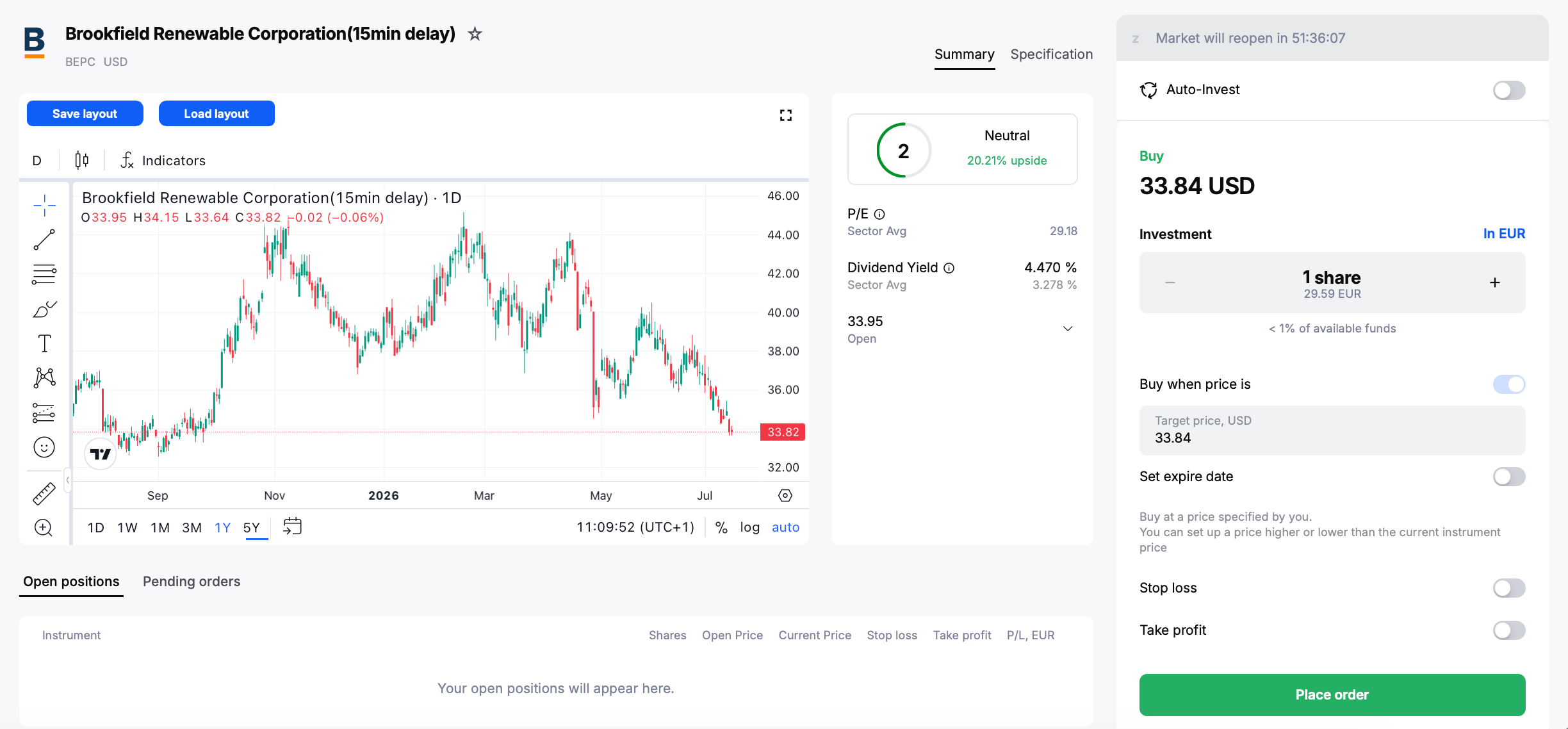
Brookfield Renewable
Brookfield Renewable operates a globally diversified portfolio of hydroelectric, wind and solar assets across the Americas, Europe and Asia.
Most of its revenue comes from long-term power purchase agreements, many of which are linked to inflation, rather than from selling into the open wholesale market at the spot price.
Besides building new capacity itself (Brookfield currently has over 85,000 MW in its advanced-stage pipeline) it has also expanded its operations significantly through acquisitions. Most recently, it took part in a deal for Boralex, a Canadian-listed operator with around 4,000 MW of wind, solar, hydro and battery storage assets. It also recently signed a 20-year hydropower supply agreement with Google.
Brookfield Renewable’s management is targeting annual dividend growth of 5%-9%, with a current quarterly distribution of $0.392 per share at the time of writing.
First Solar
First Solar is the largest US-based manufacturer of solar panels. It uses thin-film cadmium telluride technology, unlike most of its competitors which rely on crystalline silicon. This kept it mostly insulated from recent issues in the supply chain of crystalline silicon, which affected many other companies.
It sells its modules mainly to developers of utility-scale solar farms in North America, typically under supply contracts agreed in advance rather than on the spot market.
To meet growing demand, including from AI data centres, First Solar is currently expanding capacity across its Ohio, Arizona and South Carolina facilities. As of March 2026, its contract backlog stood at 47.9 GW, worth $14.4 billion, with deliveries extending through 2030.
First Solar doesn't currently pay a dividend, instead choosing to reinvest earnings back into the business to fuel future growth.
Iberdrola
Iberdrola is one of the world's largest utilities by market capitalisation, combining regulated electricity networks with large-scale renewable generation across the UK, US, Spain and Brazil.
In terms of renewables, it boasts almost 47,000 MW of operational capacity across wind, solar and hydro.
Alongside this, Iberdrola also owns and operates regulated electricity transmission and distribution networks in the UK, US, Spain and Brazil, which earn a government-agreed rate of return rather than being exposed to wholesale power prices.
In 2026, the company completed the sale of its Mexican operations for $4.2 billion, as part of its strategy to prioritise investments in its regulated network businesses and generation operations with long-term contracts.
An example of this strategy was the company’s 2024 acquisition of Electricity North West in the UK, which made it the second largest electricity distributor in the country.
Iberdrola has a long history of paying dividends and has increased its annual payout every year since 2013. However, it should be noted that future dividends are never guaranteed.
Vestas Wind Systems
Vestas Wind Systems is a Danish company which manufactures and installs wind turbines, covering both onshore and offshore projects, and also runs one of the largest turbine servicing businesses in the industry.
It earns revenue both from selling and installing new turbines under project-specific contracts, and from long-term service agreements to maintain turbines already in operation.
Its combined order backlog, covering both turbine orders and service agreements, reached a record €76.1 billion by the end of the first quarter of 2026, giving it relatively long revenue visibility.
For 2025, Vestas paid a dividend of DKK 0.74 per share and initiated a €150 million share buyback.
Ørsted
Another Danish renewable energy stock, Ørsted is the world's largest developer and operator of offshore wind farms, with 10.2 GW of installed offshore capacity and a further 8.1 GW under construction across Europe, Asia Pacific and North America.
It sells most of its power under long-term contracts or subsidy schemes tied to specific projects, rather than on the open market. However, its large-scale construction projects still carry real cost and financing risk.
In 2025, Ørsted raised around €8 billion through a rights issue, backed by the Danish state as majority shareholder, after a planned partial sale of its US Sunrise Wind project fell through. This followed a difficult few years for the company, during which it suspended its dividend.
The rights issue diluted shareholders significantly, nearly tripling Ørsted's total share count, and put further pressure on a stock that had already declined considerably.
However, it also addressed the balance sheet concerns which had weighed on share price, and Ørsted has stated it intends to reinstate its dividend in FY26.
Renewable Energy ETFs
For those who want exposure to renewable energy stocks, but would rather not pick individual companies, an alternative option are renewable energy ETFs.
Exchange-traded funds that focus on renewable or clean energy hold a basket of companies across the sector rather than a single stock. This means that company-specific risks are diversified across many holdings.
An example is the iShares Global Clean Energy Transition ETF, which tracks an index composed of companies operating in the global clean energy industry. Amongst its top holdings at the time of writing are First Solar and Vestas Wind Systems.
Risks of Investing in Renewable Energy Stocks
As with any investment, renewable energy stocks carry a number of risks, including:
- Government policy
- Weather and resource dependency
- Competition from fossil fuels and other power sources
- Interest Rates
Government Policy
Government policy plays a significant role in the renewable energy industry, influencing demand through subsidies, tax credits and emissions targets. These can change with a new administration or shifting priorities, and a change in direction may affect company valuations.
Weather
Solar and wind output depends on weather conditions, which vary by location and season and can't be fully predicted or controlled. Hydro output depends on rainfall and reservoir levels, so drought conditions can reduce generation in some years.
Competition From Fossil Fuels and Other Power Sources
Renewable energy stocks compete with fossil fuel and nuclear power for investment. Falling fossil fuel prices, or delays in retiring existing fossil fuel infrastructure, may slow the pace at which renewables gain ground, even if the longer-term trend favours them.
Interest Rates
Interest rates typically affect most sectors, not just renewable energy, as higher rates tend to weigh on stock market valuations.
However, renewable energy projects are very capital intensive, requiring significant investment relative to their ongoing running costs. This makes the sector more sensitive than many others to changes in borrowing costs. Higher rates can directly affect project returns and make existing dividend yields look less attractive next to lower risk alternatives elsewhere.
How to Invest in Renewable Energy Stocks
- Decide how you want to gain exposure, whether through individual shares or an ETF
- Register with a broker and complete the onboarding process
- Research the companies or funds you're considering
- Place your trade by searching for the stock or fund, choosing your position size and confirming the order
- Monitor your investment over time
Frequently Asked Questions
Do Renewable Energy Stocks Pay Dividends?
Some do and some don't, it varies depending on the company. Large, established utilities and infrastructure operators, such as Brookfield Renewable or Iberdrola, may pay dividends steadily. On the other hand, smaller manufacturers and companies reinvesting heavily in expansion, such as First Solar, often don't pay a dividend at all, preferring to put cash back into the business instead.
What is a Renewable Energy ETF?
A renewable energy ETF is an exchange-traded fund focused on renewable energy stocks. It will hold many companies within a single fund, spreading company-specific risk across numerous holdings. However, renewable energy ETFs remain exposed to broader sector-wide risks.
What's the Difference Between Renewable Energy Stocks and ESG Stocks?
Renewable energy stocks are shares in companies which generate or enable power from sources like wind, solar or hydro. On the other hand, ESG stocks are defined by how a company scores against environmental, social and governance criteria, which can include factors unrelated to energy at all. There’s overlap between the two categories, but they're not the same thing. A renewable energy company can score poorly on other ESG factors, and an ESG stock may have nothing to do with renewable energy.
INFORMATION ABOUT ANALYTICAL MATERIALS:
The given data provides additional information regarding all analysis, estimates, prognosis, forecasts, market reviews, weekly outlooks or other similar assessments or information (hereinafter “Analysis”) published on the websites of Admirals investment firms operating under the Admirals trademark (hereinafter “Admirals”) Before making any investment decisions please pay close attention to the following:
- This is a marketing communication. The content is published for informative purposes only and is in no way to be construed as investment advice or recommendation. It has not been prepared in accordance with legal requirements designed to promote the independence of investment research, and that it is not subject to any prohibition on dealing ahead of the dissemination of investment research.
- Any investment decision is made by each client alone whereas Admirals shall not be responsible for any loss or damage arising from any such decision, whether or not based on the content.
- With view to protecting the interests of our clients and the objectivity of the Analysis, Admirals has established relevant internal procedures for prevention and management of conflicts of interest.
- The Analysis is prepared by an analyst (hereinafter “Author”), with the assistance of AI tools. The Author Roberto Rivero is a contractor for Admirals. This content is a marketing communication and does not constitute independent financial research.
- Whilst every reasonable effort is taken to ensure that all sources of the content are reliable and that all information is presented, as much as possible, in an understandable, timely, precise and complete manner, Admirals does not guarantee the accuracy or completeness of any information contained within the Analysis.
- Any kind of past or modelled performance of financial instruments indicated within the content should not be construed as an express or implied promise, guarantee or implication by Admirals for any future performance. The value of the financial instrument may both increase and decrease and the preservation of the asset value is not guaranteed.
- Leveraged products (including contracts for difference) are speculative in nature and may result in losses or profit. Before you start trading, please ensure that you fully understand the risks involved.