Is Rolls-Royce a Good Stock to Buy?

Rolls-Royce has undergone a significant turnaround in recent years, reporting strong growth in the first half of 2026 and raising its full-year guidance. However, the stock’s high valuation means that its improvement may already be reflected in the price. Ultimately, whether Rolls-Royce is a good stock to buy depends on the individual investor in question and their assessment of the company and its valuation.
In this article, we examine Rolls-Royce and take a look at what analysts are forecasting for the stock. We’ll also explore its bull and bear cases and explain the process of how to buy Rolls-Royce shares.
The information in this article is provided for educational purposes only and does not constitute financial advice. Consult a financial advisor before making investment decisions.
Table of Contents
What Does Rolls-Royce Do?
Rolls-Royce Holdings is an aerospace and defence company which is listed on the London Stock Exchange (LSE) under the symbol RR.
The original Rolls-Royce manufactured the cars which bear the same name. However, the automobile division became a separate company in 1971 whilst under the ownership of the UK government.
Today, the company manufactures power and propulsion systems for aviation and other industries. It operates across three core businesses:
- Civil Aerospace: Manufactures and services engines for the large commercial aircraft, regional jet and business aviation markets.
- Defence: Manufactures military aero engines, naval engines and submarine nuclear power plants.
- Power Systems: Produces power and propulsion systems under its mtu brand.
Rolls-Royce Financial Results and Outlook
Rolls-Royce's latest results for the six months ended 30 June 2026 demonstrated significant growth in both profit and revenue.
Source: Rolls-Royce Half-Year 2026 Results. Past performance is not a reliable indicator of future results.
The positive performance in the first half of 2026 was supported by growth across all three of the company’s core businesses.
Civil Aerospace
Civil Aerospace benefitted from growth in engine flying hours, which translates to higher revenue as airlines on Long-Term Service Agreements (LTSAs) pay Rolls-Royce per hour that their engines fly. Revenue growth was also driven by an increase in engine deliveries and higher shop visit volumes.
Source: Rolls-Royce - Half-Year 2026 Results & Half-Year 2025 Results. Past performance is not a reliable indicator of future results.
Defence
Rolls-Royce's defence order intake in H1 was £2.4 billion and its order backlog stood at £17.5 billion, more than three years' worth of revenue. All sectors of its defence division delivered strong revenue growth, including combat, submarines and transport.
Source: Rolls-Royce - Half-Year 2026 Results & Half-Year 2025 Results. Past performance is not a reliable indicator of future results.
Power Systems
Power Systems order intake totalled £4.6 billion, more than 50% higher than the prior period. Strong demand from data centres helped boost revenue for power generation in the first half of the year.
Source: Rolls-Royce - Half-Year 2026 Results & Half-Year 2025 Results. Past performance is not a reliable indicator of future results.
Full-Year 2026 Guidance
Following its strong first half, Rolls-Royce raised its guidance for the full year, citing higher LTSA margins in Civil Aerospace, stronger profitability in Power Systems’ power generation, and increased aftermarket profitability in Defence.
Source: Rolls-Royce - Half-Year 2026 Results. Past performance is not a reliable indicator of future results.
Rolls-Royce Share Price Forecast
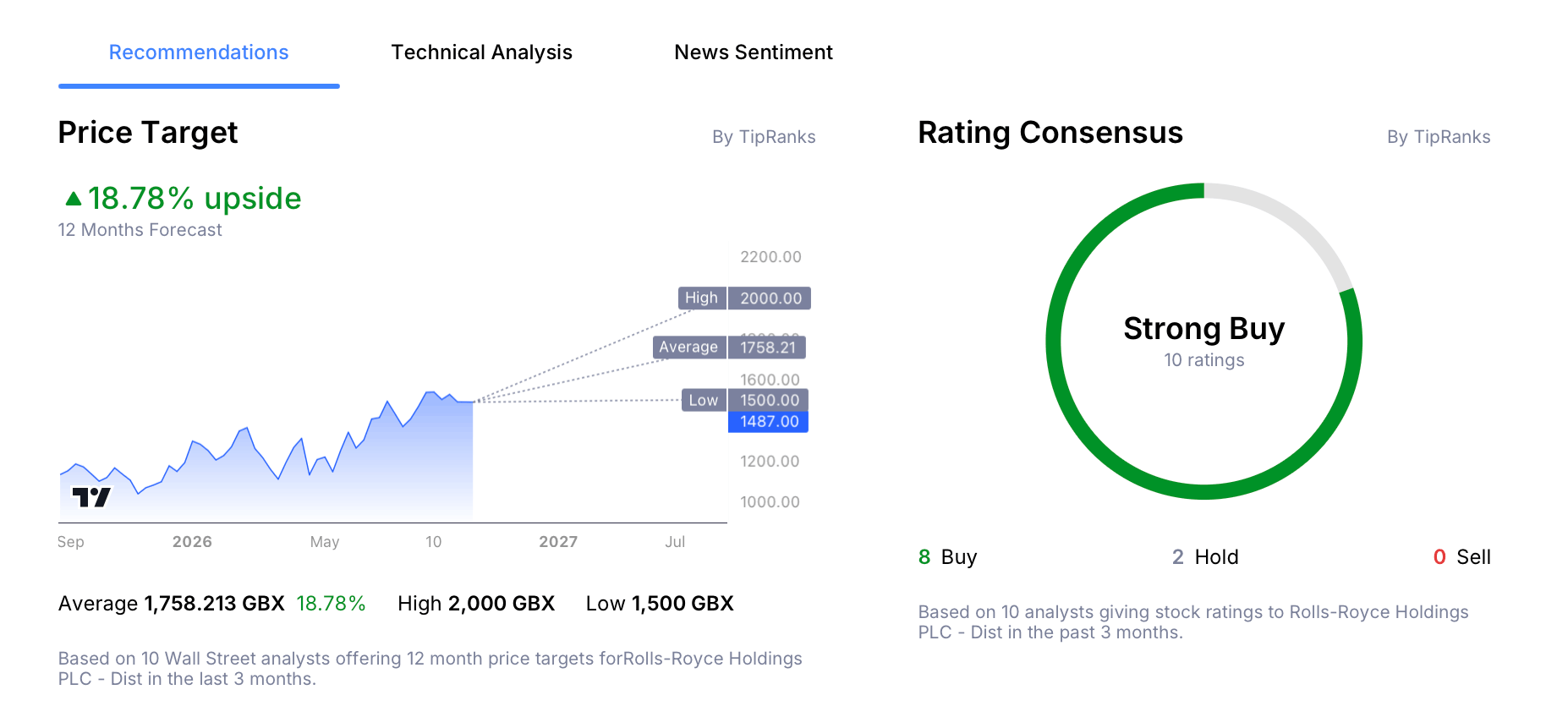
According to 10 analysts polled by TipRanks in the last three months, 8 rated Rolls-Royce a “Buy”, 2 rated it a “Hold” and 0 rated it a “Sell”. A summary of their 12-month price targets is as follows:
Is Rolls-Royce a Good Stock to Buy?
Rolls-Royce has performed strongly over the last few years, both financially and in the stock market. Whether it is a “good stock to buy” or not depends largely on the individual investor in question, their circumstances and whether they believe Rolls-Royce's performance justifies its relatively high valuation.
The Bull Case for Rolls-Royce
Factors which may support share price in the future include:
- Growing civil aerospace installed base: Besides the initial sale, Rolls-Royce also generates revenue by servicing its engines throughout their lifetime. Large engine flying hours increased 4% in the first half of 2026, whilst its order book for large engines swelled to 2,266 engines. Increased engine deliveries could expand the company’s future servicing opportunity.
- Improved profitability: Rolls-Royce reported higher operating margins across all three core businesses in the first half of 2026. The company attributed improved margins to stronger aftermarket profitability, commercial optimisation, cost efficiencies and contract improvements.
- Diversified growth opportunities: Increased defence spending from governments has provided a second engine for growth, whilst Power Systems is also experiencing rising demand.
- Shareholder returns: Rolls-Royce declared an interim dividend of 6.0p per share, alongside a multi-year buyback programme of £7 billion to £9 billion between 2026 and 2028.
Risks of Buying Rolls-Royce Shares
However, as with any investment, Rolls-Royce also faces risks, including:
- High valuation: As of 4 September 2026, Rolls-Royce trades at more than 40 times trailing earnings, which is more than double the wider FTSE 100. At that price, the company’s improvement may already be priced in, and if future performance falls short of expectations, it could lead to a steep decline.
- Civil Aerospace is cyclical: A significant proportion of revenue depends on engine flying hours and maintenance activity. Air travel is a cyclical industry, meaning that an economic downturn could significantly reduce demand for these services.
- Supply chain risks: Rolls-Royce expects aerospace supply chain issues to have a cash impact of between £150 million and £200 million in 2026.
- Some improvements might not recur: Civil aerospace margins benefitted from contractual improvements in H1. The company stated in its results that it expects a lower contribution from this in the second half, which could pressure margins.
So, is Rolls-Royce a good stock to buy?
The company is financially stronger and more profitable than it was a few years ago, and it has diversified opportunities for potential growth in the future. However, its high valuation comes with high expectations. If Rolls-Royce is unable to either match or exceed these expectations, it could weigh on share price.
How to Buy Rolls-Royce Shares
Rolls-Royce shares can be bought through an investment account which provides access to the London Stock Exchange. Regardless of the account, the process of buying Rolls-Royce shares typically follows these steps:
- Open an investment account: Choose a broker which offers access to UK-listed stocks and complete the onboarding process.
- Fund the account: Deposit funds using one of the payment methods supported by the broker.
- Find Rolls-Royce Holdings: Search for Rolls-Royce Holdings by company name or its ticker, RR.
- Choose the investment amount and order type: A market order purchases shares at the next available price, whilst a limit order allows the investor to specify the highest price they are prepared to pay.
- Review and place the order: Check the number of shares, the price and review any costs before confirming the order.
Frequently Asked Questions
Does Rolls-Royce Pay Dividends?
Yes. Rolls-Royce reinstated its dividend in 2025 after a suspension of more than five years. Future dividends are never guaranteed and depend on the company’s financial performance and dividend policy.
What Is the Rolls-Royce Stock Symbol?
Rolls-Royce Holdings is listed on the London Stock Exchange under the ticker RR.
Can You Buy Fractional Rolls-Royce Shares?
Yes, provided your broker offers the ability to buy fractional shares of the stock. Admirals offers fractional investing on selected shares and ETFs in increments of 0.01; however, availability varies between instruments.
Is Rolls-Royce Holdings the Same Company as Rolls-Royce Motor Cars?
No. The aerospace and car businesses were separated in 1971 whilst under the ownership of the UK government. Rolls-Royce Holdings is the listed engineering company which manufactures power and propulsion systems, whilst Rolls-Royce Motor Cars is now part of the BMW Group.
INFORMATION ABOUT ANALYTICAL MATERIALS:
The given data provides additional information regarding all analysis, estimates, prognosis, forecasts, market reviews, weekly outlooks or other similar assessments or information (hereinafter “Analysis”) published on the websites of Admirals investment firms operating under the Admirals trademark (hereinafter “Admirals”) Before making any investment decisions please pay close attention to the following:
- This is a marketing communication. The content is published for informative purposes only and is in no way to be construed as investment advice or recommendation. It has not been prepared in accordance with legal requirements designed to promote the independence of investment research, and that it is not subject to any prohibition on dealing ahead of the dissemination of investment research.
- Any investment decision is made by each client alone whereas Admirals shall not be responsible for any loss or damage arising from any such decision, whether or not based on the content.
- With view to protecting the interests of our clients and the objectivity of the Analysis, Admirals has established relevant internal procedures for prevention and management of conflicts of interest.
- The Analysis is prepared by an analyst (hereinafter “Author”), with the assistance of AI tools. The Author Roberto Rivero is a contractor for Admirals. This content is a marketing communication and does not constitute independent financial research.
- Whilst every reasonable effort is taken to ensure that all sources of the content are reliable and that all information is presented, as much as possible, in an understandable, timely, precise and complete manner, Admirals does not guarantee the accuracy or completeness of any information contained within the Analysis.
- Any kind of past or modelled performance of financial instruments indicated within the content should not be construed as an express or implied promise, guarantee or implication by Admirals for any future performance. The value of the financial instrument may both increase and decrease and the preservation of the asset value is not guaranteed.
- Leveraged products (including contracts for difference) are speculative in nature and may result in losses or profit. Before you start trading, please ensure that you fully understand the risks involved.