The Biggest Companies in the UK

The UK’s London Stock Exchange is home to some of the largest public companies in the world, many of which are leaders in their respective industries. Well-known companies such as Rolls-Royce, HSBC and Unilever have a global presence, with operations spanning many different countries. Nevertheless, the performance of such companies can fluctuate over time.
In this article, we’ll take a look at the top 10 biggest companies in the UK in terms of market capitalisation. We will also highlight the largest UK companies in terms of revenue.
The information in this article is provided for educational purposes only and does not constitute financial advice. Consult a financial advisor before making investment decisions.
Table of Contents
The Biggest UK Companies by Market Cap
In the following sections, we’ll take a look at the top 10 biggest UK companies by market capitalisation, which are highlighted in the table below.
Data captured: 18 February 2026. Market capitalisation figures are approximate and are subject to change on a daily basis.
AstraZeneca (AZN)
AstraZeneca is a British-Swedish pharmaceutical and biotechnology company which is headquartered in Cambridge and listed on the London Stock Exchange. As well as being the biggest company in the UK by market cap at the time of writing, it’s also one of the largest pharmaceutical companies in the world.
The company has a wide portfolio of products focused on the following therapy areas: Oncology, Biopharmaceuticals (including cardiovascular, renal & metabolism, and respiratory & immunology) and Rare Disease.
AstraZeneca is probably best known for its part in developing the Oxford-AstraZeneca Covid-19 vaccine.
HSBC (HSBA)
Founded in 1865 as the Hongkong and Shanghai Banking Corporation, HSBC is not only the largest UK bank, but also the largest in Europe in terms of both market cap and total assets.
Although both headquartered and listed in London, HSBC generates most of its revenue and profit from its operations in Asia. However, the UK remains an important market for the bank.
Shell (SHEL)
Shell is a UK multinational oil and gas company which was formed in 1890 and is one of the largest companies in the world in terms of revenue. Indeed, it regularly features in the top 20 of the Fortune Global 500 list.
Shell is active in every area of the oil and gas industry, from upstream exploration and extraction down to its customer-facing retail division, Shell Mobility, which operates over 47,000 locations worldwide.
Rio Tinto (RIO)
Rio Tinto is a British-Australian multinational mining company which, at the time of writing, is the largest mining company in the world in terms of market cap.
It was founded in 1873, taking its name from the Rio Tinto in Huelva, Spain, where it purchased a mine complex from the Spanish government. Today, it operates across 34 countries, and its core products include iron ore, copper, aluminium and lithium.
Unilever (ULVR)
Unilever is a UK consumer goods company which was formed in 1930 following a merger between Dutch margarine producer Margarine Unie and UK soap producer Lever Brothers.
It has an extensive portfolio of products which are used in over 190 countries around the world. Its list of recognisable household brands includes Domestos, Dove, Hellmann’s and Knorr.
Rolls-Royce Holdings (RR.)
Rolls-Royce Holdings is a UK aerospace and defence company, which was incorporated in 2011 and owns Rolls-Royce, which was established in 1906. It is a major manufacturer of aircraft engines for both commercial and military aircraft.
Rolls-Royce is split into three core businesses, Civil Aerospace, Defence and Power Systems. In addition, it is working on developing small modular nuclear reactors (SMRs), to deliver next generation nuclear power technology.
British American Tobacco (BATS)
British American Tobacco is a tobacco company which operates throughout the world, selling brands such as Lucky Strike.
With smoking in long-term decline around the world, British American Tobacco has also branched out into next generation products including Vuse e-cigarettes, Glo heated tobacco and Velo nicotine pouches.
GSK (GSK)
GSK, formerly GlaxoSmithKline, is a UK pharmaceutical and biotechnology company which was formed as the result of a series of mergers in the pharmaceutical industry.
It operates around the world, specialising in treatment areas including Respiratory, Immunology & Inflammation, Oncology, HIV and Infectious Diseases. GSK played a key role in developing the world's first malaria vaccine approved for widespread use.
BP (BP.)
Formerly known as British Petroleum, BP is a UK oil and gas major, which was founded in 1909 as the Anglo-Persian Oil Company. It operates around the world in all areas of oil and gas, including exploration, extraction, refining and distribution. It also operates a low-carbon energy segment.
National Grid (NG.)
National Grid is a UK electricity and gas utility company which owns and operates the electricity transmission network in England and Wales, giving it a monopoly on transmission in these countries.
The company is currently investing heavily to upgrade its infrastructure, as the transition to cleaner energy is anticipated to cause electricity demand to rise significantly over the coming decades.
The Largest UK Companies by Revenue
So, we’ve seen the biggest UK companies in terms of market capitalisation, but what about revenue?
In the table below, we’ve highlighted the five largest companies in terms of revenue. Whilst there are several familiar names, you’ll note that two of the five were not in the top 10 in terms of market cap.
Sources: Shell, Glencore, BP, HSBC Holdings, Tesco. Revenue figures from 2024 used as not all companies had reported 2025 figures at the time of writing. Revenue for HSBC includes gross figures for interest and fee income. Past performance is not a reliable indicator of future results.
How to Invest in the Largest Companies in the UK
The companies examined in this article are all components of the blue chip FTSE 100 index. In order to gain exposure to these companies, investors have a few options, including:
- Buying shares in individual companies
- Investing in an Exchange-Traded Fund (ETF) which tracks the FTSE 100.
In either case, the process is more or less the same, which we’ll explain below. However, t’s important to note that investing in risky and you should make sure you are aware of these risks before you get started.
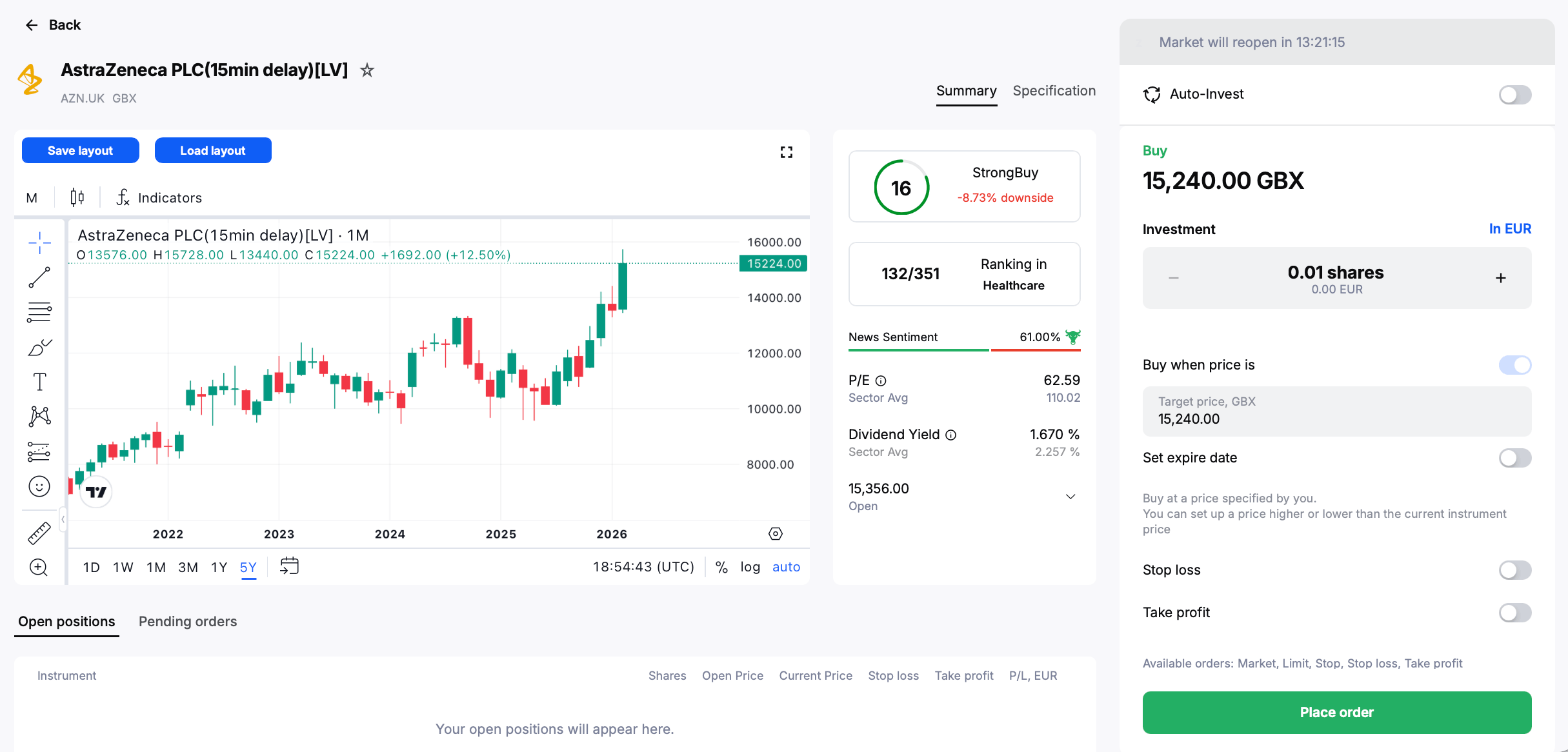
- Register for an investing account with a broker which offers access to UK stocks and complete the onboarding process.
- Log in and open the investing platform.
- Search for the stock or FTSE 100 ETF you’re interested in.
- Open the instrument page, create a new order and hit ‘Buy’ to send it to the market.
Frequently Asked Questions
What is the biggest company in the UK?
The biggest UK company in terms of market capitalisation in AstraZeneca. In terms of revenue, the largest company in the UK is Shell.
What are the biggest companies in the UK?
The five biggest public companies in the UK by market capitalisation are AstraZeneca, HSBS Holdings, Shell, Rio Tinto and Unilever.
Who is the biggest construction company in the UK?
Barratt Redrow (formerly Barratt Developments) is the largest construction company in the UK in terms of market capitalisation.
Who are biggest water companies in UK?
Severn Trend and United Utilities are the two largest listed water companies in the UK by market cap.
Which are the biggest energy companies in the UK?
The two biggest energy companies in the UK are Shell and BP in terms of market cap and revenue.
The given data provides additional information regarding all analysis, estimates, prognosis, forecasts, market reviews, weekly outlooks or other similar assessments or information (hereinafter “Analysis”) published on the websites of Admirals investment firms operating under the Admirals trademark (hereinafter “Admirals”) Before making any investment decisions please pay close attention to the following:
- This is a marketing communication. The content is published for informative purposes only and is in no way to be construed as investment advice or recommendation. It has not been prepared in accordance with legal requirements designed to promote the independence of investment research, and that it is not subject to any prohibition on dealing ahead of the dissemination of investment research.
- Any investment decision is made by each client alone whereas Admirals shall not be responsible for any loss or damage arising from any such decision, whether or not based on the content.
- With view to protecting the interests of our clients and the objectivity of the Analysis, Admirals has established relevant internal procedures for prevention and management of conflicts of interest.
- The Analysis is prepared by an analyst (hereinafter “Author”). The Author Roberto Rivero is a contractor for Admirals. This content is a marketing communication and does not constitute independent financial research.
- Whilst every reasonable effort is taken to ensure that all sources of the content are reliable and that all information is presented, as much as possible, in an understandable, timely, precise and complete manner, Admirals does not guarantee the accuracy or completeness of any information contained within the Analysis.
- Any kind of past or modelled performance of financial instruments indicated within the content should not be construed as an express or implied promise, guarantee or implication by Admirals for any future performance. The value of the financial instrument may both increase and decrease and the preservation of the asset value is not guaranteed.
- Leveraged products (including contracts for difference) are speculative in nature and may result in losses or profit. Before you start trading, please ensure that you fully understand the risks involved.