Top Cybersecurity Stocks to Invest In 2026: 5 Companies to Watch

$4.4 million! That is what a single data breach costs an organisation on average globally, according to IBM’s Cost of a Data Breach Report 2025¹. Companies using AI security tools extensively saved $1.9 million per incident compared to those that did not.
Those numbers help explain why cybersecurity has become one of the fastest-growing areas of enterprise spending, and why investors have taken a closer interest in cybersecurity stocks.
This article covers a cybersecurity stocks list worth monitoring in 2026, looks at cybersecurity ETFs as an alternative for those who prefer broader sector exposure, and outlines key advantages and risks of investing in the cybersecurity sector.
The information in this article is provided for educational purposes only and does not constitute financial advice. Consult a financial advisor before making investment decisions.
.png)
Table of Contents
- What Are Cybersecurity Stocks?
- Top Cybersecurity Stocks 2026: 5 Companies to Watch
- How to Evaluate Cybersecurity Stocks
- Risks of Investing in Cybersecurity Stocks
- Are Cybersecurity Stocks a Good Investment?
- Where to Buy Cybersecurity Stocks
- How to Invest in Cybersecurity Stocks with Admirals
- The Bottom Line on Cybersecurity Stocks
- Frequently Asked Questions on Cybersecurity Stocks
What Are Cybersecurity Stocks?
The sector spans multiple technical disciplines and business models, from cloud-native software companies to hardware appliance makers to managed security service providers.
.png)
Admirals’ Invest.MT5 account gives you direct access to all five companies covered in this article, as well as thousands of other stocks and ETFs across global exchanges.
Top Cybersecurity Stocks 2026: 5 Companies to Watch
Here is a quick list of some of the top cybersecurity stocks to watch this year: Scroll down for a deep-dive into each company.
Source: Last published official earnings report. Past performance is not indicative of future results. For illustrative purposes only.
1. Palo Alto Networks Palo Alto Networks (PANW) — One of the Top Cybersecurity Stocks
Palo Alto Networks has spent two decades evolving from a firewall company into what is now the largest pure-play cybersecurity business by revenue. The idea of its current strategy is straightforward: instead of buying five security tools from five different vendors, why not run everything through one platform? Enterprises that have made that shift are staying and spending more, as reflected in a 120% net retention rate among platformised customers.
In fiscal Q3 2026, the company reported $3.0 billion in revenue, up 31% year-on-year, and $910 million in adjusted free cash flow for the quarter alone. Management is guiding toward full-year FY2026 revenue of $11.4 billion and a 40% free cash flow margin by FY2028.
Palo Alto Networks continues to face intensifying competition from both specialist cybersecurity vendors and large technology platforms expanding into security.
2. Fortinet (FTNT) — A Leading Network Security Stock
Fortinet has been securing networks since 2000, built around a single conviction that networking and security should work as one rather than as separate layers bolted together. Today that vision spans a portfolio of over 50 enterprise-grade products, covering firewalls, Secure Access Service Edge (SASE), cloud security, and AI-driven threat protection, with well over half a million customers worldwide relying on its solutions to secure their infrastructure.
Twenty-six years in, the financials reflect a business that has found its footing. Revenue grew 20% year-over-year to $1.85 billion in Q1 2026, product revenue jumped 41%, and the company generated a record $1.01 billion in free cash flow in a single quarter while maintaining a GAAP operating margin of 31%. Management raised full-year 2026 revenue guidance to $7.71 billion to $7.87 billion following those results.
The one natural trade-off is that a meaningful share of Fortinet’s revenue comes from hardware appliances, which can be more sensitive to enterprise budget cycles than pure software peers. Growth rates are also more measured compared to some cloud-native names on this list, though the free cash flow profile is arguably the strongest of the five companies covered here.
3. CrowdStrike (CRWD) — One of the Top AI Cybersecurity Stocks
CrowdStrike was founded in 2011 on the observation that cybersecurity threats had fundamentally changed, but the solutions had not. The answer was the Falcon platform, built cloud-native from day one, using AI to detect and stop breaches across endpoints, cloud environments, identity, and data — 33 modules in total, delivered as a subscription service.
In Q1 FY2027, ended April 30, 2026, total revenue reached $1.39 billion, up 26% year-over-year, with subscription revenue of $1.32 billion making up the bulk of that figure. Free cash flow hit a record $468 million for the quarter. The company also announced a four-for-one stock split effective July 2, 2026, which will lower the per-share price without changing the underlying value of the business. CEO George Kurtz raised full-year net new ARR growth guidance to 27.7% at the midpoint following these results.
One thing investors should keep in mind: CrowdStrike reported a GAAP operating loss of $30.6 million in Q1 FY27, though that was a meaningful improvement from a $118.7 million loss in the same quarter a year earlier.
4. Zscaler (ZS) — A Cloud Cybersecurity Stock to Invest In
Zscaler is a pioneer in zero trust security, trusted by some of the world’s largest businesses, critical infrastructure organisations, and government agencies to secure users, applications, data, and devices. Its core platform, the Zero Trust Exchange, works by sitting between users and the applications they are trying to reach, verifying every connection request before granting access rather than assuming anything inside a network is safe. Running across more than 160 data centres globally, the platform uses AI to process billions of these verification requests every day.
That demand is reflected in the financials. In fiscal Q3 2026, ended April 30, 2026, revenue grew 25% YoY to $850.5 million, with non-GAAP operating margin reaching an all-time high of 23%. The company raised full-year FY2026 revenue guidance to approximately $3.33 billion.
For investors considering this as one of the cybersecurity stocks to invest in, a few things are worth weighing. Zscaler continues to report GAAP net losses, and recent growth figures include a $127 million ARR contribution from the Red Canary acquisition, making organic growth closer to 21% than the headline 25%.
5. SentinelOne (S) — A Cybersecurity Stock Under $20
Founded in 2013, SentinelOne built its Singularity platform around a single idea: that AI should detect, investigate, and respond to threats autonomously across endpoints, cloud environments, identity, and data, without waiting for an analyst to review each alert. The company has been recognised as a Leader in the Gartner Magic Quadrant for Endpoint Protection for six consecutive years.
The growth numbers from Q1 FY2027, ended April 30, 2026, reflect a business gaining momentum. Revenue grew 21% YoY to $277 million, and the company reached a notable milestone: its emerging solutions portfolio, spanning AI, data, cloud, and identity security, now accounts for approximately half of total company ARR. Non-GAAP operating margin improved to 4% from negative 2% a year earlier. Full-year FY2027 revenue guidance sits at $1.195 billion to $1.205 billion.
At around $16 per share at the time of writing, SentinelOne is one of the more accessible cybersecurity stocks under $20 by price point. The company is still in the earlier stages of its profitability journey, reporting a GAAP net loss margin of 28% in Q1 FY27.
Cybersecurity ETFs to Consider
Not every investor wants to pick individual cybersecurity stocks. For those who prefer broader sector exposure, there are several exchange-traded funds that hold a basket of publicly traded cyber security firms. Here are a few to watch:
*Expense ratio and description as of 4th June 2026. Holdings are subject to change. Past performance is not a reliable indicator of future results. For illustrative purposes only.
ETFs spread risk across multiple companies, which reduces the impact of any single stock underperforming. The trade-off is that strong performance from one holding gets diluted across the rest. As with any investment, the value of an ETF may fall as well as rise, and expense ratios may also increase or decrease over time.
How to Evaluate Cybersecurity Stocks
When researching cybersecurity companies, investors often consider:
- Revenue growth rate.
- Annual recurring revenue (ARR).
- Customer retention and expansion metrics.
- Profitability and free cash flow generation.
- Exposure to high-growth segments such as cloud security, identity security, and AI-driven protection.
- Competitive positioning within the cybersecurity industry.
These factors can help investors compare cybersecurity companies operating in different parts of the market.
Risks of Investing in Cybersecurity Stocks
While cybersecurity has been a growing industry, investors should consider several risks:
- High valuations can increase downside risk.
- Competition from large technology companies may pressure growth.
- Security failures or major outages can damage customer trust.
- Enterprise technology spending may come under pressure during prolonged economic downturns.
- Rapid technological change can alter competitive advantages.
Understanding these risks is an important part of researching cybersecurity stocks.
Are Cybersecurity Stocks a Good Investment?
The structural case for cybersecurity as an investment theme is straightforward. Cyber threats are not going away, AI is making attacks more frequent and targeted, and regulatory mandates are forcing many organisations to maintain security spending even when other budgets are cut. That combination provides a demand floor that few technology sectors enjoy. However, most cybersecurity stocks trade at elevated valuations that already price in years of strong growth.
Whether cybersecurity stocks are a good investment ultimately depends on an individual’s objectives, risk tolerance, and time horizon. Those who want sector exposure with lower single-stock risk may find that cybersecurity ETFs are a better fit for their needs.
Where to Buy Cybersecurity Stocks
Investors looking to gain exposure to cybersecurity stocks can do so through Admirals’ Invest.MT5 account which provides access to stocks and ETFs across global exchanges, including Nasdaq and NYSE.
How to Invest in Cybersecurity Stocks with Admirals
Here’s how to buy cybersecurity stocks after you’ve opened your account:
- Log in to the Dashboard from the Admirals website. From here, you can manage all of your trading and investing accounts and download different trading platforms.
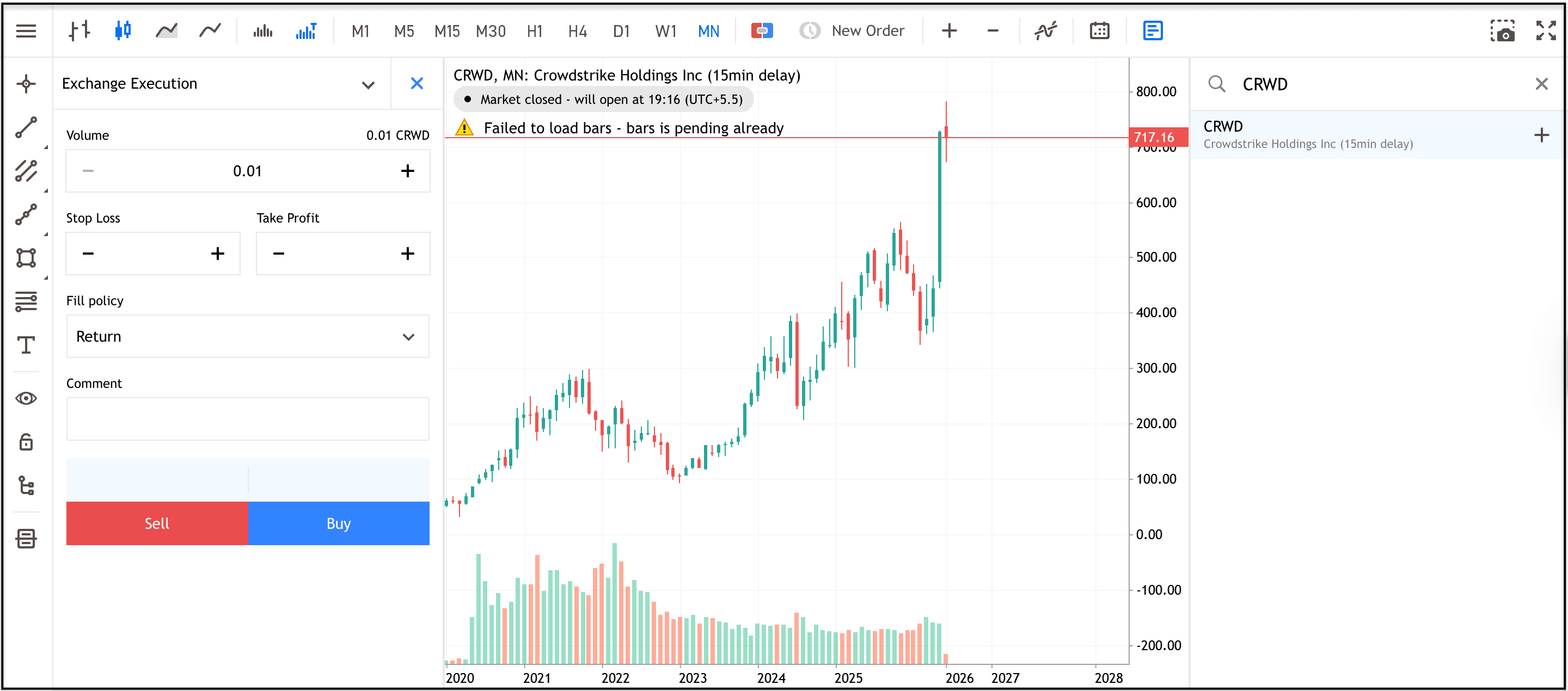
- Click on the Trade icon next to one of your accounts. This will automatically open the MetaTrader 5 WebTrader platform so you can start investing without needing to download a desktop platform.
- Type in the cybersecurity stock you wish to invest in. Admirals offers over 3,000 global stocks and ETFs to invest in. For US stocks, the commission is $0.02 per share with a minimum commission of $1.
- Click on New Order to open a trading ticket. Input your entry, stop-loss, and take profit price levels and quantity of shares.
The Bottom Line on Cybersecurity Stocks
Cybersecurity is one of the few areas of technology spending where demand rarely disappears entirely. Organisations may cut other software budgets, but they tend to keep paying for security. That dynamic, combined with AI making both attacks and defences more sophisticated, has made the sector one of the more compelling long-term technology themes.
For investors considering which cyber security firms to invest in, the five companies covered in this article represent a starting point for research. As with any investment, conducting thorough research and seeking professional financial advice before making any decision is essential.
Frequently Asked Questions on Cybersecurity Stocks
What are the top cybersecurity stocks to buy in 2026?
The top cybersecurity stocks commonly discussed in 2026 are Palo Alto Networks (PANW), Fortinet (FTNT), CrowdStrike (CRWD), Zscaler (ZS), and SentinelOne (S). This is not investment advice. Always conduct your own research before making any investment decision.
Is cybersecurity a good sector to invest in?
Cybersecurity is one of the few technology sectors where enterprise spending tends to remain resilient even when broader IT budgets are cut. Whether it suits any individual investor depends on their risk tolerance, time horizon, and portfolio objectives.
How do I invest in cybersecurity stocks?
Cybersecurity stocks listed on NASDAQ and NYSE can be bought through any investing platform that offers access to US markets, including Admirals’ Invest.MT5 account. Search the ticker, review the company’s financials and associated risks, and place an order during market hours.
What is the difference between a cybersecurity stock and a cybersecurity ETF?
A cybersecurity stock is a share in a single company operating in the sector, meaning returns and risks are tied to that specific business. A cybersecurity ETF holds a basket of multiple cybersecurity companies, spreading exposure across the sector. ETFs may suit investors who want broad sector participation without selecting individual stocks, though they also dilute the upside of any single strong performer.
Sources:
¹Cost of a Data Breach Report 2025
About Admirals
Admirals is a multi-award-winning, regulated Forex and CFD broker, offering trading on over 8,000 financial instruments via the world's most popular trading platforms: MetaTrader 4 and MetaTrader 5.
INFORMATION ABOUT ANALYTICAL MATERIALS:
- The given data provides additional information regarding all analysis, estimates, prognosis, forecasts, market reviews, weekly outlooks or other similar assessments or information (hereinafter “Analysis”) published on the websites of Admirals investment firms operating under the Admirals trademark (hereinafter “Admirals”) Before making any investment decisions please pay close attention to the following:
- This is a marketing communication. The content is published for informative purposes only and is in no way to be construed as investment advice or recommendation. It has not been prepared in accordance with legal requirements designed to promote the independence of investment research, and that it is not subject to any prohibition on dealing ahead of the dissemination of investment research.
-
Any investment decision is made by each client alone whereas Admirals shall not be responsible for any loss or damage arising from any such decision, whether or not based on the content.
With view to protecting the interests of our clients and the objectivity of the Analysis, Admirals has established relevant internal procedures for prevention and management of conflicts of interest. - The Analysis is prepared by an analyst (hereinafter “Author”) with the assistance of AI tools. The Author Amrita Kundu is a contractor for Admirals. This content is a marketing communication and does not constitute independent financial research.
- Whilst every reasonable effort is taken to ensure that all sources of the content are reliable and that all information is presented, as much as possible, in an understandable, timely, precise and complete manner, Admirals does not guarantee the accuracy or completeness of any information contained within the Analysis.
- Any kind of past or modelled performance of financial instruments indicated within the content should not be construed as an express or implied promise, guarantee or implication by Admirals for any future performance. The value of the financial instrument may both increase and decrease and the preservation of the asset value is not guaranteed.
- Leveraged products (including contracts for difference) are speculative in nature and may result in losses or profit. Before you start trading, please ensure that you fully understand the risks involved.