4 Top UK Renewable Energy Stocks

As the world transitions away from fossil fuels, renewable energy is set to account for a larger amount of global energy over the coming decades.
In this article, we’ll examine 4 of the top UK renewable energy stocks by market capitalisation, which highlight two different ways to gain exposure to the sector. SSE and Drax Group are both diversified energy companies with substantial renewable generation, whilst the Renewables Infrastructure Group and Greencoat UK Wind are investment trusts with their own wind and solar portfolios.
The information in this article is provided for educational purposes only and does not constitute financial advice. Consult a financial advisor before making investment decisions.

Table of Contents
What Are Renewable Energy Stocks?
Renewable energy stocks are companies which operate in the renewable energy industry, either by owning and/or operating renewable energy projects or by manufacturing the equipment which allows power to be generated.
Sources of renewable energy include:
- Wind
- Solar
- Hydro
- Geothermal
Top UK Renewable Energy Stocks
In the following sections, we’ll take a look at 4 of the top UK renewable energy stocks by market capitalisation across the FTSE 350.
The Renewables Infrastructure Group
The Renewables Infrastructure Group, TRIG, is a renewable energy investment company which owns a 2.7GW portfolio of wind, solar and battery storage assets across the UK and Europe.
Its revenues are largely generated through fixed-price power purchase agreements, with 75% of its revenues to December 2030 fixed per unit of electricity generated. Whilst this provides a certain predictability to income, it also means the company misses out from any upside if energy prices rise.
At the time of writing, it offers a dividend yield of around 10%, making it one of the highest yielding stocks in the FTSE 250. However, whilst high yields may appear attractive, they can often be a warning sign.
Indeed, TRIG’s share price has declined significantly over the last four years, during which time it has traded at a considerable discount to its net asset value (NAV).
The cause of this decline is largely due to higher interest rates, something which has weighed on many renewable energy stocks in recent years. Many investors consider buying investment trusts such as TRIG specifically for their income, but higher rates can increase the appeal of fixed-income instruments, such as bonds.
Furthermore, higher interest rates increase the discount rate which is used to value long-duration assets, such as a wind farm. This essentially weighs on the present value of TRIG’s assets, even if nothing about the asset has actually changed. Changes, or expectations of changes, to the NAV are typically reflected in share price.
Drax Group
Drax Group is a diversified UK energy company, with a portfolio combining biomass, hydro, pumped storage, battery storage and flexible gas generation.
In July 2026, it completed the acquisition of the Bluefield Solar Income Fund, adding around 900MW of operational solar and wind assets to its portfolio, together with a 2.9GW development pipeline.
The company also owns the UK’s largest power station, which used to be coal-fired but has been converted to generate energy from biomass and now supplies 5% of the country’s power.
Whilst biomass is classified as renewable energy under UK policy, the classification is debated due to the carbon footprint of sourcing and shipping wood pellets from overseas. Indeed, government support for biomass generation is due to be scaled back from 2027.
At the time of writing, Drax has a dividend yield of more than 4% and has hiked its annual payout each year for the last nine years. However, future dividends are never guaranteed.
Greencoat UK Wind
Greencoat UK Wind is an investment trust which, as the name suggests, invests in wind generation assets in the UK, operating a portfolio of 49 wind farms across the country with net generating capacity of 2GW.
Unlike the Renewables Infrastructure Group - which invests in wind, solar and battery storage across a number of European markets – Greencoat UK Wind provides exposure exclusively to UK wind.
The company has a stated aim of providing investors with an annual dividend which increases in line with CPI and has either increased or maintained its annual payout every year for the last 11 years.
Like TRIG, Greencoat UK Wind has one of the highest dividend yields on the FTSE 250 at the time of writing and also trades at a steep discount to its net asset value, with high interest rates weighing on share price.
SSE
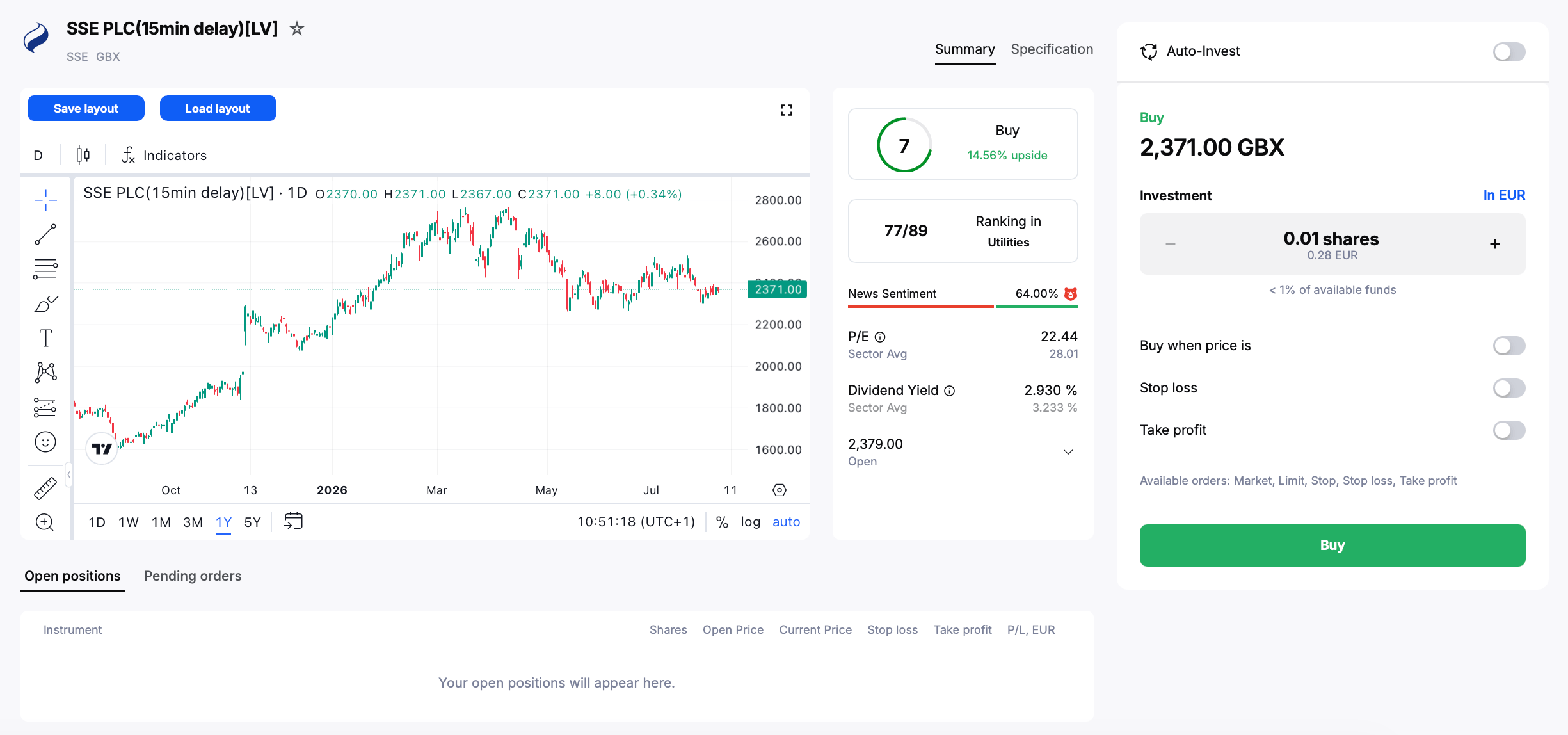
SSE is a diversified energy company which operates throughout the UK and Ireland and is a constituent of the FTSE 100 index.
Alongside its renewable generation portfolio, SSE operates a flexible thermal generation business, as well as electricity transmission and distribution businesses.
Of all the group’s businesses, its renewables segment is the largest in terms of operating profit. In the year ended 31 March 2026, SSE Renewables contributed £1.08 billion of the group’s adjusted operating profit of £2.24 billion.
SSE Renewables has a portfolio comprising of wind, hydro, solar and battery storage with generation capacity of around 4.5GW. Amongst its renewable projects is the Dogger Bank Wind Farm, which is currently under construction and, once complete, will be the world’s largest offshore wind farm.
By 2030, the company plans to increase its renewable output fivefold, enabling at least 20GW of renewable energy.
SSE has a long history of paying dividends but has reduced its payout on a couple of occasions in the last decade, most recently in 2023.
How to Invest in UK Renewable Energy Stocks
For those interested in investing in UK renewable energy stocks, the process is broadly as follows:
- Find a broker which offers access to the London Stock Exchange
- Register for an investing account and complete the onboarding process
- Open your broker’s trading platform and search for the stock by its name or ticker symbol
- Create a market order to buy shares at the next available price or a limit order to buy shares at a specific price or better
- Monitor your position over time
Frequently Asked Questions
What are the risks of investing in UK renewable energy stocks?
Like any investment, investing in UK renewable energy stocks involves risk. High interest rates in the UK have weighed on share prices in the industry and could continue to do so until rates are brought down. Other risks include potential changes in government policy or net zero targets.
Do UK renewable energy stocks pay dividends?
That depends on the company in question. Whilst many UK renewable energy stocks, such as the ones examined in this article, do pay dividends, not all of them do. Furthermore, it’s important to remember that future dividend payments are never guaranteed.
Are there other UK-listed renewable energy investment trusts besides the ones covered here?
Yes. The two renewable energy investment trusts examined in this article are just two of the largest listed in London by market capitalisation. Other examples which have not been covered include the NextEnergy Solar Fund and Foresight Environmental Infrastructure.
The given data provides additional information regarding all analysis, estimates, prognosis, forecasts, market reviews, weekly outlooks or other similar assessments or information (hereinafter “Analysis”) published on the websites of Admirals investment firms operating under the Admirals trademark (hereinafter “Admirals”) Before making any investment decisions please pay close attention to the following:
- This is a marketing communication. The content is published for informative purposes only and is in no way to be construed as investment advice or recommendation. It has not been prepared in accordance with legal requirements designed to promote the independence of investment research, and that it is not subject to any prohibition on dealing ahead of the dissemination of investment research.
- Any investment decision is made by each client alone whereas Admirals shall not be responsible for any loss or damage arising from any such decision, whether or not based on the content.
- With view to protecting the interests of our clients and the objectivity of the Analysis, Admirals has established relevant internal procedures for prevention and management of conflicts of interest.
- The Analysis is prepared by an analyst (hereinafter “Author”). The Author Roberto Rivero is a contractor for Admirals. This content is a marketing communication and does not constitute independent financial research.
- Whilst every reasonable effort is taken to ensure that all sources of the content are reliable and that all information is presented, as much as possible, in an understandable, timely, precise and complete manner, Admirals does not guarantee the accuracy or completeness of any information contained within the Analysis.
- Any kind of past or modelled performance of financial instruments indicated within the content should not be construed as an express or implied promise, guarantee or implication by Admirals for any future performance. The value of the financial instrument may both increase and decrease and the preservation of the asset value is not guaranteed.
- Leveraged products (including contracts for difference) are speculative in nature and may result in losses or profit. Before you start trading, please ensure that you fully understand the risks involved.