Top S&P 500 ETFs to Watch

The S&P 500 is a stock index composed of the 500 largest companies in the United States. There are a number of ways in which investors can gain exposure to the index, one of which is by buying shares in an S&P 500 ETF.
In this article, we will highlight what investors should look for when choosing an S&P tracker fund and compare some of the top S&P 500 ETFs available today.
The information in this article is provided for educational purposes only and does not constitute financial advice. Consult a financial advisor before making investment decisions.
What Is S&P 500 ETF?
An S&P 500 ETF is an Exchange-Traded Fund which is designed to track the Standard & Poor’s 500 Index, an index which is composed of the 500 largest publicly traded companies in the US.
Tracker funds attempt to mirror the performance of an underlying stock index in a number of different ways. Typically, the most common method for S&P 500 ETFs is physical replication, which entails creating an ETF that holds shares in all the companies within the index.
As the S&P 500 is a market capitalisation weighted index (i.e. companies with a higher market cap have greater influence over the index), these ETFs will hold company shares in proportion to their index weighting.
How to Pick the Top S&P 500 Tracker Fund
Given that S&P 500 ETFs are designed to track the performance of the same stock index, there does not tend to be a great difference between the performance of different S&P 500 ETFs.
This is because, in theory, each ETF should contain the same investments in the same proportion.
However, there are a number of factors that investors should consider when looking for the top S&P 500 ETF - including, but not necessarily limited to:
- Fees: Top of the list of considerations for many investors will be fees. ETF issuers charge an annual fee to cover the management of the fund. ETFs which passively track an index such as the S&P 500 generally charge low fees and differences in fees between providers are often minimal. However, fees do add up over time, so it’s an important factor to bear in mind.
- Liquidity: Higher liquidity makes an asset easier and quicker to buy and sell, as buyers and sellers don’t have to wait long to find a counterparty to their transaction.
- Tracking Accuracy: Given that people invest in S&P 500 ETFs to gain exposure to the S&P 500 index, it’s important that the fund in question does a good job of tracking its underlying index. Whilst there may be discrepancies in day-to-day movements, fortunately, over the longer-term, S&P 500 tracker funds are typically fairly accurate.
- Accumulating or Distributing: An important consideration for investors is whether they want to choose an accumulating or distributing ETF. As the name suggests, distributing ETFs distribute dividends amongst its shareholders, whilst accumulating ETFs automatically reinvest dividends back into the fund. For an index as popular as the S&P 500, most top ETF providers will provide both types of share class.
Top S&P 500 ETFs
In the following sections, we’ll take a look at some examples of top S&P 500 ETFs available to investors.
iShares Core S&P 500 UCITS ETF
iShares is a brand of Exchange-Traded Funds which are managed by Blackrock, one of the largest asset managers in the world.
iShares offers both an accumulating and distributing share class for its S&P 500 UCITS ETF, both of which have a total expense ratio of 0.07% a year. This S&P 500 ETF is by far the largest on this list in terms of assets, with net assets of $137 billion as of December 2025.
In the year ended 31 July 2025, the realised tracking error of this ETF was 0.02%.
| Realised Tracking Error: The annualised standard deviation of the difference in monthly returns between a fund and its benchmark index. |
Vanguard S&P 500 UCITS ETF
The Vanguard Group is one of the world’s largest ETF providers in the world and is credited with playing an important role in the rise of passive investing in recent years.
Amongst its wide range of ETFs is the Vanguard S&P 500 UCITS ETF, of which there is both a distributing and accumulating version. With around $80 billion of assets, it’s one of the largest S&P 500 tracker ETFs available in Europe and it has an ongoing charge of 0.07% a year.
In terms of tracking accuracy, the ETFs realised tracking error in the year ending 30 June 2025 was 0.023%.
SPDR S&P 500 UCITS ETF
SPDR funds are a group of ETFs which are managed by State Street Global Advisors (SSGA). The name SPDR is derived from the first member of the ETF family, the Standard & Poor’s Depositary Receipts, now known as the SPDR S&P 500 Trust ETF.
The European version, the SPDR S&P 500 UCITS ETF, is slightly smaller than the other two funds we’ve examined but has considerably lower fees, with a total expense ratio of just 0.03% a year. Whilst the difference may seem small in real terms, fees have the potential to add up over the long-term.
Like the others highlighted in our article, SPDR offers a distributing and accumulation version of their S&P 500 ETF, between the two, the fund has a total of $34 billion assets under management as of 31 December 2025.
Over the last 3 years, the ETF has recorded an annualised tracking error of 0.03%.
Xtrackers S&P 500 Inverse Daily UCITS ETF
This S&P 500 ETF differs significantly from the others examined so far.
As the name suggests, rather than tracking the performance of the S&P 500 index, the Xtrackers S&P 500 Inverse Daily UCITS ETF tracks the inverse performance of the index by aiming to reflect short exposure to the largest 500 US companies.
In other words, when the S&P 500 index rises, the inverse S&P 500 ETF falls, and vice versa.
Given the nature of the ETF, it does not use physical replication to achieve its goals. Instead, its methodology entails indirect replication, which it achieves using swaps.
Since the S&P 500 has shown a historic tendency to grow over the long-term, this ETF may be more suitable for short-term hedging or speculation as opposed to long-term investment.
As of 30 November 2025, the Xtrackers Inverse S&P 500 ETF has an annual “all-in fee” of 0.50% and total fund assets of $163.48 million.
S&P 500 ETF Comparison Table
In the table below, we’ve highlighted some of the key metrics from the three traditional S&P 500 tracker funds examined above (we’ve left out the inverse S&P 500 ETF).
Data Extracted on 8 January 2026 with most recent figures available.
How to Invest in S&P 500 ETF
With an investing account from Admirals, you can buy shares in the S&P 500 tracker funds highlighted in this article and several others. Follow these steps to get started:
- Register for an investing account and complete the onboarding process.
- Log in to the Dashboard.
- Open the web trading platform.
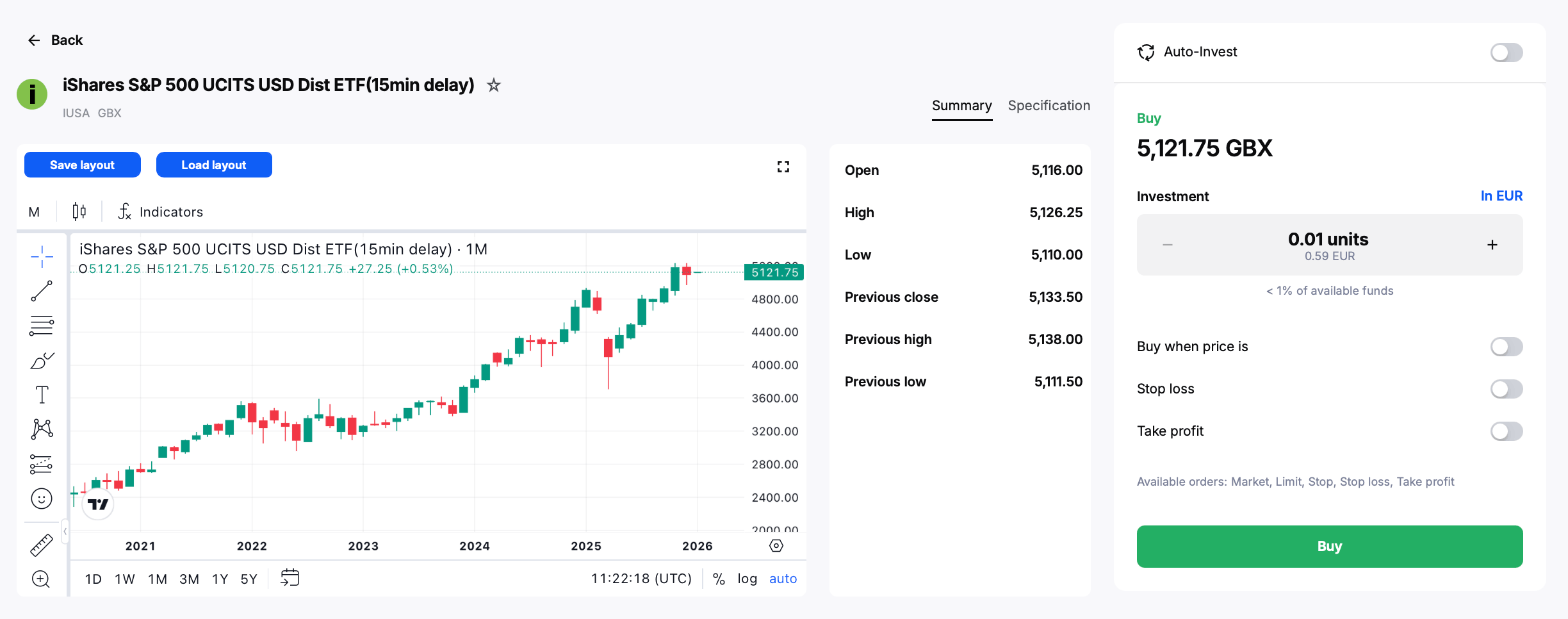
- Search for an S&P 500 ETF and open the instrument page.
- Fill out the new order ticket and click ‘Buy’ to send your order to the market.
Frequently Asked Questions
Is the S&P 500 an ETF?
No. The S&P 500 is a stock index which consists of the 500 largest publicly traded companies in the US. However, there are a wide variety of ETFs which are designed to track this stock index.
What ETF tracks the S&P 500?
There are a number of ETFs which are designed to track the S&P 500 index, including the iShares Core S&P 500 UCITS ETF, the Vanguard S&P 500 UCITS ETF and the SPDR S&P 500 UCITS ETF.
Why are there so many S&P 500 ETFs?
The S&P 500 is the most popular benchmark stock index in the world, meaning that there is an enormous amount of demand from investors who want to gain exposure it. Issuers compete for this demand and, consequently, different ETFs might have different fees, structures and target audiences.
What is the largest SP500 ETF?
The largest S&P 500 ETF in the world in terms of assets under management is the Vanguard S&P 500 ETF (VOO). In fact, it’s the largest ETF in the world by this metric.
The given data provides additional information regarding all analysis, estimates, prognosis, forecasts, market reviews, weekly outlooks or other similar assessments or information (hereinafter “Analysis”) published on the websites of Admirals investment firms operating under the Admirals trademark (hereinafter “Admirals”) Before making any investment decisions please pay close attention to the following:
- This is a marketing communication. The content is published for informative purposes only and is in no way to be construed as investment advice or recommendation. It has not been prepared in accordance with legal requirements designed to promote the independence of investment research, and that it is not subject to any prohibition on dealing ahead of the dissemination of investment research.
- Any investment decision is made by each client alone whereas Admirals shall not be responsible for any loss or damage arising from any such decision, whether or not based on the content.
- With view to protecting the interests of our clients and the objectivity of the Analysis, Admirals has established relevant internal procedures for prevention and management of conflicts of interest.
- The Analysis is prepared by an analyst (hereinafter “Author”). The Author Roberto Rivero is a contractor for Admirals. This content is a marketing communication and does not constitute independent financial research.
- Whilst every reasonable effort is taken to ensure that all sources of the content are reliable and that all information is presented, as much as possible, in an understandable, timely, precise and complete manner, Admirals does not guarantee the accuracy or completeness of any information contained within the Analysis.
- Any kind of past or modelled performance of financial instruments indicated within the content should not be construed as an express or implied promise, guarantee or implication by Admirals for any future performance. The value of the financial instrument may both increase and decrease and the preservation of the asset value is not guaranteed.
- Leveraged products (including contracts for difference) are speculative in nature and may result in losses or profit. Before you start trading, please ensure that you fully understand the risks involved.